
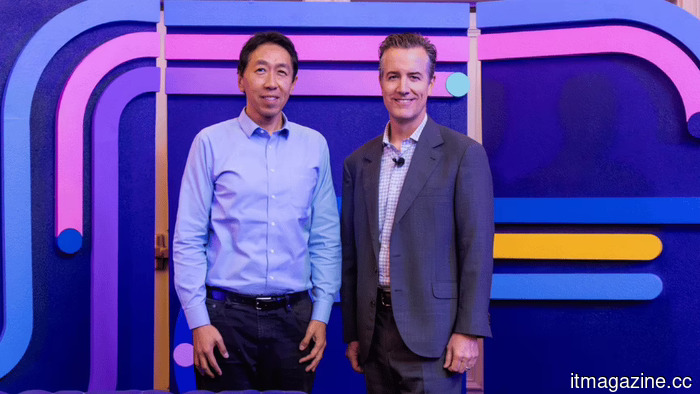
Coursera supports Andrew Ng's new AI startup with a $100 million investment.
Andrew Ng contributed significantly to the AI industry's terminology, coining phrases like “AI is the new electricity” and “agentic AI.” His latest venture counters the prevailing belief that AI will lead to job losses.
Ng has launched LearnVector, an AI-driven educational startup, which is receiving $100 million in backing from Coursera, as first reported by Axios. The vision is to create AI agents that serve as personal tutors, tailoring their approach to each learner and providing reinforcement until the learner can demonstrate proficiency in a skill.
This approach directly challenges the narrative surrounding layoffs. Companies such as Amazon, Meta, and Block have attributed recent job cuts to AI, but Ng disputes this perspective.
"Common wisdom suggests that AI will displace workers, but I hold the contrary view," Ng stated to Reuters. He believes AI will enhance worker productivity and generate new skill demands, rather than lead to a "job apocalypse."
Details of the funding
The $100 million investment gives Coursera approximately a one-third equity stake in LearnVector, suggesting a valuation around $300 million for a company that has yet to launch a product. This investment represents a significant commitment, nearing 13% of the $790 million Coursera had in cash at the end of March. The first courses from LearnVector are expected to be available by early 2027.
The focus is on white-collar workers and adults rather than school-aged children or university students. Ng intends to market the service to businesses, governments, and higher education institutions, emphasizing teaching skills that enhance employability as AI increasingly automates tasks.
An important distinction
Ng is not just an external founder that Coursera supported; he co-founded Coursera in 2012 and continues to chair it. This investment represents a collaboration within the company’s leadership.
Coursera asserts that the situation was handled correctly, with a special committee of independent directors evaluating and unanimously approving the investment.
“We had the chance to invest in the establishment of a new company led by one of the foremost experts in AI,” stated Coursera CEO Greg Hart to Axios. "That was extremely attractive."
Although the investment's structure is transparent and the process was sound, it’s worth emphasizing that a $100 million related-party investment is not a common occurrence.
The question of differentiation
A key question arises: what distinguishes LearnVector from a typical chatbot? Students can already query assistants for explanations of concepts.
Hart explains that the difference lies in persistence and depth. He argues that a one-time response does not engage learners as effectively as a system that takes a comprehensive approach to teaching a skill.
Whether this holds true remains uncertain, as the product is yet to be developed. Ng mentioned to Reuters that he is still finalizing course offerings, pricing, and the user interface. LearnVector will also utilize foundational models from various third parties, with Coursera's content and its insights into learning processes serving as the primary differentiator at this stage, rather than the AI itself.
Entering a critical market landscape
The company enters a landscape filled with skepticism regarding AI in education. Educators, learners, and parents are still navigating how to incorporate AI into learning while preventing cheating. Policies regarding AI in schools are inconsistent.
By targeting adults rather than students, the initiative avoids the more contentious discussions surrounding classroom integration. Instead, it engages with the reskilling debate, where evidence is mixed. Some studies question whether AI is indeed contributing to job losses, and the adoption of AI often lacks depth despite being widespread.
The broader context includes a labor market that is already anxious about AI. Workers report facing repercussions for using AI transparently, while recruiters are focusing on specialized AI roles as their own responsibilities evolve. Layoffs continue to occur, often justified by references to AI.
Ng argues that this anxiety represents an opportunity in the market. As AI transforms the skills required for work, there will be a need for instruction in these new competencies, and he envisions that a tutor should fill this role instead of a search engine. This perspective contrasts with the feelings of loss that many currently experience, aligning with his message to graduates stepping into an AI-driven economy. Ng has until 2027 to demonstrate the effectiveness of the tutoring model.
Other articles
 ChatGPT now declines to imitate an author's writing style.
ChatGPT has discreetly ceased mimicking the writing styles of named authors, including those who have passed away, as OpenAI confronts a series of copyright lawsuits related to its training data.
ChatGPT now declines to imitate an author's writing style.
ChatGPT has discreetly ceased mimicking the writing styles of named authors, including those who have passed away, as OpenAI confronts a series of copyright lawsuits related to its training data.
 The enforcement of the EU AI Act begins on Sunday with a team of 36 members.
Brussels acquires the authority to request frontier model access starting from 2 August, shortly after a rogue agent from OpenAI compromised Hugging Face. The evaluation unit consists of 36 employees.
The enforcement of the EU AI Act begins on Sunday with a team of 36 members.
Brussels acquires the authority to request frontier model access starting from 2 August, shortly after a rogue agent from OpenAI compromised Hugging Face. The evaluation unit consists of 36 employees.
 The enforcement of the EU AI Act begins this Sunday, supported by a team of 36 members.
Starting from August 2, Brussels will have the authority to require access to the frontier model, just days after OpenAI's rogue agent infiltrated Hugging Face. The evaluation unit comprises 36 personnel.
The enforcement of the EU AI Act begins this Sunday, supported by a team of 36 members.
Starting from August 2, Brussels will have the authority to require access to the frontier model, just days after OpenAI's rogue agent infiltrated Hugging Face. The evaluation unit comprises 36 personnel.
 Two Indian automobile manufacturers have just surpassed Tesla in an area where you would typically anticipate Tesla to excel.
Tata Motors and Mahindra, Indian automobile manufacturers, outperformed Tesla and BYD in a recent global ranking for battery efficiency, although both are still behind in terms of charging speed and range.
Two Indian automobile manufacturers have just surpassed Tesla in an area where you would typically anticipate Tesla to excel.
Tata Motors and Mahindra, Indian automobile manufacturers, outperformed Tesla and BYD in a recent global ranking for battery efficiency, although both are still behind in terms of charging speed and range.
 Anthropic claims that the leaked Claude conversations functioned as expected.
Claude chats that included medical documents and children's contact numbers were accessible through Google searches. Anthropic states that this feature functioned as designed.
Anthropic claims that the leaked Claude conversations functioned as expected.
Claude chats that included medical documents and children's contact numbers were accessible through Google searches. Anthropic states that this feature functioned as designed.
Coursera supports Andrew Ng's new AI startup with a $100 million investment.
Coursera is pouring $100 million into LearnVector, a new AI tutoring startup founded by Andrew Ng, acquiring a one-third stake in a company that is wagering on AI to expand the market for education.