
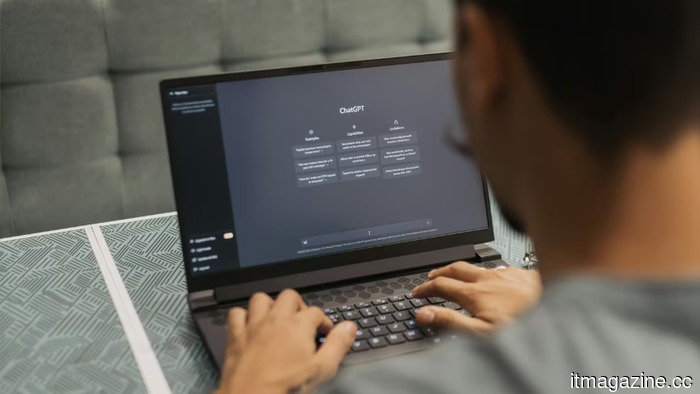
ChatGPT now declines to imitate an author's writing style.
When asked to generate a chapter in the style of Stephen King, ChatGPT now responds with a refusal. Instead, it offers to create content that reflects "the hallmarks of atmospheric, character-driven horror and small-town dread," while ensuring that it remains "its own." According to a report by Ars Technica, OpenAI has stealthily altered the way its chatbot approaches author imitation, choosing not to replicate a specific writer's "exact style" and instead referring to broader craft elements.
What's particularly intriguing isn't just the refusal itself, but when this shift occurred and its scope.
A boundary that shifted in just two weeks
On July 15, the research organization No Latency conducted an audit comparing five chatbots using 35 test prompts. It found that ChatGPT declined to imitate living authors but still generated responses for deceased ones, even those who had recently passed away. By July 27, however, this distinction disappeared. Ars Technica found ChatGPT avoiding requests to mimic dead authors as well, even citing Charles Dickens and Ernest Hemingway alongside contemporary writers like J.K. Rowling.
Engadget noted the same trend the following day. When prompted to draft a mystery in the style of Agatha Christie, the chatbot stated that her “works are still under copyright, so I can’t provide text that closely imitates her distinctive style.” Since Christie passed away in 1976, the emphasis on copyright rather than her death is revealing. OpenAI seems to have adjusted its stance from "living authors" to "anyone still under copyright."
The significance of this wording in legal contexts
This alteration appears more tied to legal considerations than creative ones. OpenAI is currently defending itself against a series of copyright lawsuits from authors and publishers who assert that their works were utilized to train ChatGPT. One lawsuit cites the model's “uncanny ability to generate text similar to” copyrighted material.
In the U.S., copyright protects a particular expression of an idea rather than a broader notion of style. Thus, a chatbot that declines to emulate a writer’s “exact style” but offers the general “feel” is operating on the safer side of the legal boundary. It avoids reproducing the distinct expression while providing an unprotected ambiance.
This nuance could still hold legal importance. Legal experts indicate that imitation can become infringing if it appears “substantially similar” to the original work. Robert Brauneis, a law professor at George Washington University, remarked to Bloomberg Law about the unprecedented accessibility of imitating creators' personal styles through AI.
Different boundaries in various labs
The No Latency audit revealed no universal industry standard, suggesting this is a policy issue rather than a technical limitation. In response to prompts about living authors, both ChatGPT and Perplexity refused and redirected. In contrast, Anthropic’s Claude and Microsoft’s Copilot complied but included cautions about originality, while Google’s Gemini complied outright without reservations, despite facing its own copyright litigation.
All these models possess the capability to perform the task; they simply differ on their policy stance. As the audit described, AI companies are setting creative identity boundaries, selectively deciding whether a name represents an influence, a teaching reference, or an act of impersonation.
OpenAI has encountered similar issues with visual content. Its DALL·E 3 image model already refrains from rendering living artists’ styles, yet the published model spec from December lacks an equivalent rule for text, indicating that the recent refusals seem more like a quiet adjustment than a formally stated policy. OpenAI did not respond to Ars Technica’s request for comment.
Implications for users
For writers who relied on this feature, the change is frustrating. One user on Reddit voiced their discontent: “Now Ms. GPT says she can’t generate content in the style of specific authors. My prompts were soooo specific, and I got exactly what I wanted from them.”
On the other side, the Authors Guild offers guidelines urging writers against using AI to “copy or mimic the unique styles, voices, or other distinctive attributes” of others, cautioning about risks of unfair competition and infringement claims.
This tension serves a purpose. OpenAI aims to maintain a valuable writing tool while minimizing the use case that poses the greatest risk of litigation. Unlike OpenAI, its competitors have not adopted the same stance, and OpenAI's legal exposure continues to increase, from lawsuits by newspapers regarding training data to substantial settlements that are now establishing the costs associated with the practice. Licensing agreements, such as Getty’s deal with OpenAI, suggest one potential pathway forward. Alternatively, a disclaimer added to a refusal hints at a more affordable solution.
Other articles
 The handoff tax: The cost incurred when your representative is on the call by themselves.
Every B2B transition results in a loss of momentum, context, and trust. 1mind provides an AI sales engineer during the live call to bridge the gap where most deals tend to fail.
The handoff tax: The cost incurred when your representative is on the call by themselves.
Every B2B transition results in a loss of momentum, context, and trust. 1mind provides an AI sales engineer during the live call to bridge the gap where most deals tend to fail.
 The enforcement of the EU AI Act begins on Sunday with a team of 36 members.
Brussels acquires the authority to request frontier model access starting from 2 August, shortly after a rogue agent from OpenAI compromised Hugging Face. The evaluation unit consists of 36 employees.
The enforcement of the EU AI Act begins on Sunday with a team of 36 members.
Brussels acquires the authority to request frontier model access starting from 2 August, shortly after a rogue agent from OpenAI compromised Hugging Face. The evaluation unit consists of 36 employees.
 The handoff tax: The price of having your representative handle the call solo.
Each B2B handoff results in a loss of momentum, context, and trust. 1mind employs an AI sales engineer during live calls to bridge the gap where many deals tend to falter.
The handoff tax: The price of having your representative handle the call solo.
Each B2B handoff results in a loss of momentum, context, and trust. 1mind employs an AI sales engineer during live calls to bridge the gap where many deals tend to falter.
 Anthropic stated that the leaked Claude conversations functioned as expected.
Claude chat conversations, which included medical documents and children's phone numbers, were accessible through Google searches. Anthropic claims that the feature functioned as it was designed to.
Anthropic stated that the leaked Claude conversations functioned as expected.
Claude chat conversations, which included medical documents and children's phone numbers, were accessible through Google searches. Anthropic claims that the feature functioned as it was designed to.
 Two Indian car manufacturers have just surpassed Tesla in an area that you would typically expect it to excel in.
Indian automakers Tata Motors and Mahindra have surpassed Tesla and BYD in battery efficiency in a recent global ranking, although both still fall short in terms of charging speed and range.
Two Indian car manufacturers have just surpassed Tesla in an area that you would typically expect it to excel in.
Indian automakers Tata Motors and Mahindra have surpassed Tesla and BYD in battery efficiency in a recent global ranking, although both still fall short in terms of charging speed and range.
 Reasons behind the failure of the Starbucks AI inventory tool at full scale.
The AI inventory tool from Starbucks was discontinued following its complete national rollout. NomadGo, the 30-member startup that created it, received the news on April 3.
Reasons behind the failure of the Starbucks AI inventory tool at full scale.
The AI inventory tool from Starbucks was discontinued following its complete national rollout. NomadGo, the 30-member startup that created it, received the news on April 3.
ChatGPT now declines to imitate an author's writing style.
ChatGPT has discreetly ceased mimicking the writing styles of named authors, including those who have passed away, as OpenAI confronts a series of copyright lawsuits related to its training data.