
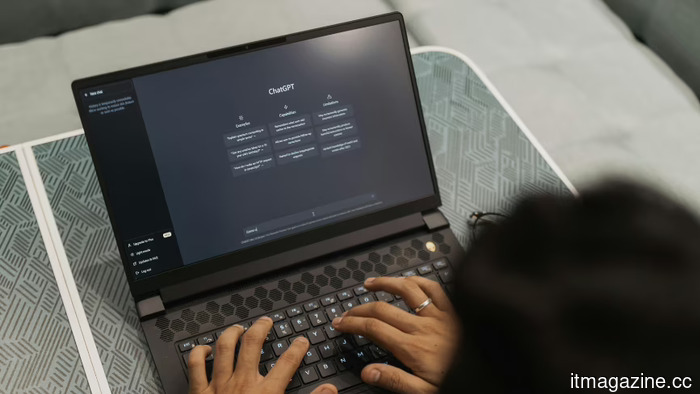
Young adults are utilizing ChatGPT to write scripts for their face-to-face interactions. Psychologists refer to this as an
Young adults are increasingly turning to AI chatbots to craft not only their messages but also their face-to-face dialogues, as reported by the Wall Street Journal. Niharika Abbaraju, a 20-year-old cancer researcher, employs ChatGPT at work for research purposes, but she also relies on it outside of work for conversational aid, creating dating app messages, icebreakers for parties, and immediate replies to people around her. If a discussion veers toward a book she hasn't read, she consults an AI summary to keep up the charade.
She is part of a larger trend among young adults who allow chatbots to influence their dating communications and social engagements, especially those dealing with social anxiety. The effects can be evident: personal trainer Andrea Wallace observed that a date's texting grammar had significantly improved, which raised suspicions. Lucas Dvorak, a Northwestern student, revealed that his girlfriend found her partner's AI usage "creepy." Kalin Lincoln, 20, utilizes ChatGPT to soften angry emails and prepare notes for tough discussions, but admits it had backfired at least once by giving her misguided advice.
Clinical psychologist Ashleigh Golden cautions that relying on AI to validate your texts can lead to a lack of trust in your own instincts. Mental health experts describe this trend as an "epidemic of self-mistrust." Relationship coach Alexandra Friedman recommends limiting AI usage for practice to once a week, advising that chatbots should be used for content rather than delivery. Researchers at Wharton have termed "cognitive surrender," which refers to individuals relying on AI even when it's incorrect, and the social equivalent applies this idea to personal interaction rather than factual accuracy. The AI-generated version of you may be more eloquent, but in-person conversations depend on personal engagement.
A study indicated that while AI-generated advice made individuals three times less accurate, it doubled their confidence. The social implications mirror this: by outsourcing dialogues, people bolster their confidence in the scripted text rather than in themselves. Each awkward situation sidestepped is a chance to build self-assurance that goes unfulfilled. The AI takes on the challenging parts, yet the underlying anxiety remains unchanged.
Other articles
 Microsoft developed a security system featuring AI agents from red, blue, and green teams. It will be available for public preview starting August 3.
Project Perception employs AI agents that continuously target, examine, and resolve security vulnerabilities. Microsoft's MAI-Cyber-1-Flash achieves a score of 96% on CyberGym, outperforming Mythos by 12 points.
Microsoft developed a security system featuring AI agents from red, blue, and green teams. It will be available for public preview starting August 3.
Project Perception employs AI agents that continuously target, examine, and resolve security vulnerabilities. Microsoft's MAI-Cyber-1-Flash achieves a score of 96% on CyberGym, outperforming Mythos by 12 points.
 Fujifilm is increasing camera prices by as much as €500. The AI memory crisis has impacted the field of photography.
Fujifilm will increase the prices of five cameras starting September 1 because of rising DRAM costs. The price of the X100 VI will rise by €200, while the GFX100 II will see an increase of €500. Canon, Sony, and Nikon are anticipated to follow suit.
Dopl Technologies secures $6.3 million to introduce remote robotic ultrasound services in rural hospitals.
Dopl Technologies secured $6.3 million to develop a telerobotic ultrasound system. Sonographers will control it remotely using haptic controllers. The next step is obtaining FDA clearance. The system promises a 90% reduction in wait times.
Fujifilm is increasing camera prices by as much as €500. The AI memory crisis has impacted the field of photography.
Fujifilm will increase the prices of five cameras starting September 1 because of rising DRAM costs. The price of the X100 VI will rise by €200, while the GFX100 II will see an increase of €500. Canon, Sony, and Nikon are anticipated to follow suit.
Dopl Technologies secures $6.3 million to introduce remote robotic ultrasound services in rural hospitals.
Dopl Technologies secured $6.3 million to develop a telerobotic ultrasound system. Sonographers will control it remotely using haptic controllers. The next step is obtaining FDA clearance. The system promises a 90% reduction in wait times.
 Amazon requested the FCC's approval for 5,105 satellites intended for a network that transmits internet directly to your mobile device.
Amazon submitted a proposal to deploy 5,105 satellites for direct-to-device connectivity. This initiative merges Kuiper and Globalstar resources, with a deployment goal set for 2028. SpaceX is already providing direct-to-device services in partnership with T-Mobile.
Amazon requested the FCC's approval for 5,105 satellites intended for a network that transmits internet directly to your mobile device.
Amazon submitted a proposal to deploy 5,105 satellites for direct-to-device connectivity. This initiative merges Kuiper and Globalstar resources, with a deployment goal set for 2028. SpaceX is already providing direct-to-device services in partnership with T-Mobile.
 FDA selects Dexcom for TEMPO pilot, bypassing premarket review.
The FDA designated Dexcom as its inaugural TEMPO participant, enabling digital health devices to be accessible to Medicare patients prior to authorization in return for real-world data.
FDA selects Dexcom for TEMPO pilot, bypassing premarket review.
The FDA designated Dexcom as its inaugural TEMPO participant, enabling digital health devices to be accessible to Medicare patients prior to authorization in return for real-world data.
 Fujifilm is increasing camera prices by as much as €500. The AI memory crisis has impacted the photography industry.
Fujifilm will increase the prices of five camera models starting September 1 due to rising DRAM costs. The X100 VI will see a price increase of €200, while the GFX100 II will rise by €500. Canon, Sony, and Nikon are anticipated to take similar actions.
Fujifilm is increasing camera prices by as much as €500. The AI memory crisis has impacted the photography industry.
Fujifilm will increase the prices of five camera models starting September 1 due to rising DRAM costs. The X100 VI will see a price increase of €200, while the GFX100 II will rise by €500. Canon, Sony, and Nikon are anticipated to take similar actions.
Young adults are utilizing ChatGPT to write scripts for their face-to-face interactions. Psychologists refer to this as an
An increasing number of young adults are utilizing AI chatbots to create dating messages, initiate conversations at parties, and provide immediate replies during face-to-face interactions. Experts caution that this practice undermines self-confidence.