
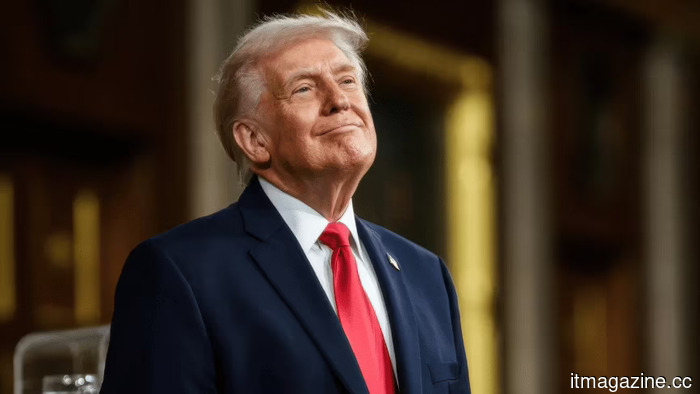
Trump's commitment to the data center's energy supply raises doubts among energy specialists.
On July 23, President Donald Trump stood at the White House and asserted that electricity costs for American families would “actually decrease,” despite the growing presence of power-intensive AI data centers across the grid. This was part of an expanded version of the Ratepayer Protection Pledge, a voluntary initiative initially introduced in March. Energy analysts took note of what was notably absent from the pledge.
The pledge encourages companies constructing data centers, including Amazon, Google, Meta, Microsoft, OpenAI, Oracle, and xAI, to finance or develop the necessary power infrastructure for their operations instead of transferring these costs to current ratepayers. The administration had already indicated its intention to extend this initiative to utility companies, and the updated version, according to the White House, now includes nearly 200 additional signatories, such as NextEra Energy, Duke Energy, various rural cooperatives, and several Republican governors.
Trump claimed that this commitment now encompasses about 80% of the electricity supplied to homes and businesses in the US, asserting that companies permitted to construct their own plants could sell excess energy back to the grid, potentially lowering rates. However, he provided no specific capacity targets, timelines, or measurable milestones.
The lack of specifics is significant, as the burden on household energy bills is already clearly established. AI data centers have contributed to increased power costs in portions of the industrial Midwest, and within the PJM Interconnection, the largest power grid in the US, data centers accounted for $6.3 billion of the $16.4 billion in expenses from the most recent capacity auction, approximately 38%, according to the grid’s independent market monitor.
“PJM is continuing to behave as if it’s business as usual,” remarked Joseph Bowring, the president of the monitor, regarding this shift. “You need to recognize that this is genuinely a paradigm shift, and ignoring it imposes costs on other customers.”
The pledge is non-binding, which is the main criticism. It lacks penalties and compliance oversight, and a peculiar aspect of federal regulations may hinder signatories from fulfilling it even if they wish to. Existing interconnection tariffs spread the costs of grid upgrades among all customers, and as FirstEnergy contended in a 2026 report to regulators, current regulations could prevent a company from covering its own infrastructure expenses even if it desires to.
Consumer advocates were straightforward. Jesse Lee from the campaign organization Climate Power described the pledge as a “pinky promise,” while a Consumer Reports survey indicated that 75% of American adults were skeptical that large developers would genuinely cover all their expenses. Researchers at the Brookings Institution noted that federal laws “cannot easily override” state public utility commissions that actually determine residential rates.
There is an additional complication. Some of the same companies that signed the pledge have opposed state-level regulations that would require them to adhere to it, according to consumer groups, which suggests that the voluntary nature of the pledge may appear less magnanimous and more like the less stringent of two alternatives.
The White House has portrayed the initiative as evidence that the expansion of AI can progress without burdening households. However, the predictions are not encouraging. The consultancy ICF has projected that data centers could increase US electricity demand by 25% by 2030 and could raise monthly bills by up to 40% over five years, with utilities planning approximately $1.4 trillion in capital investment by the end of the decade to keep pace.
Louisiana estimates it could save ratepayers $2.6 billion over 15 years from its agreement with Meta, illustrating that local calculations can yield varying results.
Congress is also addressing the issue, with the House moving forward on a bill regarding data center energy expenses, but there is currently no legislation enforcing payment from hyperscale companies.
The Federal Energy Regulatory Commission is the only entity that could give the pledge enforceability; it has already begun expediting grid connections for large users. In June, it instructed six regional grid operators to validate or revise how they charge these users, with an upcoming deadline in August.
Until those regulations are amended, the pledge remains what its critics claim it to be: a promise made in a closed setting, with no obligation for adherence.
Other articles
 The EU accuses TikTok of not safeguarding children's privacy in accordance with the DSA.
Brussels claims that TikTok allowed minors' accounts to be visible to strangers, according to initial findings from the Digital Services Act (DSA) that could result in a fine of up to 6% of its global revenue.
The EU accuses TikTok of not safeguarding children's privacy in accordance with the DSA.
Brussels claims that TikTok allowed minors' accounts to be visible to strangers, according to initial findings from the Digital Services Act (DSA) that could result in a fine of up to 6% of its global revenue.
 Instagram prohibits videos of harassment recorded with Meta glasses.
Instagram will eliminate videos recorded with Meta's smart glasses that are used to harass individuals, following instances where "pickup artist" accounts misused them as "pervert glasses." Two accounts have been removed.
Instagram prohibits videos of harassment recorded with Meta glasses.
Instagram will eliminate videos recorded with Meta's smart glasses that are used to harass individuals, following instances where "pickup artist" accounts misused them as "pervert glasses." Two accounts have been removed.
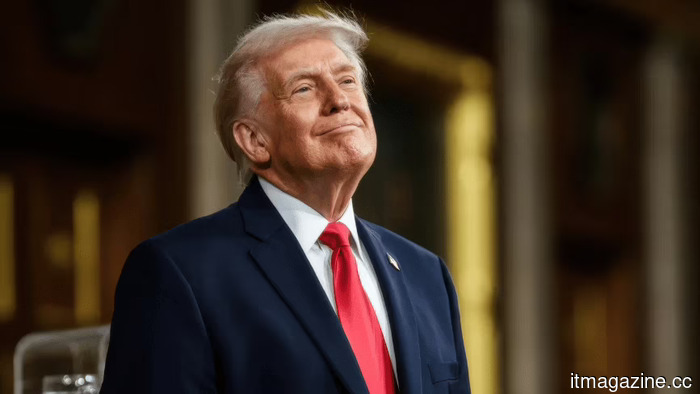 Trump's commitment to a data center power initiative has elicited skepticism from energy specialists.
Trump broadened a voluntary commitment to protect families from AI data center electricity expenses. Experts indicate that it lacks enforcement and effectiveness.
Trump's commitment to a data center power initiative has elicited skepticism from energy specialists.
Trump broadened a voluntary commitment to protect families from AI data center electricity expenses. Experts indicate that it lacks enforcement and effectiveness.
 Startups are calling on Trump to refrain from banning Chinese open-weight AI.
Almost 200 American startups, such as Y Combinator and Proton, are cautioning that a ban on Chinese open-weight AI could jeopardize their existence and give the market advantage to Anthropic.
Startups are calling on Trump to refrain from banning Chinese open-weight AI.
Almost 200 American startups, such as Y Combinator and Proton, are cautioning that a ban on Chinese open-weight AI could jeopardize their existence and give the market advantage to Anthropic.
 Researchers instilled curiosity in robots similar to that of toddlers, which enabled them to acquire language at twice the speed.
Researchers at OIST instilled curiosity in a virtual robot, allowing it to learn language at double the speed, complete with playful detours and the kinds of grammatical errors typical of toddlers.
Researchers instilled curiosity in robots similar to that of toddlers, which enabled them to acquire language at twice the speed.
Researchers at OIST instilled curiosity in a virtual robot, allowing it to learn language at double the speed, complete with playful detours and the kinds of grammatical errors typical of toddlers.
 A pastor in Florida inquired with ChatGPT if he was doing fine, which almost resulted in a life-threatening situation for him.
A pastor from Florida is taking legal action against OpenAI, claiming that ChatGPT disregarded his symptoms as trivial for several weeks, which ultimately led to him experiencing a near-fatal blood clot that doctors attribute to the chatbot's guidance.
A pastor in Florida inquired with ChatGPT if he was doing fine, which almost resulted in a life-threatening situation for him.
A pastor from Florida is taking legal action against OpenAI, claiming that ChatGPT disregarded his symptoms as trivial for several weeks, which ultimately led to him experiencing a near-fatal blood clot that doctors attribute to the chatbot's guidance.
Trump's commitment to the data center's energy supply raises doubts among energy specialists.
Trump broadened a voluntary commitment to protect families from the electricity expenses of AI data centers. Experts indicate that it lacks enforcement mechanisms and is ineffective.