
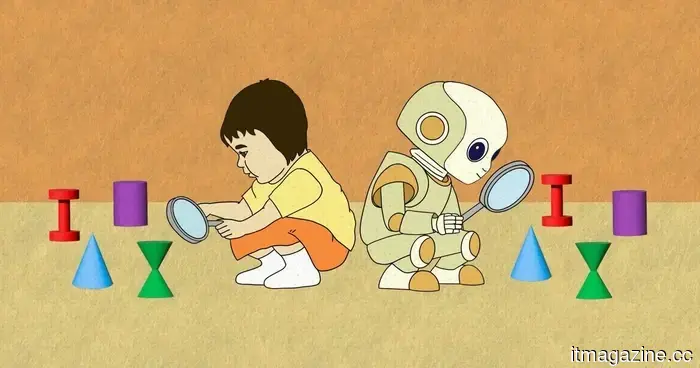
Researchers instilled curiosity in robots similar to that of toddlers, which enabled them to acquire language at twice the speed.
Endow a robot with curiosity, and it begins to acquire language (and misbehave) in a manner akin to a toddler.
Scientists have long sought to understand how children learn language so quickly, and a recent study from the Okinawa Institute of Science and Technology (OIST) may have uncovered part of the answer: curiosity.
Researchers created a virtual robot equipped with a brain-inspired neural network and placed it in a simulated 3D environment filled with shapes, colors, and simple commands such as “push left magenta dumbbell.”
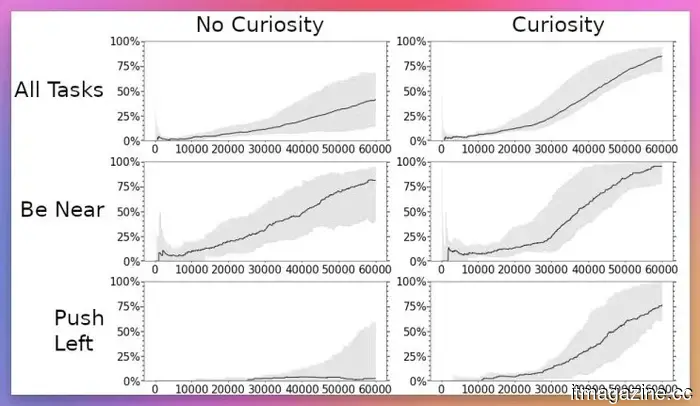
Some robots were rewarded solely for correctly completing tasks, while others received extra rewards for displaying curiosity, effectively giving them a little internal boost whenever they encountered something that challenged their pre-existing understanding of the world.
How does curiosity facilitate a robot's language learning?
The robots exhibiting curiosity didn’t just surpass their indifferent peers; they outperformed them significantly. The study, published in Science Advances, revealed that curious robots achieved a true grasp of language in roughly half the time.
Study author Theodore Tinker likened this experience to trying white chocolate for the first time, despite already enjoying dark chocolate. Taking that risk leads to a broader understanding of chocolate as a whole.
Halfway through the training, things took an even more intriguing turn. The curious robots began to knock things over and experiment with unrequested actions, essentially playing. This behavior was not programmed; it emerged spontaneously.
Do robots really make the same mistakes as toddlers?
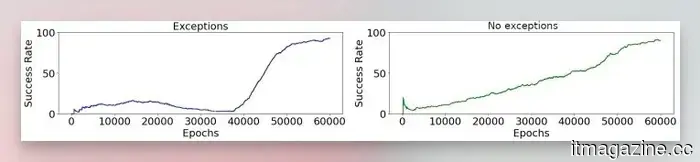
The robots also exhibited a familiar pattern seen in how children acquire language. Children often initially use certain verb forms correctly, then apply grammar rules too broadly, leading to mistakes in verbs they had previously used correctly, before eventually sorting out exceptions and self-correcting. The robots demonstrated the same U-shaped dip in performance.
It’s also a stark contrast to how modern chatbots learn. Large language models like ChatGPT train on vast datasets and predict the statistically probable next word. The robot's brain operates more similarly to ours, prioritizing accuracy while attempting to maintain its beliefs, updating them only when confronted with surprising new information.
This does not imply that robots comprehend language in the same way humans do. However, it suggests that curiosity combined with diverse experiences may significantly contribute to how toddlers decipher language with minimal information.


Other articles
 A pastor in Florida inquired with ChatGPT if he was doing fine, which almost resulted in a life-threatening situation for him.
A pastor from Florida is taking legal action against OpenAI, claiming that ChatGPT disregarded his symptoms as trivial for several weeks, which ultimately led to him experiencing a near-fatal blood clot that doctors attribute to the chatbot's guidance.
A pastor in Florida inquired with ChatGPT if he was doing fine, which almost resulted in a life-threatening situation for him.
A pastor from Florida is taking legal action against OpenAI, claiming that ChatGPT disregarded his symptoms as trivial for several weeks, which ultimately led to him experiencing a near-fatal blood clot that doctors attribute to the chatbot's guidance.
 Microsoft replaces OpenAI and eliminates the SMS login option.
Microsoft is substituting OpenAI's image models in PowerPoint and Bing to reduce expenses by 85%, and is discontinuing SMS logins due to the increased effectiveness of phishing facilitated by AI.
Microsoft replaces OpenAI and eliminates the SMS login option.
Microsoft is substituting OpenAI's image models in PowerPoint and Bing to reduce expenses by 85%, and is discontinuing SMS logins due to the increased effectiveness of phishing facilitated by AI.
 The EU accuses TikTok of not safeguarding children's privacy in accordance with the DSA.
Brussels claims that TikTok allowed minors' accounts to be visible to strangers, according to initial findings from the Digital Services Act (DSA) that could result in a fine of up to 6% of its global revenue.
The EU accuses TikTok of not safeguarding children's privacy in accordance with the DSA.
Brussels claims that TikTok allowed minors' accounts to be visible to strangers, according to initial findings from the Digital Services Act (DSA) that could result in a fine of up to 6% of its global revenue.
 The EU has accused TikTok of not adequately safeguarding children's privacy in accordance with the DSA.
Brussels claims that TikTok allowed minors’ accounts to be accessible to strangers, according to initial findings from the DSA, which could result in a penalty of up to 6% of global revenue.
The EU has accused TikTok of not adequately safeguarding children's privacy in accordance with the DSA.
Brussels claims that TikTok allowed minors’ accounts to be accessible to strangers, according to initial findings from the DSA, which could result in a penalty of up to 6% of global revenue.
 A pastor from Florida inquired with ChatGPT about his well-being, and it almost led to a life-threatening situation.
A pastor in Florida is taking legal action against OpenAI, claiming that ChatGPT minimized his symptoms as trivial for several weeks. Subsequently, he experienced a nearly fatal blood clot, which doctors attribute to the guidance he received from the chatbot.
A pastor from Florida inquired with ChatGPT about his well-being, and it almost led to a life-threatening situation.
A pastor in Florida is taking legal action against OpenAI, claiming that ChatGPT minimized his symptoms as trivial for several weeks. Subsequently, he experienced a nearly fatal blood clot, which doctors attribute to the guidance he received from the chatbot.
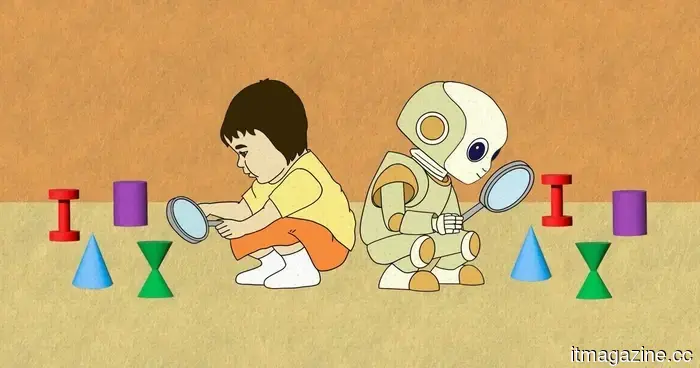 Researchers created robots with curiosity similar to that of toddlers, resulting in them acquiring language at twice the speed.
Researchers at OIST equipped a virtual robot with curiosity, allowing it to learn language at double the speed, complete with playful detours and the grammatical mistakes typical of toddlers.
Researchers created robots with curiosity similar to that of toddlers, resulting in them acquiring language at twice the speed.
Researchers at OIST equipped a virtual robot with curiosity, allowing it to learn language at double the speed, complete with playful detours and the grammatical mistakes typical of toddlers.
Researchers instilled curiosity in robots similar to that of toddlers, which enabled them to acquire language at twice the speed.
Researchers at OIST instilled curiosity in a virtual robot, allowing it to learn language at double the speed, complete with playful detours and the kinds of grammatical errors typical of toddlers.