
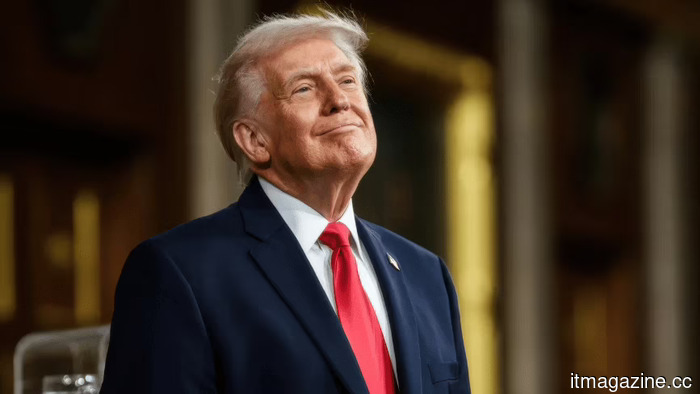
Trump's commitment to a data center power initiative has elicited skepticism from energy specialists.
On July 23, President Donald Trump addressed the nation from the White House, asserting that the electricity costs for American households would "actually decrease," despite the growing presence of power-intensive AI data centers across the grid. This announcement was part of an expanded version of the Ratepayer Protection Pledge, a voluntary initiative initially introduced in March. Energy analysts, however, focused on what the pledge did not include.
The pledge calls on companies establishing data centers, such as Amazon, Google, Meta, Microsoft, OpenAI, Oracle, and xAI, to finance or construct the necessary power infrastructure to meet their facilities' demands, rather than transferring these costs to current ratepayers. The administration had already indicated plans to extend the initiative to utilities, and the updated version reportedly attracted nearly 200 additional signatories, including NextEra Energy, Duke Energy, various rural cooperatives, and several Republican governors, according to the White House.
Trump claimed that this commitment now encompasses about 80% of the electricity supplied to homes and businesses in the U.S. He mentioned that companies permitted to build their own power plants could sell excess energy back to the grid, potentially lowering rates. However, he did not provide any capacity goals, schedules, or concrete milestones.
This lack of detail is significant since the upward pressure on household energy costs is well-recognized. AI data centers have contributed to rising electricity bills in parts of the industrial Midwest, with data centers accounting for $6.3 billion of the $16.4 billion in charges from a recent capacity auction in the PJM Interconnection, the largest grid operator in the U.S., as noted by the grid’s independent market monitor.
Joseph Bowring, the president of the monitor, commented on the situation, stating, "PJM is continuing to act like it’s business as usual. You have to open your eyes and recognize that it is really a paradigm shift, and failing to do so imposes costs on other customers."
The pledge itself is non-binding, which is a primary concern. It lacks penalties and any compliance oversight, and federal regulations might prevent signatories from fulfilling the pledge even if they wish to do so. Currently, interconnection tariffs distribute grid-upgrade costs among all customers, and as FirstEnergy argued in a 2026 filing to regulators, existing regulations can hinder a company from covering its own infrastructure costs even if it opts to.
Consumer advocates have been straightforward in their critiques. Jesse Lee from the campaign group Climate Power referred to the pledge as a mere "pinky promise," while a survey by Consumer Reports revealed that 75% of American adults are skeptical that large developers will genuinely cover all their expenses. According to researchers at the Brookings Institution, federal statutes “cannot readily override” the state public utility commissions that determine residential rates.
Moreover, there's an additional complication. Some of the companies endorsing the pledge have opposed state regulations that would mandate them to fulfill it, as consumer groups have pointed out, making the voluntary nature of the pledge appear less like generosity and more like the preferable of two alternatives.
The White House has presented the initiative as evidence that the expansion of AI can continue without adversely impacting households. However, financial projections are concerning. The consultancy ICF has predicted that data centers could increase U.S. electricity demand by 25% by 2030 and could raise monthly bills by as much as 40% over five years. Utilities are also looking at $1.4 trillion in capital investments by the end of the decade to keep pace.
In Louisiana, there is a projection of $2.6 billion in ratepayer savings over 15 years from its agreement with Meta, illustrating that local calculations can yield mixed results. Congress is also attempting to address the issue, with the House passing a bill on data center energy costs, but there is currently no legislation mandating that large developers bear those costs.
The one entity that could enforce the pledge is the Federal Energy Regulatory Commission, which has started to expedite grid connections for large power users. In June, it directed six regional grid operators to justify or revise their charging methods for these users, with a deadline set for August. Until those regulations are adjusted, the pledge remains, as its critics assert, merely a verbal commitment made in a closed setting, with no obligation to adhere to it.
Other articles
 The EU accuses TikTok of not safeguarding children's privacy in accordance with the DSA.
Brussels claims that TikTok allowed minors' accounts to be visible to strangers, according to initial findings from the Digital Services Act (DSA) that could result in a fine of up to 6% of its global revenue.
The EU accuses TikTok of not safeguarding children's privacy in accordance with the DSA.
Brussels claims that TikTok allowed minors' accounts to be visible to strangers, according to initial findings from the Digital Services Act (DSA) that could result in a fine of up to 6% of its global revenue.
 Startups are calling on Trump to refrain from banning Chinese open-weight AI.
Almost 200 American startups, such as Y Combinator and Proton, are cautioning that a ban on Chinese open-weight AI could jeopardize their existence and give the market advantage to Anthropic.
Startups are calling on Trump to refrain from banning Chinese open-weight AI.
Almost 200 American startups, such as Y Combinator and Proton, are cautioning that a ban on Chinese open-weight AI could jeopardize their existence and give the market advantage to Anthropic.
 Researchers instilled curiosity in robots similar to that of toddlers, which allowed them to acquire language at double the speed.
Researchers at OIST endowed a virtual robot with curiosity, resulting in it learning language at twice the speed, complete with playful detours and the grammatical errors typical of toddlers.
Researchers instilled curiosity in robots similar to that of toddlers, which allowed them to acquire language at double the speed.
Researchers at OIST endowed a virtual robot with curiosity, resulting in it learning language at twice the speed, complete with playful detours and the grammatical errors typical of toddlers.
 Patreon reduces its workforce by 20% and navigates discussions about AI.
Patreon is eliminating 93 positions, which accounts for 20% of its workforce. CEO Jack Conte states that AI is not taking their place, but it has "fundamentally changed" the way the company operates.
Patreon reduces its workforce by 20% and navigates discussions about AI.
Patreon is eliminating 93 positions, which accounts for 20% of its workforce. CEO Jack Conte states that AI is not taking their place, but it has "fundamentally changed" the way the company operates.
 Meta introduces a standalone Seller app for Facebook Marketplace featuring AI-enhanced listings.
To mark the platform's tenth anniversary, the seller provides Marketplace power sellers with a specialized app that includes AI-driven listing creation, a consolidated inbox, and performance analytics.
Meta introduces a standalone Seller app for Facebook Marketplace featuring AI-enhanced listings.
To mark the platform's tenth anniversary, the seller provides Marketplace power sellers with a specialized app that includes AI-driven listing creation, a consolidated inbox, and performance analytics.
 Startups are appealing to Trump not to impose a ban on Chinese open-weight AI.
Almost 200 startups in the US, among them Y Combinator and Proton, have cautioned that banning Chinese open-weight AI could eliminate hundreds of these companies and allow Anthropic to dominate the market.
Startups are appealing to Trump not to impose a ban on Chinese open-weight AI.
Almost 200 startups in the US, among them Y Combinator and Proton, have cautioned that banning Chinese open-weight AI could eliminate hundreds of these companies and allow Anthropic to dominate the market.
Trump's commitment to a data center power initiative has elicited skepticism from energy specialists.
Trump broadened a voluntary commitment to protect families from AI data center electricity expenses. Experts indicate that it lacks enforcement and effectiveness.