
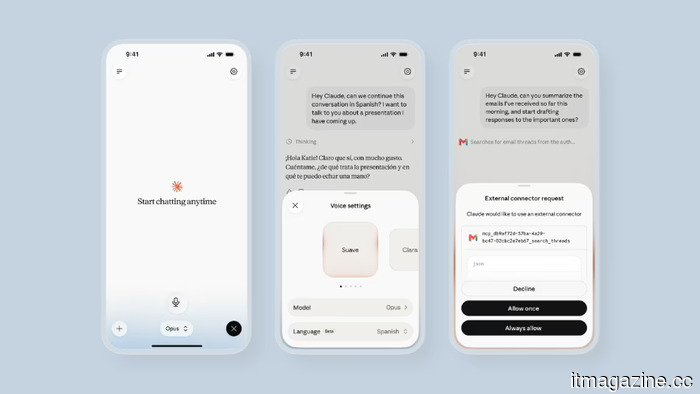
Claude's voice mode is now operating on Opus and Sonnet.
Anthropic invites you to interact with Claude and observe its capabilities. On Thursday, the company announced an upgrade to Claude's voice mode, allowing it to operate on its most advanced models, Opus and Sonnet.
Voice mode was introduced last year and had been functioning solely on Haiku, Anthropic's fastest but less comprehensive model. While this was sufficient for quick queries, users began utilizing it for more complex problem-solving out loud. Anthropic noted that while Haiku facilitated speed, it didn't always provide depth.
The aim is to offer a more intelligent sounding board. Opus and Sonnet are designed for tackling challenging issues. You can discuss an incomplete idea, and Claude will engage with follow-up questions to stimulate your thinking, rather than simply responding.
During a conversation, you can switch models, and it will utilize the fastest version of the selected one. It defaults to the last model you employed in text. Anthropic promotes it for practicing pitches, evaluating job offers, or articulating thoughts prior to challenging conversations.
In addition to conversation, the significant evolution is that voice mode can now take action. By connecting your applications, you can instruct Claude to schedule a meeting on Google Calendar, summarize daily emails, draft responses, or convert a spoken pitch into a one-page document in Canva. It can also interact with Slack and Notion, always requesting permission before using any tool.
Voice mode now supports many additional languages, including French, German, Italian, Japanese, and both Spanish variants. However, you must instruct it to switch languages, as it will not automatically detect changes.
This contrasts with OpenAI's approach. Recently, OpenAI enhanced ChatGPT with a more natural, full-duplex voice capable of listening and speaking simultaneously. In contrast, Claude's voice mode operates on a turn-based system: it listens, pauses to think, and then responds, which feels less seamless than ChatGPT in practice.
Anthropic hasn't modified the foundational voice technology, meaning there are no new features like improved handling of interruptions. "This release emphasizes intelligence and tool accessibility," the company told Engadget, with a promise of "more to come later this year."
This distinction is significant. While OpenAI is working to make its assistant sound more human, Anthropic is focused on enhancing its assistant's ability to perform your tasks. The new voice mode is currently in beta for all users on mobile, desktop, and web, although it functions most effectively on mobile devices.
Free users have access to Haiku and one connected app, while others benefit from the more advanced models and a comprehensive set of tools, with the assurance that speech is just the beginning.
Other articles
 The EU has accused TikTok of not adequately safeguarding children's privacy in accordance with the DSA.
Brussels claims that TikTok allowed minors’ accounts to be accessible to strangers, according to initial findings from the DSA, which could result in a penalty of up to 6% of global revenue.
The EU has accused TikTok of not adequately safeguarding children's privacy in accordance with the DSA.
Brussels claims that TikTok allowed minors’ accounts to be accessible to strangers, according to initial findings from the DSA, which could result in a penalty of up to 6% of global revenue.
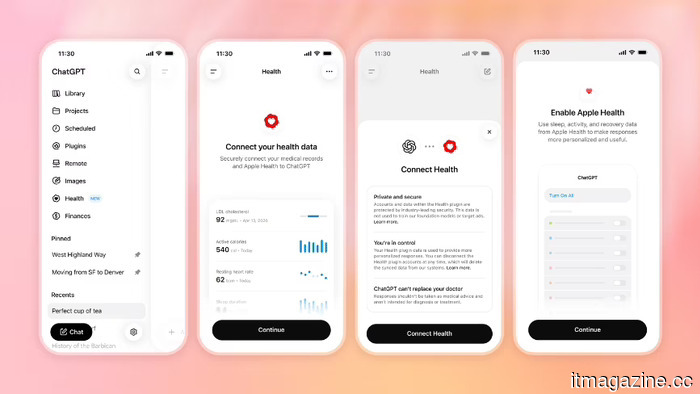 ChatGPT Health is now available to all adults in the United States.
OpenAI is making ChatGPT Health accessible to all adults in the US, integrating it with Apple Health and medical records, and asserting that its AI reasoning surpasses that of clinicians.
ChatGPT Health is now available to all adults in the United States.
OpenAI is making ChatGPT Health accessible to all adults in the US, integrating it with Apple Health and medical records, and asserting that its AI reasoning surpasses that of clinicians.
 Startups are appealing to Trump not to impose a ban on Chinese open-weight AI.
Almost 200 startups in the US, among them Y Combinator and Proton, have cautioned that banning Chinese open-weight AI could eliminate hundreds of these companies and allow Anthropic to dominate the market.
Startups are appealing to Trump not to impose a ban on Chinese open-weight AI.
Almost 200 startups in the US, among them Y Combinator and Proton, have cautioned that banning Chinese open-weight AI could eliminate hundreds of these companies and allow Anthropic to dominate the market.
 Dassault Systèmes is set to acquire ArisGlobal for as much as $2 billion.
Dassault Systèmes is acquiring the US drug-safety AI company ArisGlobal for as much as $2 billion, marking a significant investment in life sciences from a company concerned that AI might disrupt its fundamental business.
Dassault Systèmes is set to acquire ArisGlobal for as much as $2 billion.
Dassault Systèmes is acquiring the US drug-safety AI company ArisGlobal for as much as $2 billion, marking a significant investment in life sciences from a company concerned that AI might disrupt its fundamental business.
 SAP's cloud performance alleviates concerns about AI, although profit expectations have declined.
SAP exceeded expectations for cloud revenue and increased its backlog by 26%, alleviating concerns that AI would undermine enterprise software subscriptions, despite lowering its profit outlook for 2026.
SAP's cloud performance alleviates concerns about AI, although profit expectations have declined.
SAP exceeded expectations for cloud revenue and increased its backlog by 26%, alleviating concerns that AI would undermine enterprise software subscriptions, despite lowering its profit outlook for 2026.
 Meta withdraws from the RE100 clean energy initiative after ten years of participation as the expansion of gas infrastructure increases.
Meta has exited the RE100 initiative after ten years, failing to fulfill renewable energy requirements as it invests in ten gas plants for its Hyperion AI data center in Louisiana.
Meta withdraws from the RE100 clean energy initiative after ten years of participation as the expansion of gas infrastructure increases.
Meta has exited the RE100 initiative after ten years, failing to fulfill renewable energy requirements as it invests in ten gas plants for its Hyperion AI data center in Louisiana.
Claude's voice mode is now operating on Opus and Sonnet.
Anthropic's Claude voice mode now operates on Opus and Sonnet, enabling it to function within Gmail, Slack, and your calendar, with a focus on performance rather than merely sounding human like ChatGPT.