
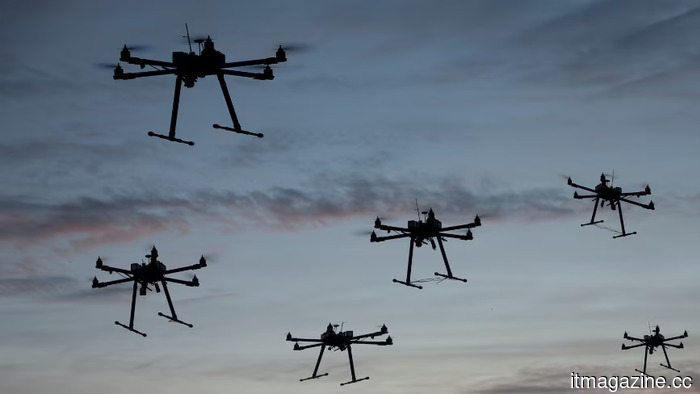
Drone manufacturers compete to develop navigation systems that can withstand jamming in war zones.
**TL;DR** GPS jamming in Ukraine is increasing the need for alternative drone navigation. At Farnborough, Q-CTRL (quantum), ASIO (vision), and ANELLO (laser gyro) presented their solutions.
GPS spoofing and jamming have become common tactics on the battlefield in Ukraine, disconnecting drones from their operators and making some guided munitions ineffective. US-made Excalibur artillery shells lost popularity after early successes due to their GPS guidance being vulnerable to jamming. Even fibre-optic control cables have been thwarted by entangled lines across fields. This situation has led to a surge of companies developing navigation systems that can function without GPS.
Three of these companies showcased their innovations at the Farnborough International Airshow this week. The Australian firm Q-CTRL employs quantum measurements of the Earth's magnetic and gravitational fields to maintain drones' course in GPS-denied environments. “The technology is not a replacement for GPS,” stated Charlie Burnard, Q-CTRL’s global head of government engagement, “but a reliable, resilient backup for scenarios where GPS or other navigation methods fail.” The Israeli company ASIO utilizes onboard cameras and image processing for navigation, while the US-based ANELLO Photonics has created a fibre-optic laser gyroscope with no moving parts, comparable in size to a matchbook.
Most systems incorporate multiple guidance methods. All use inertial navigation, which tracks velocity and movement from a starting point; however, inertial guidance alone tends to drift over time as small errors accumulate. The new technologies aim to counteract this drift without depending on external signals that adversaries can jam. The Ukrainian drone company Sine has developed a satellite-free navigation system using time-of-flight techniques to evade Russian electronic warfare, and the UK achieved the world's first quantum navigation flights earlier this year.
Ukraine’s extensive drone operations emphasize the urgency of this issue. Kyiv targets locations in Russia that were previously inaccessible, including oil refineries, whose destruction has forced Russia to export unprocessed crude at unprecedented levels since the conflict began. Long-range drones traveling hundreds of kilometers through contested electromagnetic environments require navigation solutions that remain reliable throughout their journeys. For many missions, merely getting "near a target" suffices, but these companies are focused on closing the gap between near and missed.
Other articles
 Amazon is revamping Prime Video with increased AI features, but will it address the issues that annoy viewers?
Amazon is experimenting with a redesign of Prime Video that utilizes AI, which may lead to a shift in paid studio placements to be based on algorithm-driven rankings. This has raised concerns about whether the recommendations for viewers will genuinely enhance their experience.
Amazon is revamping Prime Video with increased AI features, but will it address the issues that annoy viewers?
Amazon is experimenting with a redesign of Prime Video that utilizes AI, which may lead to a shift in paid studio placements to be based on algorithm-driven rankings. This has raised concerns about whether the recommendations for viewers will genuinely enhance their experience.
 The postponement of Google's Gemini highlights a more significant issue: employee morale.
Insiders informed Axios that low morale, a disputed Pentagon agreement, and a talent drain are hindering Google's AI models, leading to negative cash flow. Google refutes these claims.
The postponement of Google's Gemini highlights a more significant issue: employee morale.
Insiders informed Axios that low morale, a disputed Pentagon agreement, and a talent drain are hindering Google's AI models, leading to negative cash flow. Google refutes these claims.
 Apple's privacy policy indicates that an AI shopping assistant will be introduced to the Apple Store app.
An update to the privacy policy for the Apple Store app outlines a "Virtual Shopping Assistant" that gathers chat, location, and device information. It is not currently operational.
Apple's privacy policy indicates that an AI shopping assistant will be introduced to the Apple Store app.
An update to the privacy policy for the Apple Store app outlines a "Virtual Shopping Assistant" that gathers chat, location, and device information. It is not currently operational.
 Ford is transitioning from Google Maps to Apple Maps for its upcoming electric vehicles.
Ford plans to integrate Apple Maps into its upcoming UEV platform, beginning with a $30,000 electric pickup set to launch in 2027, while road data will also enhance the next version of BlueCruise.
Ford is transitioning from Google Maps to Apple Maps for its upcoming electric vehicles.
Ford plans to integrate Apple Maps into its upcoming UEV platform, beginning with a $30,000 electric pickup set to launch in 2027, while road data will also enhance the next version of BlueCruise.
 Jensen Huang earned $172 billion from selling AI chips. He has just donated $75 million to an art school.
Nvidia CEO Jensen Huang contributed $75 million to Vanderbilt for a college focused on art, architecture, and design in San Francisco. It is set to open next year at the former CCA campus.
Jensen Huang earned $172 billion from selling AI chips. He has just donated $75 million to an art school.
Nvidia CEO Jensen Huang contributed $75 million to Vanderbilt for a college focused on art, architecture, and design in San Francisco. It is set to open next year at the former CCA campus.
 Reddit might restrict Google's access to its content due to traffic generated by AI.
Reddit's shares dropped by 9% following a report suggesting it might restrict Google's access to its content for AI purposes, as AI Overviews significantly reduce the referral traffic that publishers depend on.
Reddit might restrict Google's access to its content due to traffic generated by AI.
Reddit's shares dropped by 9% following a report suggesting it might restrict Google's access to its content for AI purposes, as AI Overviews significantly reduce the referral traffic that publishers depend on.
Drone manufacturers compete to develop navigation systems that can withstand jamming in war zones.
Q-CTRL relies on quantum measurements, ASIO utilizes camera vision, and ANELLO has created a laser gyro the size of a matchbook. All these technologies are designed to ensure drones remain on course when GPS signals are blocked.