
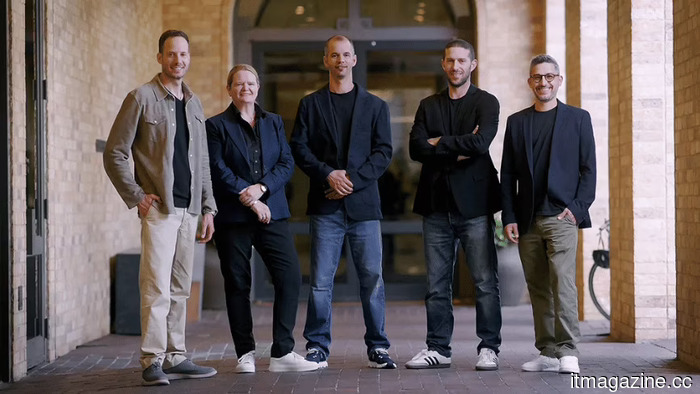
Glow, founded by a former Meta executive, has secured $180 million for its AI-driven endpoint security solutions.
The founder is now asking companies to place their trust in AI for their laptops, despite having previously built one of Silicon Valley’s most infamous surveillance tools. Roi Tiger co-created Onavo, the application that Meta transformed into a means of spying on its competitors. His new venture, Glow, aims to do nearly the opposite.
Glow has emerged from stealth mode with $180 million in funding and a valuation of $1.2 billion. The funding round was led by Sequoia, Cyberstarts, Greenoaks, and Redpoint Ventures, with participation from Index Ventures, Lux Capital, and others. Established in 2025 and operating between Tel Aviv and Palo Alto, the startup has already hired nearly 100 employees.
Focusing on prevention rather than detection, Glow’s approach deviates from the conventional workings of most security systems. Current tools primarily identify threats and react after they occur. In contrast, Glow aims to prevent such threats by utilizing AI agents that monitor everything operating on a device, assess the risk, and block unauthorized software before it can be executed.
“Prevention has always been the optimal answer in security. It simply hasn't been feasible at an enterprise level without hindering business operations,” Tiger stated. “AI changes that.” He argues that AI has necessitated a transformation in approach. According to Glow, the use of AI on corporate devices has surged from 15% to 45% in a year, much of which is unauthorized.
This expansion increases the potential for attacks, especially as adversaries obtain advanced models of their own. Glow contends that teams should operate under the assumption that attackers are employing Mythos-class AI, capable of exploiting any overlooked vulnerabilities at machine speed. Its agents utilize Anthropic and Google Gemini models through Amazon Bedrock, supplemented by Glow’s proprietary reasoning engine. The company claims that its system has already prevented malicious code from installing on client devices.
However, Tiger’s history complicates the situation. He co-founded Onavo, a data-analytics app that Meta acquired in 2013, where he served for nine years, ultimately becoming VP of engineering. According to Tech Funding News, Onavo formed the basis of “Project Ghostbusters.”
Court documents released in 2024 revealed that Meta repurposed Onavo’s VPN to intercept and decrypt competitors’ encrypted traffic, specifically targeting Snapchat, YouTube, and Amazon. Apple removed the app in 2018, and Meta shut it down in 2019. The filings described the actions as criminal, and Tiger has not publicly addressed his involvement, with Glow's launch not referencing it.
The irony is palpable; Onavo functioned in secrecy to observe and report, while Glow promises transparency in controlling what operates on a device and managing potential risks.
Achieving a valuation of a billion dollars without disclosing any revenue is noteworthy for Glow. The company has not identified any clients apart from broad industries such as healthcare, retail, and financial services. It joins a trend of AI-security startups that have surpassed a billion-dollar valuation prior to demonstrating viable business models, a phenomenon familiar in the Israeli cyber industry that produced Wiz. Many of Glow’s investors also supported Wiz.
Glow faces competition from established players like CrowdStrike, Microsoft, and SentinelOne, who have built their empires based on detection. An open question remains: will enterprises trust an AI agent to autonomously block software without human intervention? For a founder whose previous actions diminished such trust, this presents a fitting challenge.
Altri articoli
 Meta's AI moderation is incorrectly suspending accounts.
Meta's AI moderation is incorrectly removing accounts on Facebook and Instagram, and the typical method to contest an unjust ban usually involves additional AI.
Meta's AI moderation is incorrectly suspending accounts.
Meta's AI moderation is incorrectly removing accounts on Facebook and Instagram, and the typical method to contest an unjust ban usually involves additional AI.
 In June, electric vehicle sales in Europe jumped by nearly 40 percent, with their market share exceeding 25 percent.
In June, battery-electric vehicle registrations reached 275,060 in 17 European markets, leading to first-half sales exceeding 1,240,000 and a market share surpassing 25 percent.
In June, electric vehicle sales in Europe jumped by nearly 40 percent, with their market share exceeding 25 percent.
In June, battery-electric vehicle registrations reached 275,060 in 17 European markets, leading to first-half sales exceeding 1,240,000 and a market share surpassing 25 percent.
 The Galaxy Z Fold 8 Ultra arrives featuring a more enhanced display, a larger battery, and a $100 increase in price.
The new Galaxy Z Fold 8 Ultra from Samsung begins at a price of $2,099.99 and features a clearer display, larger battery, and enhanced ultrawide camera, all within a slightly thinner design.
The Galaxy Z Fold 8 Ultra arrives featuring a more enhanced display, a larger battery, and a $100 increase in price.
The new Galaxy Z Fold 8 Ultra from Samsung begins at a price of $2,099.99 and features a clearer display, larger battery, and enhanced ultrawide camera, all within a slightly thinner design.
 AI companies are acquiring vintage books to ensure clean training data.
The broker ISBNdb is offering pre-2022 print books for AI labs as the final clean training data. Scanning these books involves discretely destroying them.
AI companies are acquiring vintage books to ensure clean training data.
The broker ISBNdb is offering pre-2022 print books for AI labs as the final clean training data. Scanning these books involves discretely destroying them.
 AI companies are purchasing vintage books to acquire clean training data.
Broker ISBNdb is offering pre-2022 print books from AI labs as the final source of slop-free training data. The process of scanning these books involves quietly destroying them.
AI companies are purchasing vintage books to acquire clean training data.
Broker ISBNdb is offering pre-2022 print books from AI labs as the final source of slop-free training data. The process of scanning these books involves quietly destroying them.
 The White House allocates $5 billion for AI research in the largest federal science reform in 80 years.
Federal agencies have dedicated more than $5 billion to the Genesis Mission, an initiative led by the Energy Department aimed at utilizing AI to speed up research across 278 projects.
The White House allocates $5 billion for AI research in the largest federal science reform in 80 years.
Federal agencies have dedicated more than $5 billion to the Genesis Mission, an initiative led by the Energy Department aimed at utilizing AI to speed up research across 278 projects.
Glow, founded by a former Meta executive, has secured $180 million for its AI-driven endpoint security solutions.
Glow, established by the former Meta VP who developed the Onavo surveillance app, has emerged from stealth mode with a valuation of $1.2 billion to prevent risky software using AI.