
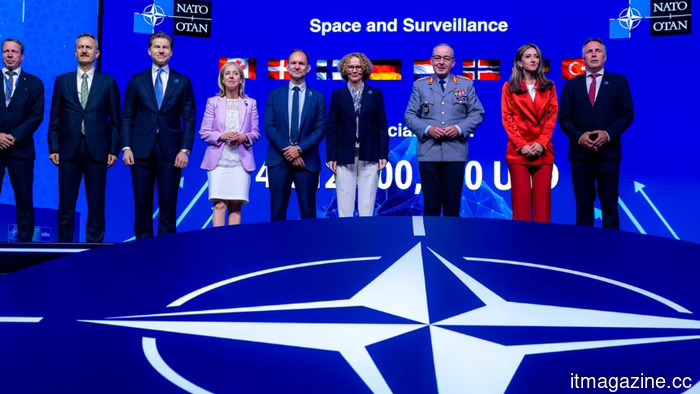
Eight NATO member countries initiate HALO, a strategy to connect military satellites into a singular, integrated mega-constellation.
TL;DR: Eight NATO nations initiated HALO at the Ankara summit to link their military satellites into a massive network for communications and missile tracking.
At the NATO Summit Defence Industry Forum in Ankara, eight nations announced a plan to connect their military satellites into a unified mega-constellation, representing the Alliance’s most significant step toward regarding space as a collective asset rather than individual national resources. The initiative, named HALO (Hybrid Alliance Layered Operations in Space), includes Canada, Denmark, Finland, Germany, the Netherlands, Norway, Sweden, and Türkiye. Its goal is to facilitate rapid communication, intelligence exchange, and missile tracking across borders.
HALO aims to address the financial and coverage challenges associated with single-nation satellite fleets by integrating sovereign, nationally owned satellites into a shared network. Each country will maintain ownership and control of its satellites, a distinction that renders the project politically feasible but architecturally complicated. This arrangement ensures that no single ally relinquishes military space capabilities to a collective command while still enabling the Alliance to function as if operating a unified fleet.
The Ankara forum also yielded several other space commitments. Canada joined STARLIFT, the 15th participant in a multinational effort initiated in October 2024, which is establishing a network of spaceports across Alliance territory for the rapid deployment of assets in emergencies. Additionally, German launch firm Isar Aerospace secured a contract with Canada’s Maritime Launch Services for access to Spaceport Nova Scotia, enhancing its launch site options in North America.
Spain has become the 19th country to participate in the Alliance's Persistent Surveillance from Space (APSS) program, the largest multinational investment in space-based capabilities in NATO's history. APSS achieved initial operational capability in December 2025 and operates a virtual constellation of national and commercial surveillance satellites known as Aquila. Spain will provide coastal surveillance imagery from its Atlantic Constellation satellites.
As one of HALO's founding members, Türkiye also announced plans to develop two more high-resolution reconnaissance satellites to complement its existing IMECE Earth observation satellite. Furthermore, the country is investing in low-orbit satellites for military communications and early warning radar systems, amplifying its already prominent national space program on NATO’s southern front.
This series of announcements underscores the rapid shift of space from a supportive role to a foundational element of Alliance defense strategy. Five years prior, NATO lacked multinational space programs of this magnitude; now it oversees HALO for satellite networking, APSS for surveillance, STARLIFT for launch access, and cybersecurity operations designed to safeguard the spacecraft. The pivotal challenge ahead will be whether the political resolve to integrate sovereign assets into shared networks can withstand the realities of national defense budgets and procurement schedules.
Published July 21, 2026 - 4:41 pm UTC
Other articles
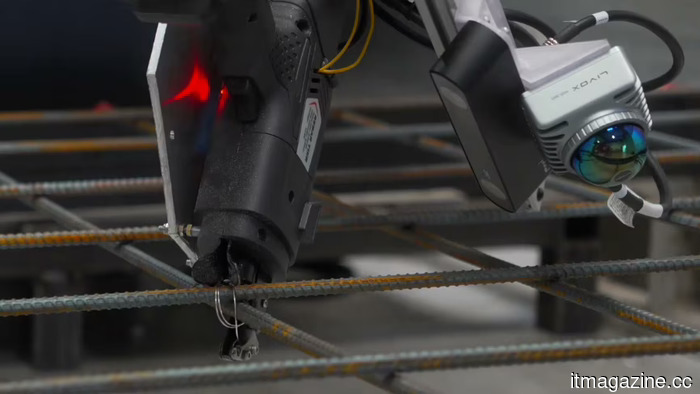 Gritt secures $32 million to develop AI robots that attach to current construction machinery, enabling quicker solar farm construction.
Gritt secured $32 million in funding, primarily from Obvious Ventures, for AI robots that can be attached to current construction machinery, enabling solar panel installation at a rate four times quicker.
Gritt secures $32 million to develop AI robots that attach to current construction machinery, enabling quicker solar farm construction.
Gritt secured $32 million in funding, primarily from Obvious Ventures, for AI robots that can be attached to current construction machinery, enabling solar panel installation at a rate four times quicker.
 Apple's upcoming major experiment with iPhone displays might be its largest one to date.
Apple might be evaluating a display close to 7 inches for an upcoming iPhone, but the speculated panel has not been linked to any completed model or verified independently prior to its potential launch in 2027.
Apple's upcoming major experiment with iPhone displays might be its largest one to date.
Apple might be evaluating a display close to 7 inches for an upcoming iPhone, but the speculated panel has not been linked to any completed model or verified independently prior to its potential launch in 2027.
 London-based robotics startup Humanoid has secured $152 million in its Series A funding round, with Bosch poised to produce its wheeled robots on a large scale.
Humanoid secured $152 million in funding, spearheaded by Prime Movers Lab, achieving a valuation of one billion dollars, and has Bosch as its contract manufacturer along with 34,000 reported pre-orders.
London-based robotics startup Humanoid has secured $152 million in its Series A funding round, with Bosch poised to produce its wheeled robots on a large scale.
Humanoid secured $152 million in funding, spearheaded by Prime Movers Lab, achieving a valuation of one billion dollars, and has Bosch as its contract manufacturer along with 34,000 reported pre-orders.
 Big Tech is concealing $1.65 trillion in AI liabilities that are off the balance sheet.
A Nikkei study revealed that Alphabet, Microsoft, Amazon, Meta, and Oracle hold $1.65 trillion in off-balance-sheet debt for AI, exceeding their reported figures. This practice is entirely legal.
Big Tech is concealing $1.65 trillion in AI liabilities that are off the balance sheet.
A Nikkei study revealed that Alphabet, Microsoft, Amazon, Meta, and Oracle hold $1.65 trillion in off-balance-sheet debt for AI, exceeding their reported figures. This practice is entirely legal.
 Vibecoded applications are overwhelming Apple's App Store, and users are becoming increasingly frustrated with them.
This year, submissions to the App Store have increased twofold, thanks to AI tools simplifying the development process. However, download rates haven't matched this growth, as users are becoming fatigued from sifting through low-quality, AI-generated applications.
Sila secures $300 million to accelerate gigascale anode manufacturing and strengthen battery supply chains in the US.
Sila secured $300 million, with Atreides Management and Sutter Hill leading the round, to enhance its Moses Lake silicon anode facility, despite the fact that no EV batteries have been delivered as of now.
Vibecoded applications are overwhelming Apple's App Store, and users are becoming increasingly frustrated with them.
This year, submissions to the App Store have increased twofold, thanks to AI tools simplifying the development process. However, download rates haven't matched this growth, as users are becoming fatigued from sifting through low-quality, AI-generated applications.
Sila secures $300 million to accelerate gigascale anode manufacturing and strengthen battery supply chains in the US.
Sila secured $300 million, with Atreides Management and Sutter Hill leading the round, to enhance its Moses Lake silicon anode facility, despite the fact that no EV batteries have been delivered as of now.
Eight NATO member countries initiate HALO, a strategy to connect military satellites into a singular, integrated mega-constellation.
At the Ankara summit, NATO allies initiated HALO to connect national military satellites for communication, intelligence, and missile tracking throughout the Alliance.