
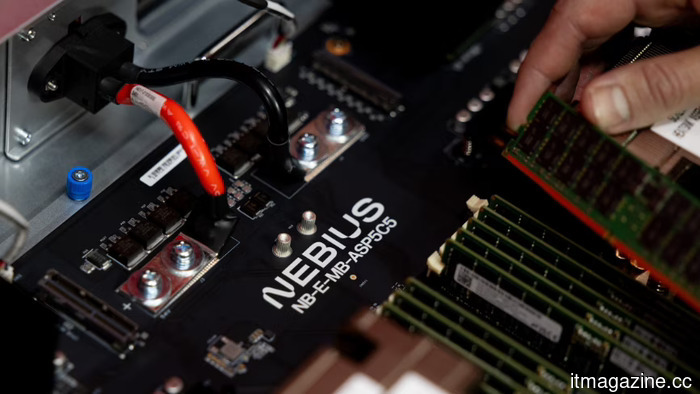
Nebius secured $775 million by using its GPUs as collateral for a loan. Additionally, it possesses $40 billion in further contracts available for securitization.
**TL;DR** Nebius secured $775 million in GPU-backed debt at SOFR + 2.50%, maturing in 2030. With contracts worth over $40 billion from Microsoft and Meta, it plans to replicate this model on a larger scale.
Nebius has successfully raised $775 million through its first secured debt facility, leveraging deployed GPU infrastructure and cash flows from an investment-grade customer. The facility is due to mature on October 31, 2030, and carries a pricing of SOFR + 2.50%, equating to approximately 6.8% at current rates. When combined with the cash flows from the customer agreement, this facility more than covers the capital expenditures needed for the infrastructure deployment. The offer was significantly oversubscribed.
The innovative structure is what sets it apart. Nebius is treating its GPU clusters similarly to how airlines manage their aircraft or telecom companies handle spectrum—as assets that can be collateralized against long-term revenue contracts. In March, Meta pledged up to $27 billion to Nebius, while Microsoft has a deal valued at up to $19.4 billion. With over $40 billion already secured in contracted revenue from investment-grade clients, Nebius anticipates attracting more capital under comparable favorable conditions. The company has recently delivered the latest planned capacity tranche to Microsoft and asserts that it is on track.
MUFG acted as the structuring agent and sole bookrunner for the transaction, while ABN AMRO, Bank of America, Deutsche Bank, and HSBC served as mandated lead arrangers. Citi, Crédit Agricole, ING, and Morgan Stanley were senior lead arrangers, and Goldman Sachs also took part. The extensive syndicate of nine banks from the US, Europe, and Japan highlights the growing recognition of GPU infrastructure as a viable collateral class by institutional lenders.
For Nebius, this facility transforms an operational asset into growth capital without diluting shareholder equity, which is particularly significant for a company whose stock experienced an 8% increase following the announcement. In 2024, Nebius launched an AI data center in Paris as part of a $1 billion expansion in Europe and has since broadened its footprint to Finland, the UK, and the US. COO Ophir Nave noted that the financing supports a “disciplined, diversified approach” across owned data centers and asset-light partnerships. The real challenge will be whether this model can be replicated. With $40 billion in contracts backing it, Nebius has ample resources. However, the scalability of the GPU-as-collateral approach will hinge on residual value assumptions that remain untested in this industry.
Other articles
 Google's AI has just reimagined the greatest goal ever scored by Pele, which was never captured on film.
Google utilized live stadium capture and merged it with archival content to recreate Pele's iconic goal. The Veo video engine, Gemini Omni, and Nano Banana Pro AI tools were also involved in the process of resurrecting this forgotten masterpiece.
Google's AI has just reimagined the greatest goal ever scored by Pele, which was never captured on film.
Google utilized live stadium capture and merged it with archival content to recreate Pele's iconic goal. The Veo video engine, Gemini Omni, and Nano Banana Pro AI tools were also involved in the process of resurrecting this forgotten masterpiece.
.jpg) This gripping true story thriller is among the three underrated Netflix series you ought to check out this weekend (July 17-19).
This weekend's Netflix lineup includes a humorous animated film set in an apocalypse, a chilling mystery from Iceland, and a true crime thriller, all of which are both critically recognized and overlooked.
France and Germany have committed to developing a European competitor to Palantir's military artificial intelligence software.
Macron and Merz have signed a joint declaration to create a "European sovereign digital backbone" for defense, with France's Arcadia identified as the initial point of reference.
This gripping true story thriller is among the three underrated Netflix series you ought to check out this weekend (July 17-19).
This weekend's Netflix lineup includes a humorous animated film set in an apocalypse, a chilling mystery from Iceland, and a true crime thriller, all of which are both critically recognized and overlooked.
France and Germany have committed to developing a European competitor to Palantir's military artificial intelligence software.
Macron and Merz have signed a joint declaration to create a "European sovereign digital backbone" for defense, with France's Arcadia identified as the initial point of reference.
 China is redesigning smartphones to focus on AI agents. ZTE's NaviX sold out within hours.
ZTE revealed the NaviX Ultra at WAIC, branding it as the first agentic AI phone in the world. It operates on ByteDance's Doubao. Additionally, StepFun and Honor presented comparable devices.
China is redesigning smartphones to focus on AI agents. ZTE's NaviX sold out within hours.
ZTE revealed the NaviX Ultra at WAIC, branding it as the first agentic AI phone in the world. It operates on ByteDance's Doubao. Additionally, StepFun and Honor presented comparable devices.
 Meta has secured a patent for an AI system that continuously monitors your voice and gauges your mood throughout the day.
A Meta patent outlines a device that captures speech, sighs, and laughter to create an ongoing emotional profile. Amazon attempted a similar approach but was unsuccessful.
Meta has secured a patent for an AI system that continuously monitors your voice and gauges your mood throughout the day.
A Meta patent outlines a device that captures speech, sighs, and laughter to create an ongoing emotional profile. Amazon attempted a similar approach but was unsuccessful.
 The White House is now determining who has access to advanced AI models, rather than the laboratories.
The Trump administration is controlling which companies have access to new AI models from Anthropic and OpenAI, transferring authority from technology corporations to the government.
The White House is now determining who has access to advanced AI models, rather than the laboratories.
The Trump administration is controlling which companies have access to new AI models from Anthropic and OpenAI, transferring authority from technology corporations to the government.
Nebius secured $775 million by using its GPUs as collateral for a loan. Additionally, it possesses $40 billion in further contracts available for securitization.
Nebius has obtained $775 million in debt, which is supported by its deployed GPU infrastructure and contracted cash flows. The facility will mature in 2030 and is priced at SOFR plus 2.50%.