
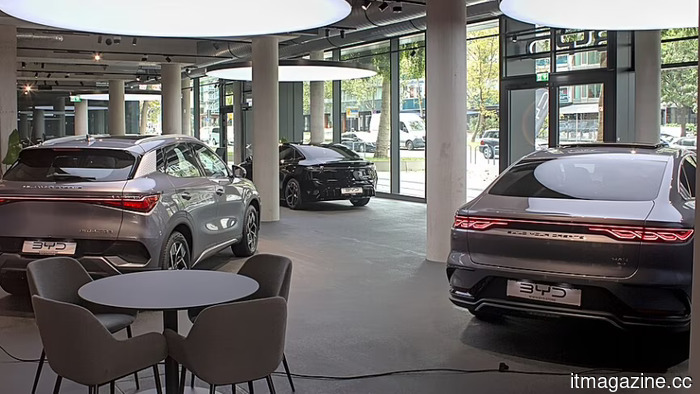
Chinese car sales in the UK soared from 384 in 2015 to 285,000 last year. The reason for this is the difference in tariffs.
**TL;DR**: Sales of Chinese cars in the UK surged to 285,000 in 2025, a significant increase from 384 in 2015. The absence of additional tariffs on plug-in hybrids makes the UK more accessible than the EU or US.
In 2015, only 384 vehicles made in China were purchased in Britain. Last year, that figure jumped to 285,000, according to automotive consulting firm Mobility Global. Growth is accelerating, with BYD nearly doubling its sales in the UK during the first half of 2026 to over 37,000 units. Chinese brands now account for around 13% of new car registrations in the UK, compared to just half that a year prior.
This is largely due to a discrepancy in tariffs. The EU imposes countervailing duties of as much as 35.3% on Chinese battery-electric vehicles and is planning to introduce additional tariffs on plug-in hybrids. The US enforces a hefty 100% tariff. In contrast, the UK imposes no extra tariffs on Chinese plug-in hybrids, making it the most accessible major Western market for Chinese car manufacturers. “It becomes an excellent-sized market that’s progressing well towards electrification and is in demand for more affordable vehicles that fill that gap,” remarked Will Roberts from Benchmark, an automotive consultancy.
The price difference is notable. In the UK, a German-built Volkswagen Tiguan plug-in hybrid retails for just over £43,000 ($58,000), while the Chinese-made BYD Seal U is priced nearly £10,000 less. Customers at a Geely dealership in Maidstone shared with CNBC that the value proposition is clear: superior features at a lower cost. Canada welcomed Chinese EVs into its market in January with a cap of 49,000 units, but the UK’s policy is more lenient, featuring no quotas or extra duties.
China's internal auto market is slowing, with retail sales dropping 26% in the first half of 2026, even as exports climbed by 72%, according to the China Association of Automobile Manufacturers. That surge in exports needs a destination. Former GM board member Jon McNeill told CNBC that Chinese manufacturers are entering Europe “with very appealing cars at competitive prices and technology that outshines what is available from European producers.” Geely has halted the construction of new factories, opting instead to utilize Volvo's existing plants to bypass tariffs and manage overcapacity. However, the UK's open market may not be sustainable; should Chinese market share continue to grow, there will likely be increasing pressure to conform to EU tariff regulations. For now, the sale of 285,000 cars in one year speaks volumes.
Other articles
.jpg) This gripping true story thriller is among the three underrated Netflix series you ought to check out this weekend (July 17-19).
This weekend's Netflix lineup includes a humorous animated film set in an apocalypse, a chilling mystery from Iceland, and a true crime thriller, all of which are both critically recognized and overlooked.
This gripping true story thriller is among the three underrated Netflix series you ought to check out this weekend (July 17-19).
This weekend's Netflix lineup includes a humorous animated film set in an apocalypse, a chilling mystery from Iceland, and a true crime thriller, all of which are both critically recognized and overlooked.
 The White House is now determining who has access to advanced AI models, rather than the laboratories.
The Trump administration is controlling which companies have access to new AI models from Anthropic and OpenAI, transferring authority from technology corporations to the government.
The White House is now determining who has access to advanced AI models, rather than the laboratories.
The Trump administration is controlling which companies have access to new AI models from Anthropic and OpenAI, transferring authority from technology corporations to the government.
 Following YouTube, TikTok is experimenting with its own tool for detecting AI-generated likenesses.
As deepfakes become more prevalent, TikTok is following YouTube by offering creators tools to identify and report unauthorized AI representations of themselves.
France and Germany have committed to developing a European competitor to Palantir's military artificial intelligence software.
Macron and Merz have signed a joint declaration to create a "European sovereign digital backbone" for defense, with France's Arcadia identified as the initial point of reference.
Following YouTube, TikTok is experimenting with its own tool for detecting AI-generated likenesses.
As deepfakes become more prevalent, TikTok is following YouTube by offering creators tools to identify and report unauthorized AI representations of themselves.
France and Germany have committed to developing a European competitor to Palantir's military artificial intelligence software.
Macron and Merz have signed a joint declaration to create a "European sovereign digital backbone" for defense, with France's Arcadia identified as the initial point of reference.
 What Features are Most Important in a Printer for a Small Business or Home Office?
Features such as print speed, wireless reliability, AI-driven scanning, and integrated security are what significantly impact a bustling home office or small business.
What Features are Most Important in a Printer for a Small Business or Home Office?
Features such as print speed, wireless reliability, AI-driven scanning, and integrated security are what significantly impact a bustling home office or small business.
 If you’re getting ready for back-to-school shopping, here are my recommended gaming laptops.
Searching for a gaming laptop for college? These five Back-to-School selections offer a good balance of performance, productivity, and long-lasting value for both students and gamers.
If you’re getting ready for back-to-school shopping, here are my recommended gaming laptops.
Searching for a gaming laptop for college? These five Back-to-School selections offer a good balance of performance, productivity, and long-lasting value for both students and gamers.
Chinese car sales in the UK soared from 384 in 2015 to 285,000 last year. The reason for this is the difference in tariffs.
In 2025, sales of vehicles manufactured in China in the UK rose to 285,000. Unlike the EU, the UK imposes no extra tariff on plug-in hybrids. Brands like BYD and Geely are rapidly increasing their market presence.