
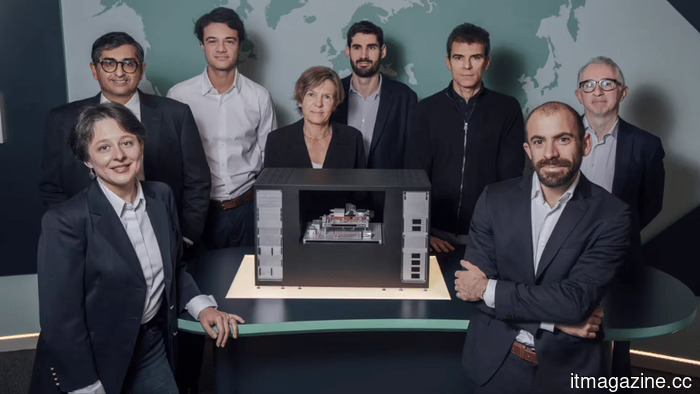
Pasqal's $2 billion Nasdaq wager is subject to a French veto.
Pasqal, a French quantum computing company, is set to go public on Nasdaq with a valuation of $2 billion, approximately 100 times its revenue. Its filings highlight two key points: the potential for quantum computing profitability remains uncertain, and Paris has the authority to determine ownership of the company.
By merging with Bleichroeder Acquisition Corp. II, a special purpose acquisition company, Pasqal is joining the US market. The valuation of $2 billion positions the company at about 100 times its €16.5 million revenue for 2025, which seems high until compared to industry peers.
CEO Wasiq Bokhari asserts that in the realm of quantum computing, Pasqal is relatively affordable, noting that comparable companies like Quantinuum recently entered the public market with a valuation of around $20 billion—approximately 647 times its 2025 revenue. This comparison illustrates the market's valuation approach, focusing not on current earnings from the technology but on future potential. The filings candidly acknowledge the risks, cautioning that “commercial traction of quantum computing technology may never occur” and that the machines might not fulfill expectations.
Another notable risk is the political aspect involved in Pasqal’s operations. As a critical technology entity based in France, the company's filings indicate “French state influence.” Thus, any non-French or non-EU investor wishing to acquire a significant stake must obtain approval from the French Ministry of the Economy.
This means that Paris retains control over ownership, reflecting Europe’s strategic tech policy, which aims to foster and manage technological champions. For a company seeking funds from international investors, this stipulation presents a significant challenge and explains why Pasqal's choice to list in the US is especially significant.
Bokhari explains that the decision to pursue a US listing stems from the availability of extensive capital. This trend has led numerous European deep-tech companies to establish their presence in the US market. Notably, IQM was recognized as the first European quantum firm on a major US exchange, with others in advanced hardware and chip inspection also opting for funding in regions with deeper financial resources.
The deal is substantial, with Pasqal anticipating around $500 million in gross proceeds. The merged entity will operate as Pasqal Holding SA and aims to finalize its Nasdaq listing in the latter half of the year. Both parties outlined the agreement in a Form F-4 submitted to the SEC on May 26, which was later amended.
This situation underscores a broader challenge for Europe: it develops its most innovative companies domestically, only to see them valued more favorably abroad. Pasqal’s documents clarify why this is the case. A $2 billion investment in quantum technology demands both ample and patient financing, and the French ownership veto complicates such ventures. As the company itself admits, the question of whether the technology will ultimately justify its valuation remains unanswered.
Other articles
 LimX Dynamics reaches a humanoid valuation of $2.2 billion.
China's LimX Dynamics secured $200 million at a valuation of $2.21 billion. The founder stated, “going public is essential” as over 100 Chinese humanoid companies compete to list.
LimX Dynamics reaches a humanoid valuation of $2.2 billion.
China's LimX Dynamics secured $200 million at a valuation of $2.21 billion. The founder stated, “going public is essential” as over 100 Chinese humanoid companies compete to list.
 If you capture in RAW format, Snapseed has conveniently addressed one of your major concerns.
The latest Android update for Snapseed introduces support for a majority of major RAW formats, as well as in-tool undo and redo options.
If you capture in RAW format, Snapseed has conveniently addressed one of your major concerns.
The latest Android update for Snapseed introduces support for a majority of major RAW formats, as well as in-tool undo and redo options.
 Firefox is increasing its update frequency, which is beneficial for your security.
Firefox users will no longer need to wait a month for the next update since Mozilla is shifting to a quicker release schedule.
Firefox is increasing its update frequency, which is beneficial for your security.
Firefox users will no longer need to wait a month for the next update since Mozilla is shifting to a quicker release schedule.
 Your seemingly broken TV might be less faulty than it appears.
A repair technician asserts that a small backlight issue can cause certain televisions to seem entirely nonfunctional, possibly leading owners to consider replacement before realizing that the core problem might still be fixable.
Your seemingly broken TV might be less faulty than it appears.
A repair technician asserts that a small backlight issue can cause certain televisions to seem entirely nonfunctional, possibly leading owners to consider replacement before realizing that the core problem might still be fixable.
 Moneybox achieves unicorn status on London's newly launched Pisces market.
Moneybox has emerged as Europe's latest unicorn, valued at £800 million (US$1.1 billion), following a £45 million staff share sale on the LSE’s new Pisces market, rather than through a fundraising effort.
Moneybox achieves unicorn status on London's newly launched Pisces market.
Moneybox has emerged as Europe's latest unicorn, valued at £800 million (US$1.1 billion), following a £45 million staff share sale on the LSE’s new Pisces market, rather than through a fundraising effort.
 Moneybox reaches unicorn status on London’s new Pisces market.
Moneybox has become Europe's latest unicorn, valued at £800 million (US$1.1 billion), following a £45 million employee share sale on the new Pisces market of the LSE, rather than through a fundraising effort.
Moneybox reaches unicorn status on London’s new Pisces market.
Moneybox has become Europe's latest unicorn, valued at £800 million (US$1.1 billion), following a £45 million employee share sale on the new Pisces market of the LSE, rather than through a fundraising effort.
Pasqal's $2 billion Nasdaq wager is subject to a French veto.
Pasqal is set to go public on Nasdaq through a SPAC at a valuation of $2 billion, which equates to roughly 100 times its revenue. Its filings caution that quantum technology may not yield returns, and buyers can be vetted by France.