
Huawei Digital Power now competes with Tesla's energy division in terms of revenue.
When you ask most people what Huawei manufactures, they will likely mention smartphones, 5G technology, or a decade's worth of geopolitical debates. Very few think of solar inverters.
However, Huawei Digital Power Technology, the division responsible for producing solar inverters, battery storage systems, and electric vehicle chargers, achieved a revenue of 68.7 billion yuan in 2025, reflecting a 24.4% increase from the prior year, as stated in the group's annual report.
To make this figure more relatable, consider Tesla. Its energy generation and storage division, which includes the Megapack and Powerwall, generated $12.77 billion in 2025, marking roughly a 27% increase on record deployments of 46.7 GWh. Both companies are of a similar size and growth rate, yet one garners significantly more public interest.
Tesla’s energy division gets attention during earnings calls, in analyst reports, and on various social media platforms, while Huawei’s is mainly discussed among procurement managers.
Part of this discrepancy is structural: Huawei is unlisted, employee-owned, and only issues an annual report that spans several hundred pages, with Digital Power taking up just a single line.
The overall group reported 880.9 billion yuan in revenue and 68 billion yuan in net profit for 2025, indicating that the energy sector constitutes about 8% of the total. If it were to be spun off, it would still represent a substantial company.
Another factor is that the West has largely lost interest. Huawei has been excluded from telecommunications networks in much of Europe and North America due to national security concerns, leading many to assume the company has diminished. In reality, it has merely pivoted towards the energy transition sector, where political scrutiny is lower and profit margins are decent.
Solar inverters represent a lucrative business opportunity that can grow quietly. They are practical, established standards-driven products that are difficult to replace once installed, linking solar arrays to the grid, which is the critical juncture for data.
The annual report does not specify revenue by product line for this division, so the exact contribution of inverters compared to storage systems or charging infrastructure remains undisclosed, along with profit figures. Investors in publicly traded competitors would likely react strongly to such omissions, but Huawei faces no such pressure.
The growth is primarily driven by markets outside of America and Europe, with Brazil becoming increasingly important. Huawei entered a partnership with SECPower in December to expand its energy storage operations there, coinciding with a new Brazilian law introducing a competitive hourly pricing mechanism and expanding storage incentives.
Africa also serves as a significant market, where Huawei has leveraged localized services to grow its installed base.
This development does not occur in isolation. Chinese manufacturers already dominate solar panel production, prompting Europe to stockpile €7 billion worth of Chinese solar panels under the guise of energy security, a self-defeating argument upon deeper reflection.
Meanwhile, Beijing is attempting to connect renewable energy generation directly to its data centers, and Europe is learning the difficult lesson, exemplified by Denmark's hold on grid connections, that AI demand and clean energy do not necessarily align in timing or location.
This trend is familiar to anyone who has observed China's rise in the solar, battery, and electric vehicle industries. Companies enter a hardware sector viewed as low-margin plumbing by Western firms, seizing volume, standards, and installed bases, only to discover that this plumbing is, in fact, the strategic asset.
Other articles
 NestAI from Finland is developing the AI infrastructure that European armed forces seek to possess.
Finland, Estonia, and the Helsinki-based lab NestAI have entered into an agreement regarding defense AI. There is no financial transaction involved. The emphasis is on maintaining sovereign control of the code.
NestAI from Finland is developing the AI infrastructure that European armed forces seek to possess.
Finland, Estonia, and the Helsinki-based lab NestAI have entered into an agreement regarding defense AI. There is no financial transaction involved. The emphasis is on maintaining sovereign control of the code.
 A Seoul court has put a hold on the order designating Coupang's founder as its controlling individual.
The Seoul High Court has put a hold on the FTC’s classification of Coupang founder Bom Kim as the controlling figure of the group while his legal action against the regulator moves forward.
A Seoul court has put a hold on the order designating Coupang's founder as its controlling individual.
The Seoul High Court has put a hold on the FTC’s classification of Coupang founder Bom Kim as the controlling figure of the group while his legal action against the regulator moves forward.
 How to install the macOS 27 Golden Gate public beta on your Mac?
No developer account is needed. The public beta of macOS 27 Golden Gate is now available for installation via System Settings, and it introduces Siri AI directly to your Mac.
How to install the macOS 27 Golden Gate public beta on your Mac?
No developer account is needed. The public beta of macOS 27 Golden Gate is now available for installation via System Settings, and it introduces Siri AI directly to your Mac.
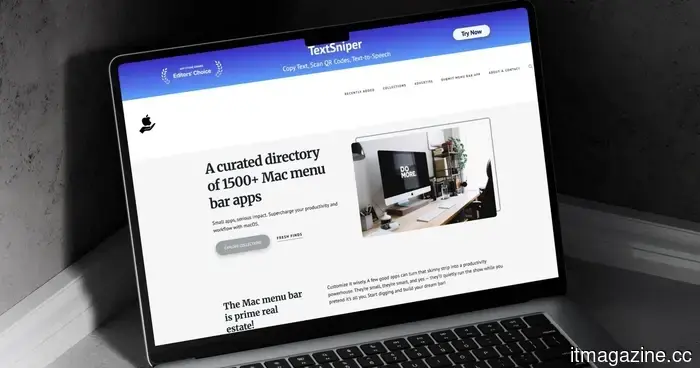 This website is a treasure trove for those who enjoy Mac menu bar applications.
MacMenuBar is a carefully organized directory featuring over 1,500 Mac menu bar applications, categorized into groups such as clipboard managers, timers, and window managers. Here's why you should consider bookmarking it.
This website is a treasure trove for those who enjoy Mac menu bar applications.
MacMenuBar is a carefully organized directory featuring over 1,500 Mac menu bar applications, categorized into groups such as clipboard managers, timers, and window managers. Here's why you should consider bookmarking it.
 This website is a treasure trove for those who enjoy Mac menu bar applications.
MacMenuBar is a carefully organized collection of over 1,500 Mac menu bar applications, classified into groups such as clipboard managers, timers, and window managers. Here's why you should consider bookmarking it.
This website is a treasure trove for those who enjoy Mac menu bar applications.
MacMenuBar is a carefully organized collection of over 1,500 Mac menu bar applications, classified into groups such as clipboard managers, timers, and window managers. Here's why you should consider bookmarking it.
 This Android malware is capable of monitoring your screen, accessing your messages, and remotely controlling your device.
A revised variant of the RedHook Android malware utilizes the built-in debugging feature of your phone to remotely control your device, bypassing the need for root access or a USB cable.
This Android malware is capable of monitoring your screen, accessing your messages, and remotely controlling your device.
A revised variant of the RedHook Android malware utilizes the built-in debugging feature of your phone to remotely control your device, bypassing the need for root access or a USB cable.
Huawei Digital Power now competes with Tesla's energy division in terms of revenue.
Huawei Digital Power recorded 68.7 billion yuan in 2025, an increase of 24%, bringing it close to Tesla’s energy division, which is valued at $12.8 billion.