
China's BrainCo believes that brain technology can be achieved through a headband rather than through surgical procedures.
The most prominent competition in brain-computer interfaces centers around surgical procedures. However, according to CNBC, one of China's leading neurotechnology companies is intentionally not participating in this area. Based in Hangzhou, BrainCo develops devices that can interpret brain signals from outside the skull. Their headbands and caps detect electrical signals through the scalp without the need for surgery.
BrainCo is recognized as part of Hangzhou's "six little dragons," a group of startups that embody the ambitions of China's tech sector. Established in 2015, the company emerged from the Harvard Innovation Labs.
What the company produces
BrainCo's clinical work is particularly noteworthy. Its bionic hands, which have received approval from the US FDA, interpret neural and muscular signals from amputees and translate intended movements into finger movements.
Beyond this, the product range extends into consumer markets. Their wearable technology includes a sleep aid that utilizes low-intensity electrical pulses to target neurochemicals linked to stress relief. This product strategy is a small-scale representation of their larger approach: demonstrate the technology’s efficacy in medicine, where benefits are clear, and then integrate the sensors into everyday products.
Two philosophies, two funding frameworks
In stark contrast, Neuralink, led by Elon Musk, involves the implantation of electrodes directly into brain tissue, which offers stronger signals but also entails significantly greater risks. The invasive nature of this field is evolving, with Paradromics having successfully implanted a brain chip in its first patient and Science Corp planning its own implantation. The sector is no longer solely dominated by one player.
China is pursuing both avenues, having already authorized the world’s first commercial brain implant. Non-invasive devices still make up approximately 82% of China's BCI market.
The funding landscape differs as well. In the US, neurotechnology is primarily funded by billionaires, while in China, there are seven government ministries involved, along with a national BCI strategy aimed at achieving key advancements by 2027. As a result, BrainCo has managed to raise about 2 billion yuan, around $280 million, co-led by IDG Capital, and has confidentially filed for a listing in Hong Kong.
A concerning aspect
Wearable devices reduce the medical risks but introduce a different set of concerns. While a brain implant cannot be casually distributed across a classroom, deploying a headband is entirely feasible. BrainCo is well aware of these nuances. In 2019, its Focus headbands were tested on students in a primary school in Zhejiang to measure attention levels for teachers, sparking significant backlash.
The local education authority suspended the trial. BrainCo clarified that the devices were used in school trials to enhance learning efficiency and had not been sold to any public institution.
This incident posed fundamental questions early on. Neural data is incredibly personal, and the most user-friendly technology is also the one most readily applied to individuals who may not have consented. Concerns like these are not new to the field; debates regarding the exciting versus alarming aspects of brain-computer interfaces have persisted for years. However, what is novel is the possibility of this technology being implemented without the oversight of a surgeon.
The undefined boundary
Some stakeholders in the industry advocate for a clear separation. Inbrain, a competitor to Neuralink, has pledged to limit brain implants strictly to healthcare applications, completely excluding consumer uses.
A wearable technology company, however, cannot make such assurances, as targeting the consumer market is fundamental to its mission. This is the compromise BrainCo has chosen, which is a logical decision for a business. Whether this choice is reasonable for the broader population relies on regulations that largely remain unestablished. While surgical procedures garner attention, it is the headband that is likely to find its way onto millions of heads.
Other articles
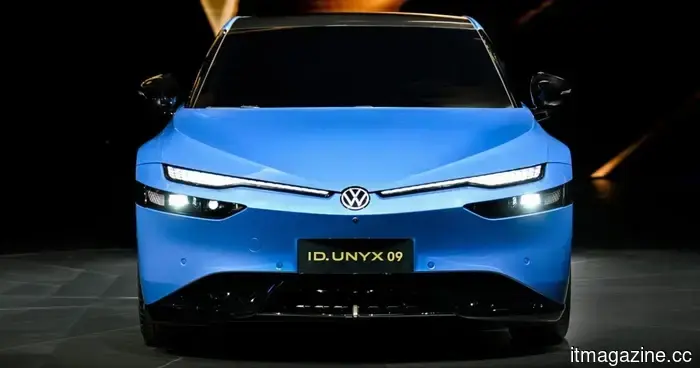 The ID. Unyx 09 from Volkswagen has just been leaked, and it's the type of electric vehicle I'm eager to see in the US.
It may be available for purchase in China in the second half of 2026, and the rest of the world is likely to be frustrated that it won't be released here.
The ID. Unyx 09 from Volkswagen has just been leaked, and it's the type of electric vehicle I'm eager to see in the US.
It may be available for purchase in China in the second half of 2026, and the rest of the world is likely to be frustrated that it won't be released here.
 Meta's strongest week since 2024 can be summed up in one word: compute.
Meta rose 6% on Friday and saw a 15% increase over the week following the announcement of Meta Compute, a strategy to offer AI computing resources to external clients.
Meta's strongest week since 2024 can be summed up in one word: compute.
Meta rose 6% on Friday and saw a 15% increase over the week following the announcement of Meta Compute, a strategy to offer AI computing resources to external clients.
 The competition in AI is no longer focused on having the largest model.
Businesses are selecting AI models based on the specific task, cost, and control rather than their ranking on benchmarks. The concept of 'good enough' is outperforming 'best', and the expenses highlight the reasoning behind this choice.
The competition in AI is no longer focused on having the largest model.
Businesses are selecting AI models based on the specific task, cost, and control rather than their ranking on benchmarks. The concept of 'good enough' is outperforming 'best', and the expenses highlight the reasoning behind this choice.
 The surge in gas power plants due to AI, and the struggle to prevent it.
AI data centers have triggered the most significant surge in gas plant construction to date. Clean energy proponents are unable to match this expansion, so they are targeting regulators instead.
The surge in gas power plants due to AI, and the struggle to prevent it.
AI data centers have triggered the most significant surge in gas plant construction to date. Clean energy proponents are unable to match this expansion, so they are targeting regulators instead.
 The demand for AI is 'boundless.' So why are the shares of semiconductor companies declining?
Executives assert that the demand for AI is limitless and their order books are filled for the next five years. Nevertheless, chip stocks continue to fluctuate. The issue lies in the disparity between expectations and actual demand.
The demand for AI is 'boundless.' So why are the shares of semiconductor companies declining?
Executives assert that the demand for AI is limitless and their order books are filled for the next five years. Nevertheless, chip stocks continue to fluctuate. The issue lies in the disparity between expectations and actual demand.
China's BrainCo believes that brain technology can be achieved through a headband rather than through surgical procedures.
BrainCo monitors brain activity via the scalp rather than using implants. This makes it easier to expand compared to Neuralink, but also more challenging to regulate.