

AI has already come into the hands of the wrong people, and they are utilizing it to create bombs.
Artificial intelligence has rapidly emerged as the preferred tool for a range of tasks, including composing emails, summarizing meetings, aiding students with study materials, and assisting developers in debugging code. However, the same technology that offers time-saving benefits can also be abused, as indicated by a new report revealing that terrorist groups are finding ways to exploit it.
A research paper shared with The New York Times before its official release reveals that Boko Haram members have been utilizing popular AI chatbots to facilitate both routine operations and activities related to combat. Interviews with 27 former members conducted in Nigeria over the last two years suggest that tools like ChatGPT, Gemini, Claude, Grok, Meta AI, and DeepSeek are being used to obtain technical information, troubleshoot weapons, and even plan attacks.
This issue isn't merely the actions of a few rogue individuals.
What raises particular concern is that this behavior isn't attributed to a handful of individuals experimenting with AI. The report indicates that the use of AI within the group has become systematic, featuring dedicated teams, internal training, and the sharing of knowledge among members. Researchers also noted that some users have found ways to circumvent safety measures meant to prevent AI from responding to violent requests.
Conversing with AI technology for customer service on the internet reveals a digital chatbot, a robot that generates responses, and serves as a virtual assistant.
However, this does not imply that current AI chatbots are dispensing harmful directives indiscriminately. Much of the research focuses on activities up to the end of 2024, and AI companies assert that their newer models incorporate stronger safeguards. They also emphasize that many requests may fall within morally ambiguous territory. For instance, querying an AI about how to fix a motorcycle or grasp fundamental chemistry is not inherently dangerous, despite the potential for similar information to be misapplied.
The ongoing challenge is to maintain a proactive stance.
OpenAI informed The New York Times that using ChatGPT to assist terrorism or violence contravenes its policies, and the company is continuously enhancing its protective measures against misuse. Meta similarly pointed out that the research largely involved outdated versions of its AI models and stated that it has since fortified its safety protocols. Meanwhile, xAI and DeepSeek did not respond to requests for comment, as per the report.
Security experts warn against assuming that AI suddenly grants terrorist organizations superhuman abilities. The logistics, funding, communication, and human coordination necessary for planning and executing attacks are still reliant on real-world processes that a chatbot cannot replace. Researchers believe it's more plausible that AI enhances the capabilities of less experienced members without significantly altering the overall threat landscape. Nonetheless, the report serves as a further reminder that the conversation around AI safety is not only about students cheating on assignments or people generating fake images. As AI models continue to advance and become more accessible, companies will face ongoing pressure to ensure that powerful tools remain beneficial for legitimate users and are increasingly difficult for malicious actors to misuse.
Shimul is a contributor at Digital Trends, boasting over five years of experience in the tech industry.
Researchers concealed a prompt injection within a PNG file, and the AI was deceived by it.
Coding assistants like Claude are becoming the preferred coworkers for developers. They can review code, elucidate confusing functions, and even create entire features with a single prompt. However, new research indicates that this growing trust could potentially become their greatest vulnerability. A group of security researchers (Professor Sudipta Chattopadhyay and researcher Murali Ediga) has showcased an unconventional attack that doesn’t directly target the AI model. Instead, it exploits aspects the AI overlooks during code reviews. Instead of embedding malicious instructions within lines of code, the researchers concealed them in an image file. Since many AI review tools regard images as decorative rather than content needing scrutiny, the pull request can appear harmless and pass through the review process.
Claude Code can now navigate the web without needing Chrome.
The desktop application now incorporates an in-app browser capable of reading websites, clicking links, and interacting with web applications.
Developers often find themselves switching back and forth between their code editor, browser tabs, API documentation, GitHub issues, and design files. Anthropic believes Claude Code should handle all these tasks without constantly prompting users to change windows. The company has introduced a new in-app browser for Claude Code on desktop, enabling its AI coding assistant to access websites, read documentation, review designs, and engage with web pages directly within the application.
Apple is suing OpenAI over the alleged theft of trade secrets in a high-profile lawsuit.
The lawsuit alleges that OpenAI recruited Apple employees and accessed confidential information regarding unreleased products.
For the last two years, Apple and OpenAI have been seen as close partners in AI development. ChatGPT powers essential features for Apple Intelligence, Siri can transfer complex queries to OpenAI, and together the companies have helped introduce generative AI to millions of Apple devices. Now, that partnership has taken a significant turn. What is Apple accusing OpenAI of?







Other articles
 Researchers concealed a prompt injection within a PNG, and the AI was deceived by it.
Recent security research indicates that a seemingly innocuous PNG image could deceive AI coding assistants into revealing sensitive information.
Researchers concealed a prompt injection within a PNG, and the AI was deceived by it.
Recent security research indicates that a seemingly innocuous PNG image could deceive AI coding assistants into revealing sensitive information.
 The appearance of an AI interviewer might be just as important as the choices it makes.
Candidates responded variably to the same AI hiring rejections based on the race and gender of the avatar, indicating that issues of fairness can originate from interface design even before the algorithm is reviewed.
The appearance of an AI interviewer might be just as important as the choices it makes.
Candidates responded variably to the same AI hiring rejections based on the race and gender of the avatar, indicating that issues of fairness can originate from interface design even before the algorithm is reviewed.
 Researchers concealed a prompt injection within a PNG file, and the AI was deceived by it.
Recent security research indicates that a seemingly innocent PNG image could trick AI coding assistants into revealing sensitive information.
Researchers concealed a prompt injection within a PNG file, and the AI was deceived by it.
Recent security research indicates that a seemingly innocent PNG image could trick AI coding assistants into revealing sensitive information.
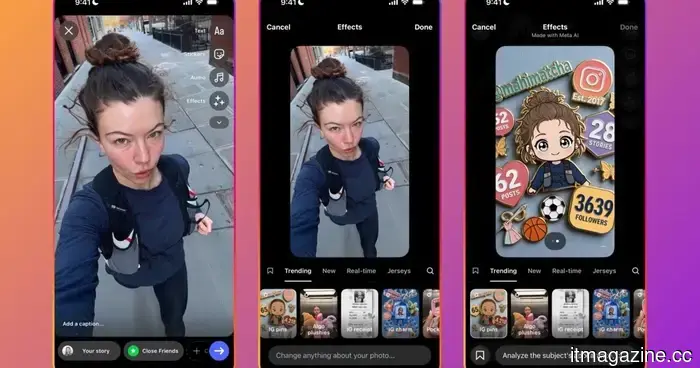 Meta has just removed its most contentious AI image generation feature only days after its debut.
Meta introduced a feature that allowed users to create AI images of public Instagram accounts, with the opt-in setting enabled by default, but then decided to retract it.
Meta has just removed its most contentious AI image generation feature only days after its debut.
Meta introduced a feature that allowed users to create AI images of public Instagram accounts, with the opt-in setting enabled by default, but then decided to retract it.
 You may choose to stop utilizing AI, but this recent report suggests that you are likely unable to avoid it.
A recent survey in the UK reveals that individuals are intentionally restricting their use of AI, despite the fact that many feel it has become challenging or even impossible to avoid exposure to AI.
You may choose to stop utilizing AI, but this recent report suggests that you are likely unable to avoid it.
A recent survey in the UK reveals that individuals are intentionally restricting their use of AI, despite the fact that many feel it has become challenging or even impossible to avoid exposure to AI.
 The new Play Store listing for Google’s Magic Pointer indicates a Gemini shortcut designed for Google Books.
The recently discovered Magic Pointer listing from Google shows a Gemini-powered cursor for Google Books; however, due to compatibility issues with Android devices, the feature is still in early preview and not available for consumer testing at this time.
The new Play Store listing for Google’s Magic Pointer indicates a Gemini shortcut designed for Google Books.
The recently discovered Magic Pointer listing from Google shows a Gemini-powered cursor for Google Books; however, due to compatibility issues with Android devices, the feature is still in early preview and not available for consumer testing at this time.
AI has already come into the hands of the wrong people, and they are utilizing it to create bombs.
Researchers indicate that widely-used AI tools have been allegedly exploited by terrorist organizations, even with existing safeguards, showcasing the troubling aspects of generative AI.