
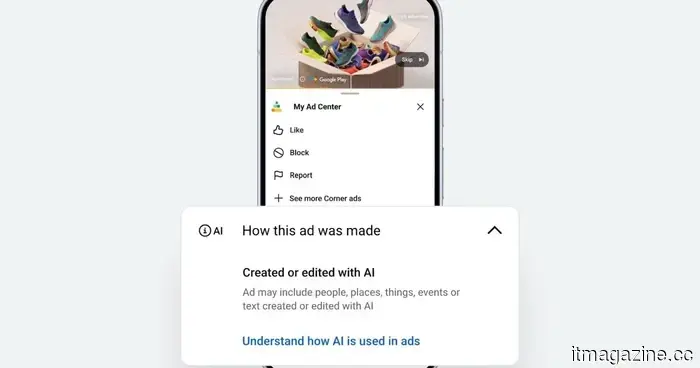
You can now verify whether a Google ad was created with AI.
Google will automatically label its own AI ads, but ads generated by third-party AI tools still depend on advertisers to disclose that information.
Have you ever seen an ad and questioned whether it was created by a real person or generated by AI in mere seconds? Google has now provided a way for you to discover the answer.
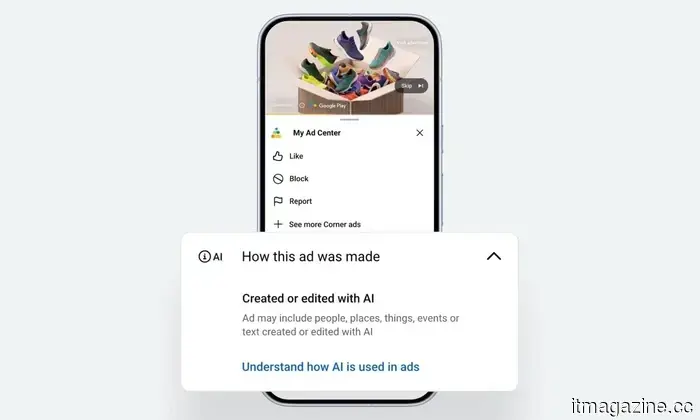
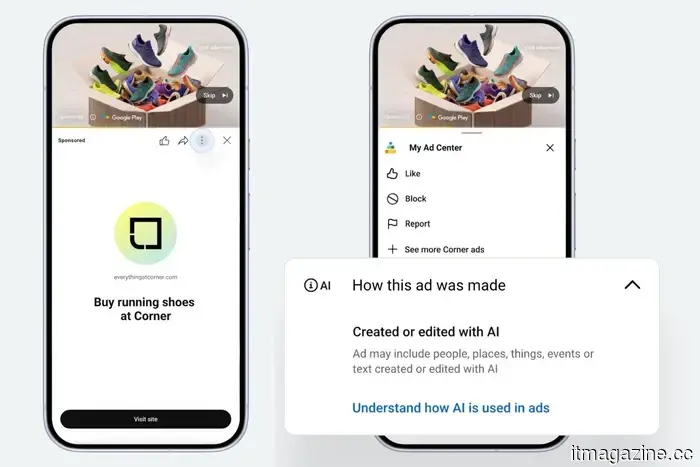
The company recently introduced a new AI transparency label indicating whether an ad was created or modified using generative AI tools. This label can be found in Google’s My Ad Center and is being rolled out globally on Google Search, YouTube, and Discover.
How can you locate the AI label on Google ads?
It's easy to find. Simply tap the three-dot menu or the info button on any ad, and you will see a section titled “How this ad was made.” If AI was involved in the ad’s creation, you may see a label that says “Created or edited with AI.”
For ads made with Google's own generative AI advertising tools, the label will be applied automatically, so you won't need to rely on the advertiser for that information. However, if an advertiser utilizes a third-party AI tool, they can choose to disclose that information manually through My Ad Center. In some regions, local regulations might also necessitate that AI labels appear directly on the ads.
What is the reason behind Google's addition of AI labels?
As AI-generated images and videos become increasingly realistic, distinguishing how advertising content was created is becoming more challenging. Google states that these new labels aim to provide greater transparency for users, while also assisting advertisers in keeping up with the changing industry standards.
The company has already implemented disclosures for digitally altered political ads and has enhanced support for technologies such as SynthID, which powers AI image watermarks in Google Photos, as well as C2PA, a standard that Google is integrating into Google Messages to identify AI-generated images in chats.
In addition, Google is experimenting with ways to display AI-generated image labels directly in Google Search and has enhanced Gemini's capability to assist users in recognizing AI-generated videos. The new ad labels further these initiatives by introducing similar transparency to commercial advertising.
Manisha Priyadarshini is a tech and entertainment writer with over nine years of editorial experience.
Your Google AI Studio apps can finally have polished, presentable web links
AI Studio web apps can now utilize personalized subdomains.
Google AI Studio has made the process of building a web app surprisingly simple. You can outline your requirements, fine-tune the design through prompts, and publish the end result without needing a traditional development environment. However, there's often a frustrating aspect after deployment when the completed app still resides behind a lengthy, forgettable Cloud Run link.
Google is addressing that final hurdle. AI Studio now allows you to assign a deployed web app a custom address under the “ai.studio” domain, like “your-app-name.ai.studio.” A recognizable URL will enhance the project's appearance in a portfolio, client demonstration, social media post, or internal project page.
Read more
Outlook will soon alert you before replying to an outdated email
Microsoft is introducing reply notifications, rule-based templates, and better categories to Outlook.
Microsoft has been working on resolving some long-standing issues within Windows 11, including aspects of the Start menu and Search. According to a report from Windows Latest, the company is also preparing several valuable updates for the new Outlook app on Windows 10 and Windows 11, which became widely available in 2024.
Microsoft will implement a warning for users who attempt to reply to an older email when a newer response has already been received in the same conversation. This alert aims to prevent users from responding without considering the latest information within the thread.
Read more
Google has recently altered how it evaluates the AI models utilized for Android coding.
Android Bench has introduced a new testing framework and eight new models, resulting in updated rankings.
Google has revised its assessment of which AI models excel at generating Android app code, leading to a shake-up in the rankings that developers refer to when selecting their tools. The company's Android Bench leaderboard, launched in March, now operates on a new testing system called Harbor. Google states that this replaces the older, more general testing tool previously employed and provides a clearer understanding of how models perform on actual Android tasks, such as updating legacy code to Jetpack Compose or managing networking for wearable devices.
New models are reshuffling the top rankings.
Read more


Other articles
 Mercor aims for a $20 billion valuation and acquires Deeptune.
Mercor is negotiating to increase its valuation to $20 billion and has acquired Deeptune, an AI-training startup supported by its own CEO. The details are in the footnotes.
Mercor aims for a $20 billion valuation and acquires Deeptune.
Mercor is negotiating to increase its valuation to $20 billion and has acquired Deeptune, an AI-training startup supported by its own CEO. The details are in the footnotes.
 Facewatch will notify UK police within seconds if you are flagged.
Facewatch will soon notify the police within approximately four seconds when a flagged customer enters a store in the UK. Civil liberties organizations describe this as a "dangerous escalation."
Facewatch will notify UK police within seconds if you are flagged.
Facewatch will soon notify the police within approximately four seconds when a flagged customer enters a store in the UK. Civil liberties organizations describe this as a "dangerous escalation."
 A recent leak regarding the Galaxy Z Fold 8 indicates that consumers in the US should anticipate a price increase.
A recent leak indicates that the Galaxy Z Fold 8 Ultra may have a price increase of $100 in the US, aligning with an already anticipated price rise for Europe.
A recent leak regarding the Galaxy Z Fold 8 indicates that consumers in the US should anticipate a price increase.
A recent leak indicates that the Galaxy Z Fold 8 Ultra may have a price increase of $100 in the US, aligning with an already anticipated price rise for Europe.
 The Prime Minister of Malaysia is initiating the development of an AI version of himself.
Anwar Ibrahim's administration is set to introduce PMX AI, an interactive avatar modeled on his speeches, designed to communicate in his style and guide citizens through government services.
MiniMax secures $2 billion as its CEO waives salary until AGI is achieved.
MiniMax is seeking to raise as much as $2 billion following an 80% decline, with founder Yan Junjie declaring he will forgo his salary until artificial general intelligence (AGI) is achieved and promising 5% of his shares to employees and for open-source initiatives.
The Prime Minister of Malaysia is initiating the development of an AI version of himself.
Anwar Ibrahim's administration is set to introduce PMX AI, an interactive avatar modeled on his speeches, designed to communicate in his style and guide citizens through government services.
MiniMax secures $2 billion as its CEO waives salary until AGI is achieved.
MiniMax is seeking to raise as much as $2 billion following an 80% decline, with founder Yan Junjie declaring he will forgo his salary until artificial general intelligence (AGI) is achieved and promising 5% of his shares to employees and for open-source initiatives.
 The debt of Big Tech in relation to AI has reached $350 billion and is making its way to Europe.
Alphabet, Amazon, Meta, Microsoft, and Oracle have increased their debt to $350 billion to invest in AI, and are currently entering European bond markets, starting with France.
The debt of Big Tech in relation to AI has reached $350 billion and is making its way to Europe.
Alphabet, Amazon, Meta, Microsoft, and Oracle have increased their debt to $350 billion to invest in AI, and are currently entering European bond markets, starting with France.
You can now verify whether a Google ad was created with AI.
Google is introducing an AI transparency label for advertisements on Search, YouTube, and Discover, allowing you to verify whether an ad was created using generative AI.