
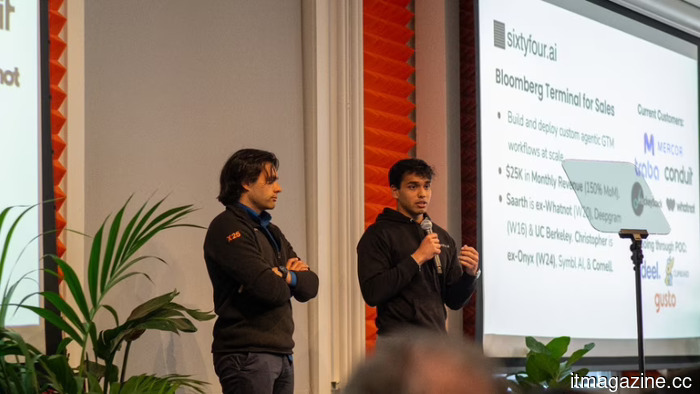
The Eval Stack: Demonstrating that the agents are correct rather than asserting it.
Most AI research tools direct a language model to the web and rely on the output without questioning it. In contrast, Saarth Shah developed Sixtyfour with a different approach: evaluate everything and only release what enhances the score.
Saarth Shah maintains a scoreboard where each version of Sixtyfour's research agents is assessed against questions created manually by experts and verified against real-world cases, across various sectors. The grade solely determines what gets launched. This rigorous oversight is why a payments company chooses his software over a human analyst to determine the authenticity of a stranger.
Typically, AI research tools take a shortcut by directing a language model to the open web, querying it, and allowing it to generate responses. While the output is coherent, Shah focused early on its accuracy and the means to verify it.
For a time, the industry attributed the issue of inaccuracies—known as hallucination—to models fabricating facts and sources. While that challenge is valid and gradually improving—frontier models exhibit fewer hallucinations than a year ago, especially with live web searches—the limitation that concerns Shah is the model's scope.
A language model equipped with a search box only accesses information visible to someone using a browser and nothing beyond that. The key facts in an investigation often lie beneath the surface, hidden in licensed and proprietary records, unindexed documents, and the complex networks designed to obscure fraud. Conventional surface research fails to reach these depths.
"The models improve continually, yet they still can only access what a browser user can view," Shah remarked. "The answers crucial to this work reside several levels deeper, and one must actively seek them out."
Approximately 96 percent of enterprises currently utilize AI agents, highlighting the need to bridge the gap between a system that provides answers and one that delivers accurate responses—now a central issue in production AI. Even the most advanced models struggle with realistic, long-term professional tasks, where a single mistake can derail the outcome. Shah recognized long ago, even before benchmarks validated the idea, that capability and reliability are distinct attributes, with the latter requiring intentional engineering.
What he has created is a uniquely structured system. Sixtyfour’s agents navigate between two inadequate options: outdated static databases and general models that improvise. Each investigation combines live web research, public records, legal filings, open-source intelligence, and licensed data, compiling everything into a report that links every claim back to its source. Nothing is claimed without being traceable to a document, adhering to the type of evidentiary standards expected in court.
In practice, a single query expands into multiple inquiries. If Sixtyfour is asked to verify a seller, its agents gather corporate filings, cross-reference addresses and officers, check sanctions and litigation records, and search the live web for the actual business footprint. When a lead emerges, the agent follows it, accumulating context until it can resolve the inquiry rather than stopping at the first seemingly reasonable answer. The output is a dossier where each statement connects to the underlying document, allowing a reviewer to scrutinize the machine’s reasoning instead of just accepting it.
What Shah takes the most pride in is often overlooked by other companies. For every domain his agents cover, he devised evaluation systems that assess their output against known answers, enabling the company to substantiate its accuracy rather than merely stating it in marketing materials. Additionally, they do not release any product improvements without demonstrable enhancements in the evaluation system. They continuously raise the benchmark using real-world samples, striving to push the boundaries further.
"Every answer must demonstrate its reasoning," Shah stated. "If we can't reference the filing or record, we won't release the answer. The citation is the essence, not a mere embellishment."
Creating those evaluations represented a significant portion of the effort needed to achieve global excellence, with the toughest challenge being the truth itself. Existing data vendors often fall short as reliable sources, as their information tends to be outdated or insufficiently detailed. Consequently, to properly grade an agent on genuinely complex cases, Sixtyfour sometimes identifies the answer through thorough human investigation and then formulates it as a test that the agents must successfully navigate. The goal is to match, and eventually surpass, the best investigators, thereby setting evaluation standards that no single reviewer could achieve alone.
The discipline is rigorous. Every new tool the team incorporates is tested against the evaluation set before deployment, and if a promising addition lowers the score, it is removed. While a competitor might replicate an architecture diagram in a day, it cannot duplicate years of graded performance from production systems and the nuances that drive the AI agents to excel.
This is why Sixtyfour leads the recon benchmark, outpacing systems from many larger laboratories.
Competitors prioritize different metrics. For instance, Parallel, a web research company, focuses on lengthy, in-depth answers, while Exa develops embedding-based semantic search geared towards discovery rather than validation. Sixtyfour, however, measures something more specific and challenging: whether a particular assertion about a specific entity is verifi
Other articles
 1X's NEO robot is equipped with hands capable of sensing when a glass is slipping.
The NEO home robot from 1X features new tendon-driven hands that offer 25 degrees of freedom and tactile skin. It can easily detect a slipping glass, but performing actual tasks remains challenging.
1X's NEO robot is equipped with hands capable of sensing when a glass is slipping.
The NEO home robot from 1X features new tendon-driven hands that offer 25 degrees of freedom and tactile skin. It can easily detect a slipping glass, but performing actual tasks remains challenging.
 Disney+ is considering a free tier as a strategy to counter YouTube's increasing influence in the TV market.
Disney is in the initial stages of talks regarding the possibility of offering some Disney+ content for free, as YouTube's increasing share of television viewership is pressuring paid streaming services to adjust.
Disney+ is considering a free tier as a strategy to counter YouTube's increasing influence in the TV market.
Disney is in the initial stages of talks regarding the possibility of offering some Disney+ content for free, as YouTube's increasing share of television viewership is pressuring paid streaming services to adjust.
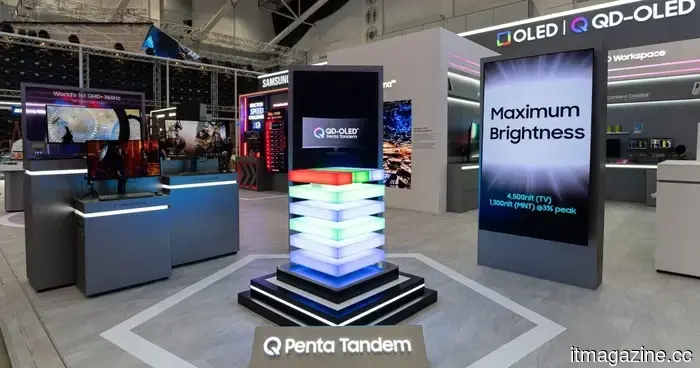 Samsung has introduced a new line of OBLYX OLED panels, set to debut in your gaming laptops shortly.
Samsung Display has launched OBLYX, its inaugural brand for OLED gaming laptops, aiming to take advantage of the swiftly increasing demand for high-end gaming screens, especially in China.
Samsung has introduced a new line of OBLYX OLED panels, set to debut in your gaming laptops shortly.
Samsung Display has launched OBLYX, its inaugural brand for OLED gaming laptops, aiming to take advantage of the swiftly increasing demand for high-end gaming screens, especially in China.
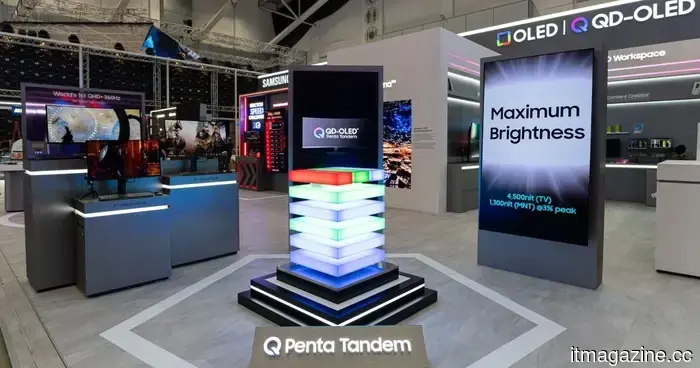 Samsung is introducing a new type of OBLYX OLED panels, which are expected to be available in gaming laptops shortly.
Samsung Display has launched OBLYX, marking its inaugural OLED gaming laptop brand, as it aims to take advantage of the swiftly increasing demand for high-end gaming displays, especially in China.
Samsung is introducing a new type of OBLYX OLED panels, which are expected to be available in gaming laptops shortly.
Samsung Display has launched OBLYX, marking its inaugural OLED gaming laptop brand, as it aims to take advantage of the swiftly increasing demand for high-end gaming displays, especially in China.
 What features define the optimal stablecoin payment solution?
A comprehensive guide to assessing stablecoin payment solutions for businesses, focusing on aspects such as acceptance, settlement, compliance, payouts, and API integration for e-commerce, SaaS, marketplaces, and international operations.
What features define the optimal stablecoin payment solution?
A comprehensive guide to assessing stablecoin payment solutions for businesses, focusing on aspects such as acceptance, settlement, compliance, payouts, and API integration for e-commerce, SaaS, marketplaces, and international operations.
 Tingyu Su emphasizes the importance of considering the founding designer as a strategic hire right from the beginning of the company's development for AI startups.
Tingyu Su, the founding designer of the healthcare AI startup Youlify, points out that as AI simplifies software development, the role of the founding designer becomes essential. This individual plays a vital strategic role by linking product development, branding, and customer experience right from the start.
Tingyu Su emphasizes the importance of considering the founding designer as a strategic hire right from the beginning of the company's development for AI startups.
Tingyu Su, the founding designer of the healthcare AI startup Youlify, points out that as AI simplifies software development, the role of the founding designer becomes essential. This individual plays a vital strategic role by linking product development, branding, and customer experience right from the start.
The Eval Stack: Demonstrating that the agents are correct rather than asserting it.
Sixtyfour CEO Saarth Shah discusses how his company developed AI research agents based on strict evaluation systems instead of just focusing on the fluency of language models. This approach involved creating a verification framework that demonstrates accuracy through graded benchmarks and referenced sources.