

SAP avoids an EU antitrust penalty by expanding its support market.
SAP has managed to avoid an EU antitrust fine. The European Commission announced it would accept a series of commitments from the German software company, concluding an investigation into SAP’s handling of maintenance and support for its on-premise enterprise software, thus avoiding a potential penalty that could have amounted to billions. This type of negotiated resolution has become Brussels’ preferred approach in complicated tech cases.
The investigation began in September 2025, when regulators initiated a probe over concerns that SAP’s practices hindered competition in the aftermarket for software maintenance and support.
The concern is a common one in enterprise software: once a customer is dependent on a core system, the conditions for keeping it operational can effectively exclude rival providers who might offer more affordable or superior support.
Instead of engaging in a legal battle, SAP opted for a set of concessions. The company committed to providing an alternative method for calculating the license fees on which maintenance and service charges are based, a crucial change that influences how customers are priced into remaining with the service.
Additionally, SAP agreed to eliminate reinstatement fees and reduce back-maintenance charges for customers who choose to leave and later return. These fees often create hurdles that make switching support providers too costly, which was exactly what regulators objected to.
Moreover, a further commitment allows customers to terminate their licenses under specific conditions, such as insolvency or bankruptcy, giving struggling businesses an option they previously lacked. Collectively, these measures are intended to genuinely facilitate exiting, pausing, or switching SAP support rather than simply maintaining the status quo.
These commitments will be applied globally and will last for ten years, marking an unusually expansive and long-term undertaking that transforms a European agreement into a worldwide change in how SAP regards its customers. For a company with a customer base that includes many of the world’s major enterprises, the extent of this change is as significant as its implications.
This outcome aligns with a recent trend in the Commission’s enforcement actions. Instead of pursuing lengthy litigation processes leading to fines and appeals, Brussels has been increasingly utilizing commitment decisions to prompt rapid behavioral changes, a strategy observed in its investigations of hardware and medtech markets ranging from chips to dental aligners.
By settling, the company avoids a fine and a formal admission of wrongdoing, while the regulator secures enforceable commitments without the delays associated with a full case.
For SAP, the decision is clear-cut. A fine would have been a one-time expense, but an official infringement ruling would have provided customers and competitors with leverage for years.
Agreeing to the commitments eliminates the legal uncertainty while allowing the company to present its changes as a customer-centric initiative rather than a concession.
However, these concessions do come with costs. Making it easier to exit and cheaper to return diminishes the steady maintenance revenue that has historically been a reliable aspect of SAP’s business. The actual extent to which this loosens customers' ties will depend on whether third-party support providers can now compete on previously unfavorable terms.
There is also a strategic angle to consider. SAP has been working for years to transition customers from on-premise systems to its cloud subscriptions, and the aftermarket scrutinized by the Commission is linked to the older, installed-software landscape the company is attempting to move away from. Easing restrictions on legacy support is more manageable when the focus is on a different future.
The settlement leaves an unanswered question: While the Commission has redefined the rules for the aftermarket on paper, whether customers will take advantage of their newfound flexibility or continue to stick with established habits remains to be seen in the coming decade. For now, SAP retains its finances, its market position, and a ten-year commitment to comply.
Other articles
 Fraimic's E Ink art frame creates artwork based on your voice and does so in a stunning manner.
Fraimic's voice-to-art E Ink canvas allows you to vocalize a prompt, create AI-generated artwork using GPT Image 2.0, and showcase it in a paper-like Spectra 6 frame, all without needing a subscription.
Fraimic's E Ink art frame creates artwork based on your voice and does so in a stunning manner.
Fraimic's voice-to-art E Ink canvas allows you to vocalize a prompt, create AI-generated artwork using GPT Image 2.0, and showcase it in a paper-like Spectra 6 frame, all without needing a subscription.
 The UN's digital agency has introduced a program aimed at ensuring the reliability of AI agents.
The ITU is establishing a focus group aimed at ensuring AI agents remain identifiable and under human oversight, which was initiated at the AI for Good Summit held in Geneva.
The UN's digital agency has introduced a program aimed at ensuring the reliability of AI agents.
The ITU is establishing a focus group aimed at ensuring AI agents remain identifiable and under human oversight, which was initiated at the AI for Good Summit held in Geneva.
 Fidji Simo resigns from her position as the second-in-command at OpenAI.
Fidji Simo, the applications chief at OpenAI, is transitioning to a part-time advisory position after a chronic illness has worsened while she was on medical leave.
Fidji Simo resigns from her position as the second-in-command at OpenAI.
Fidji Simo, the applications chief at OpenAI, is transitioning to a part-time advisory position after a chronic illness has worsened while she was on medical leave.
 GIGABYTE delights gamers with a new WOLED monitor.
The company GIGABYTE, which usually keeps hardware enthusiasts entertained, has announced the launch of its new gaming monitor GO27Q24G. This 27-inch beauty is frameless and aims to fulfill all the needs of the modern esports player.
GIGABYTE delights gamers with a new WOLED monitor.
The company GIGABYTE, which usually keeps hardware enthusiasts entertained, has announced the launch of its new gaming monitor GO27Q24G. This 27-inch beauty is frameless and aims to fulfill all the needs of the modern esports player.
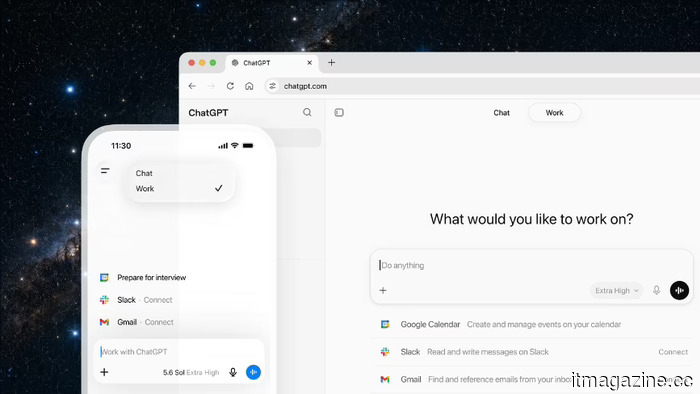 OpenAI introduces ChatGPT Work, an agent designed to complete tasks.
OpenAI has introduced ChatGPT Work, an agent powered by GPT-5.6 that interacts with your applications and files, executes scheduled tasks, and can remain engaged with a project for extended periods.
OpenAI introduces ChatGPT Work, an agent designed to complete tasks.
OpenAI has introduced ChatGPT Work, an agent powered by GPT-5.6 that interacts with your applications and files, executes scheduled tasks, and can remain engaged with a project for extended periods.
 Fidji Simo resigns from her position as the second-in-command at OpenAI.
Fidji Simo, the head of applications at OpenAI, is transitioning to a part-time advisory position following a worsening of a chronic illness during her medical leave.
Fidji Simo resigns from her position as the second-in-command at OpenAI.
Fidji Simo, the head of applications at OpenAI, is transitioning to a part-time advisory position following a worsening of a chronic illness during her medical leave.
SAP avoids an EU antitrust penalty by expanding its support market.
The European Commission has approved SAP’s pledges to facilitate customer transitions or the termination of support contracts, thereby concluding an antitrust investigation without imposing a penalty.