
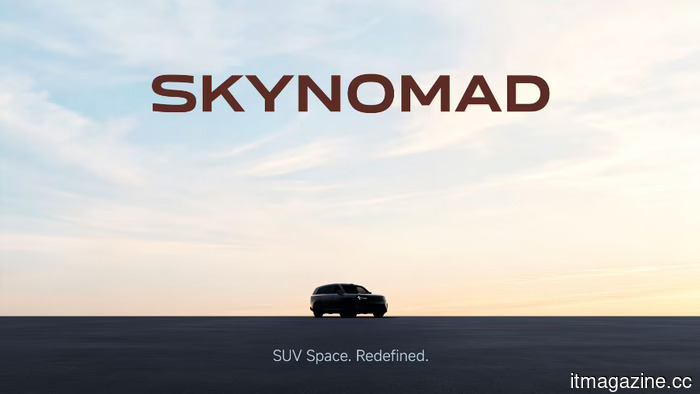
Xiaomi introduces Sky Nomad, a square-shaped SUV lineup targeting the family vehicle market in China.
Xiaomi has expanded its venture into the automotive industry, announcing on Thursday a new SUV series named Sky Nomad and giving the first detailed look at the boxy vehicle that will spearhead this series.
This initiative places the smartphone manufacturer firmly in China’s most profitable vehicle segment, distancing it from the sporty image associated with its SU7 and YU7 models. The electric vehicle division of the company described Sky Nomad as its second product line following the SU7/YU7 range, branding it an “intelligent, transformable large-space SUV.” In China, this series will be marketed under the name Xiaomi Pengcheng.
Founder and CEO Lei Jun clearly differentiated between the two ranges, characterizing the SU7 and YU7 as “driver’s cars” while positioning Sky Nomad as a mobile living space. He mentioned that the vehicle should adapt to the needs of its owners, transforming when parked into “a studio for one, a café for two, a reception room for three, or a playground for the entire family.”
Lei indicated that the new lineup had been refined over three and a half years using the Xiaomi Kunlun platform, which the company began developing from scratch in early 2023. He added that the vehicle’s flat floor and long-rail seating allow for interior reconfiguration.
The first model, internally codenamed Kunlun N3 and anticipated to hit showrooms as the N90, is a full-size SUV measuring over 5.3 meters in length with a 3.1-meter wheelbase. Unlike Xiaomi's previous cars, it is not purely battery-electric; rather, the N90 is an extended-range electric vehicle that employs a 1.5-liter turbocharged engine solely as a generator, with the wheels never driven by this engine. Equipped with a battery pack exceeding 70 kWh, it offers an electric-only range of 400 to 500 km and a total range of over 1,500 km, according to reports from Chinese and specialized outlets.
The design significantly diverges from Xiaomi’s sleek sedans, featuring a robust, upright profile, a roof-mounted lidar unit, and electrically deployed door steps. It is expected to come in five- and seven-seat configurations, with the seven-seater reportedly including a built-in rooftop tent aimed at catering to China’s rapidly growing camping market.
Pricing has yet to be officially announced, but estimates suggest it could start as low as 200,000 yuan (approximately $29,400), as reported by the Chinese outlet 21jingji. This price point would undercut both the Li Auto L9 and the Huawei-backed Aito M9, which are priced above 250,000 yuan and currently dominate the extended-range market, accounting for seven of the ten best-selling models last year.
The timing of this launch is strategic, as China’s Ministry of Industry and Information Technology authorized Xiaomi to manufacture extended-range vehicles at its Beijing facility on June 10, eliminating the last regulatory barrier for a previously battery-electric-only manufacturer.
Xiaomi is eager for this new line to achieve sales quickly, setting a delivery target of 550,000 vehicles by 2026—about a 34% increase from the 410,000 delivered last year. However, it only delivered 185,055 cars in the first half of the year, achieving roughly a third of that target. To meet this goal, it would need to average more than 60,000 deliveries per month for the remainder of the year, a pace it has yet to maintain.
Chinese electric cars have begun gaining traction beyond the mainland, with enthusiastic reviews of models from BYD, Xiaomi, and Zeekr circulating on US social media despite high import tariffs. However, in the domestic market, competition in the family SUV sector is where profit margins lie, a space Xiaomi has so far ceded to its competitors.
It remains unclear whether Sky Nomad will function as an independent sub-brand or simply a new series, with Lei not providing a definitive statement on the matter. Meanwhile, the company continues to introduce added convenience features for existing owners, including a robotic charging arm for home garages, and announced that the SUV will launch “soon” in the upcoming second half of the year.
Other articles
 Criterion mentions that Burnout hasn't been overlooked, but that's precisely what concerns me.
Criterion states that Burnout is still a key aspect of the studio's identity, yet Battlefield represents its future. Although this decision is quite logical in light of Battlefield 6's success, it also underscores the scarcity of genuine arcade racing games in the current landscape.
Criterion mentions that Burnout hasn't been overlooked, but that's precisely what concerns me.
Criterion states that Burnout is still a key aspect of the studio's identity, yet Battlefield represents its future. Although this decision is quite logical in light of Battlefield 6's success, it also underscores the scarcity of genuine arcade racing games in the current landscape.
 A survey reveals that fifty percent of parents are concerned that their children depend excessively on AI.
A Deloitte survey conducted with 1,150 parents regarding back-to-school concerns reveals that half of them are worried their child depends too heavily on AI, while many also believe schools do not teach enough AI skills.
A survey reveals that fifty percent of parents are concerned that their children depend excessively on AI.
A Deloitte survey conducted with 1,150 parents regarding back-to-school concerns reveals that half of them are worried their child depends too heavily on AI, while many also believe schools do not teach enough AI skills.
 My top choice for a multiplayer survival sandbox is finally receiving the mobile version it truly deserves.
Don’t Starve Together will be available on mobile starting July 21, offering players a mobile option to survive The Constant alongside friends.
My top choice for a multiplayer survival sandbox is finally receiving the mobile version it truly deserves.
Don’t Starve Together will be available on mobile starting July 21, offering players a mobile option to survive The Constant alongside friends.
 Spotify has finally allowed users to pin more than four items in their library, a change that has been a long time coming.
Spotify's library pin limit had been fixed at four for many years. It has now been increased to 20, making it the most generous pin limit among the leading music streaming services.
Spotify has finally allowed users to pin more than four items in their library, a change that has been a long time coming.
Spotify's library pin limit had been fixed at four for many years. It has now been increased to 20, making it the most generous pin limit among the leading music streaming services.
 Revolut appoints former Chase UK chief Kuba Fast to head its European banking operations.
Revolut has appointed Kuba Fast, the former head of Chase UK, as the CEO of Revolut Bank UAB and its European operations, taking over from Joe Heneghan.
Revolut appoints former Chase UK chief Kuba Fast to head its European banking operations.
Revolut has appointed Kuba Fast, the former head of Chase UK, as the CEO of Revolut Bank UAB and its European operations, taking over from Joe Heneghan.
 Sonos experiences a loss of ten years' worth of design expertise as layoffs affect its upper management.
Sonos has let go of senior design and product leaders who have been with the company for ten years or longer, in what the CEO describes as a move for greater speed, while some employees refer to it as a cost-cutting measure.
Sonos experiences a loss of ten years' worth of design expertise as layoffs affect its upper management.
Sonos has let go of senior design and product leaders who have been with the company for ten years or longer, in what the CEO describes as a move for greater speed, while some employees refer to it as a cost-cutting measure.
Xiaomi introduces Sky Nomad, a square-shaped SUV lineup targeting the family vehicle market in China.
Xiaomi has announced the Sky Nomad, a new SUV series that features an extended-range N90 equipped with a rooftop tent, aiming to compete with Li Auto and Aito in the Chinese market.