
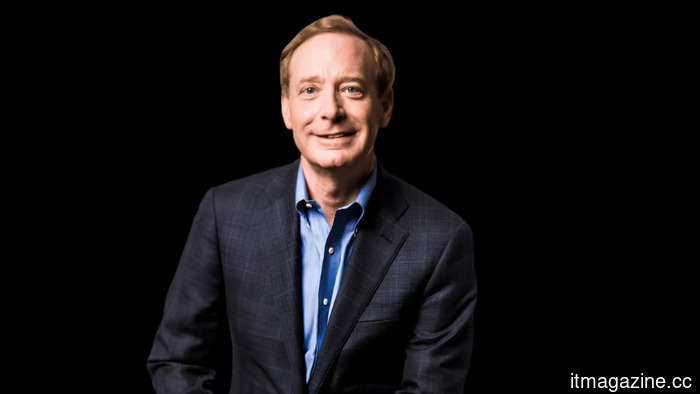
Brad Smith: the United States oversees AI without defined regulations.
Microsoft president Brad Smith states that the US is currently regulating AI without a clear framework of rules. He cautions that this ambiguity poses a problem for the entire industry. He made these comments to Fortune during the AI for Good Global Summit.
“What we currently have is regulation without transparent or comprehensive guidelines,” Smith noted. “In the absence of rules, businesses are unable to strategize.”
His concerns arise after two sudden actions taken by the Trump administration. Last month, the Commerce Department invoked export-control laws to restrict Anthropic’s Fable 5 and Mythos 5 models globally, citing cybersecurity risks. Shortly thereafter, officials urged OpenAI to postpone the public release of its GPT-5.6 family, granting early access solely to government-approved partners.
Both restrictions have since been relaxed. Fable 5 was reinstated this month, and GPT-5.6 is now being made available to the public. Smith acknowledges that Washington was justified in addressing the Fable issue but believes the regulatory approach it adopted was flawed.
“The government received information indicating an urgent cybersecurity threat. When it receives such information, I believe it is appropriate to take action,” he said. “However, it only had one regulatory mechanism at its disposal: an export control.” Legal experts argue that these controls were established before the advent of API-served models, raising questions about their viability in a court of law.
Critics argue that the outcome resembles a licensing system without any legislative backing. A June executive order initiated a voluntary pre-release review but did not establish formal approval guidelines. The government has yet to disclose who qualifies as a “trusted partner” or which models will be subject to scrutiny next.
“The government lacks the necessary tools,” Smith stated. “Common sense dictates not to be overly aggressive, but there should be enough sensitivity to take appropriate actions.”
The situation involving Anthropic has also sparked discussions about sovereign AI—the effort by governments to control the models and their underlying infrastructure. In Europe, a French politician compared the shutdown to a blockade of the Strait of Hormuz, while Canadian Prime Minister Mark Carney remarked that it served as a lesson about relying on too few providers.
Smith believes that people have misinterpreted the export action as an attempt to isolate foreign entities. He clarifies that the aim was to remove the model from the market entirely. “They requested Anthropic to withdraw Fable, but when Anthropic refused, they resorted to export controls to enforce it, both domestically and internationally,” he explained.
Regardless, he emphasizes that the responsibility now lies with Washington and US companies to demonstrate that their systems are reliable. “Consumers will only purchase what we offer if they are assured of a consistent supply,” he noted. Salesforce CEO Marc Benioff expressed a contrary view at the same event, stating he felt "good" about the block and believed Europe misunderstood a security measure as an act of aggression.
The significance of this situation highlights the considerable influence the US currently possesses over which AI models can be distributed globally. However, it has hardly formalized any of this authority. For a business that markets AI on an international scale, this lack of visible guidelines is an even greater concern. While one can debate regulations, dealing with invisible policies poses a much greater challenge for planning.
Other articles
 The Halide 3.1 update introduces improved photo straightening, a warmer appearance, and enhanced focus tapping features.
Halide 3.1 introduces perspective correction, a fresh Scarlet color look, raw-only shooting capability, and improved focus taps, arriving just six weeks after the release of Mark III.
The Halide 3.1 update introduces improved photo straightening, a warmer appearance, and enhanced focus tapping features.
Halide 3.1 introduces perspective correction, a fresh Scarlet color look, raw-only shooting capability, and improved focus taps, arriving just six weeks after the release of Mark III.
 The reliance of Britain on US cloud services has become a billion-pound risk.
Almost all public organizations in the UK rely on US hyperscale companies, consolidating billions of pounds and essential services within systems that Whitehall cannot entirely monitor.
The reliance of Britain on US cloud services has become a billion-pound risk.
Almost all public organizations in the UK rely on US hyperscale companies, consolidating billions of pounds and essential services within systems that Whitehall cannot entirely monitor.
 Your dog has the ability to run, but Fi’s new tracker, supported by Starlink satellites, ensures you can always locate them.
Fi Ultra employs Starlink satellite connectivity to ensure that lost dogs remain traceable outside of cellular coverage, reducing the likelihood of adventurous pups disappearing without a trace.
Your dog has the ability to run, but Fi’s new tracker, supported by Starlink satellites, ensures you can always locate them.
Fi Ultra employs Starlink satellite connectivity to ensure that lost dogs remain traceable outside of cellular coverage, reducing the likelihood of adventurous pups disappearing without a trace.
 Databento secures $97 million to compete with Bloomberg's terminal.
Market data startup Databento has secured $97 million in a Series B funding round led by NEA, expanding its challenge against the Bloomberg terminal into Europe, APAC, and AI laboratories.
Databento secures $97 million to compete with Bloomberg's terminal.
Market data startup Databento has secured $97 million in a Series B funding round led by NEA, expanding its challenge against the Bloomberg terminal into Europe, APAC, and AI laboratories.
 New EU regulations require all cars to be equipped with a driver-monitoring camera.
The second-phase vehicle safety regulations of the EU require all new cars and vans to be equipped with driver-attention cameras and pedestrian-detecting brakes starting from 7 July 2026.
New EU regulations require all cars to be equipped with a driver-monitoring camera.
The second-phase vehicle safety regulations of the EU require all new cars and vans to be equipped with driver-attention cameras and pedestrian-detecting brakes starting from 7 July 2026.
 Suspected Chinese agents infiltrate university email servers.
Proofpoint reports that a group aligned with China is exploiting vulnerabilities in Roundcube to infiltrate mailboxes at universities in the US and Canada, aiming to steal research related to physics and defense.
Suspected Chinese agents infiltrate university email servers.
Proofpoint reports that a group aligned with China is exploiting vulnerabilities in Roundcube to infiltrate mailboxes at universities in the US and Canada, aiming to steal research related to physics and defense.
Brad Smith: the United States oversees AI without defined regulations.
Microsoft president Brad Smith states that Washington is imposing regulations on AI without clear guidelines, following sudden export-control actions against Anthropic and OpenAI.