

AMD's CTO explains the necessity of additional CPUs for agentic AI.
At the RAISE Summit in Paris, Mark Papermaster was confronted directly by the interviewer who humorously suggested he should have purchased AMD shares six months ago when they were around $200; they have since surpassed $500. AMD has transitioned from being the small competitor striving to catch up to Intel in CPUs and Nvidia in GPUs to a company with a market valuation close to a trillion dollars, having increased by over 140% in just a year.
So, what prompted this sudden market shift? According to Papermaster, AMD laid its foundation years ago. The company released its first leading server CPU in 2017 and has maintained a consistent annual launch schedule. The recent change lies in the functioning of AI.
Why CPUs are essential alongside GPUs for agents
The narrative surrounding the AI boom typically centers on GPUs, but Papermaster aims to broaden that perspective. He contends that for agentic applications, the reliance on CPUs has actually increased. “You’re actually using more and more CPU,” he stated, noting that it takes approximately four times the amount of CPU power to operate what modern agents accomplish.
This increased reliance is due to orchestration. While managing a single agent is straightforward, a real workflow involves multiple agents operating simultaneously, launching sub-agents for specific tasks, and managing an expanding context. This essential coordination and reasoning occur on the CPU before the more intensive matrix calculations are handled by the GPU. In this way, agentic AI leverages both CPU and GPU.
Papermaster has witnessed this development at AMD. The company has begun designing its own chips with help from AI, significantly reducing the time required for various tasks from months to weeks or even days. He noted that productivity increases have surged from around 10% to a much more substantial figure in the past six months.
A career at pivotal moments
Papermaster provides valuable insight into such transitions. He has experience in hardware from the PC era, spent years at IBM, and collaborated with Steve Jobs at Apple on the iPhone and iPad. He has witnessed the evolution from traditional computing to cloud technology, and now, AI.
His rationale for the accelerated pace of change in this current moment is straightforward. The PC and internet democratized access to information, while mobile technology made it portable. Now, he observes that models can reason, and agentic systems can connect various steps to accomplish actual tasks rather than just retrieving answers.
Transitioning from chips to systems
A significant shift for AMD is its business model. The company has moved beyond merely selling silicon and is now focused on providing optimized systems while pursuing efficiency throughout the entire stack.
This is illustrated by AMD's acquisition of ZT Systems for $4.9 billion, aimed at enhancing hyperscale infrastructure. AMD's goal is to optimize the entire cluster, combining CPU, GPU, and networking, rather than isolating a single component. Papermaster refers to this approach as holistic design: “You have to design for the system, all the way through the application stack.” AMD retained its design expertise while offloading the manufacturing sector to Sanmina to avoid competing with its customers.
The flagship product is Helios, AMD’s rack-scale AI system, which integrates 72 of the company’s next-generation Instinct GPUs alongside its server CPUs, designed for large-scale training and inference. Papermaster emphasizes the necessity to "feed the beast," ensuring that networking, software, and memory all scale together. He pointed out that the key lies in identifying and eliminating bottlenecks without causing disparity among components.
The commitment to openness
Another long-standing principle for AMD is its commitment to openness. Its ROCm software stack is open-source, and Helios employs an open rack standard established by Meta for the Open Compute Project. The networking component is also open, contrasting sharply with the closed systems favored by its main GPU competitor.
Does this openness hinder speed? A closed system can operate more quickly due to its comprehensive control. However, Papermaster asserts that AMD is focused on a long-term strategy. The company launches new features with select lead customers before making them widely available for community development. “We’ve been committed to open systems, open ecosystems,” he mentioned, suggesting that collaboration among multiple partners leads to greater results than one firm operating in isolation.
Strengthening ties to Europe
This philosophy resonates well in Europe, where buyers increasingly seek to avoid dependency on a single U.S. supplier. AMD's chips are already utilized in some of the region's largest systems, including Finland's LUMI supercomputer and France's emerging exascale infrastructure. Papermaster emphasized that these open systems enable researchers to customize models for their languages and maintain control over their own sovereign infrastructure.
He also expressed admiration for Brussels, noting their energy regulations and promotion of open systems as a recurring theme throughout the week. In his view, early drafts of the EU’s AI regulations seemed to favor a single vendor, but later revisions now encourage diversity and choice. AMD is targeting European clients interested in
Other articles
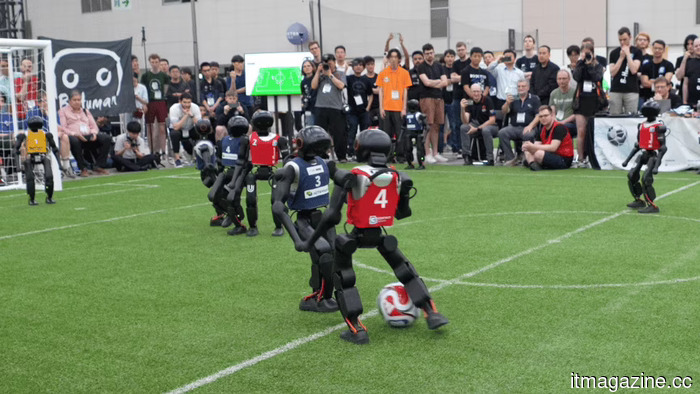 Robots dominated RoboCup 2026, and they have their sights set on the human World Cup.
Beijing's Booster Robotics fueled all the victorious teams at RoboCup 2026 in South Korea. The objective of the sport is to surpass the human World Cup champions by the year 2050.
Robots dominated RoboCup 2026, and they have their sights set on the human World Cup.
Beijing's Booster Robotics fueled all the victorious teams at RoboCup 2026 in South Korea. The objective of the sport is to surpass the human World Cup champions by the year 2050.
 Claude Reflect has arrived. It’s your typical annual Wrapped, but this time featuring Anthropic's AI.
Anthropic introduced Claude Reflect, a usage dashboard that monitors your AI usage patterns over time and then inquires if you'd like to reduce your engagement.
Claude Reflect has arrived. It’s your typical annual Wrapped, but this time featuring Anthropic's AI.
Anthropic introduced Claude Reflect, a usage dashboard that monitors your AI usage patterns over time and then inquires if you'd like to reduce your engagement.
 Meta's newest AI model, Muse Spark 1.1, is capable of operating your computer autonomously.
Meta is reinforcing its commitment to AI agents with Muse Spark 1.1, a model that goes beyond answering questions — it can utilize applications, navigate the internet, and even control your computer to perform tasks for you.
Meta's newest AI model, Muse Spark 1.1, is capable of operating your computer autonomously.
Meta is reinforcing its commitment to AI agents with Muse Spark 1.1, a model that goes beyond answering questions — it can utilize applications, navigate the internet, and even control your computer to perform tasks for you.
 The speculations regarding a $300 price increase for the iPhone 18 Pro series appear to be becoming more plausible.
A third supply chain analysis corroborates what the WSJ and IDC have previously indicated: the iPhone 18 Pro Max is experiencing a notable rise in its bill of materials (BOM).
The speculations regarding a $300 price increase for the iPhone 18 Pro series appear to be becoming more plausible.
A third supply chain analysis corroborates what the WSJ and IDC have previously indicated: the iPhone 18 Pro Max is experiencing a notable rise in its bill of materials (BOM).
 Meta’s newest AI model, Muse Spark 1.1, has the capability to operate your computer on your behalf.
Meta is intensifying its focus on AI agents with Muse Spark 1.1, a model that goes beyond just answering questions — it can utilize apps, surf the web, and even control your computer to perform tasks for you.
Meta’s newest AI model, Muse Spark 1.1, has the capability to operate your computer on your behalf.
Meta is intensifying its focus on AI agents with Muse Spark 1.1, a model that goes beyond just answering questions — it can utilize apps, surf the web, and even control your computer to perform tasks for you.
 I was aware that there was a lot of low-quality AI content on LinkedIn. A startling report indicates that the issue is even more severe than we thought.
In a review of one million posts, LinkedIn accounted for nearly two-thirds of the AI-generated social content that was identified, even though it constituted only one-third of the content examined.
I was aware that there was a lot of low-quality AI content on LinkedIn. A startling report indicates that the issue is even more severe than we thought.
In a review of one million posts, LinkedIn accounted for nearly two-thirds of the AI-generated social content that was identified, even though it constituted only one-third of the content examined.
AMD's CTO explains the necessity of additional CPUs for agentic AI.
At RAISE, Mark Papermaster from AMD stated that agentic AI relies more on CPUs rather than solely on GPUs, which accounts for AMD's pursuit of a trillion-dollar valuation.