
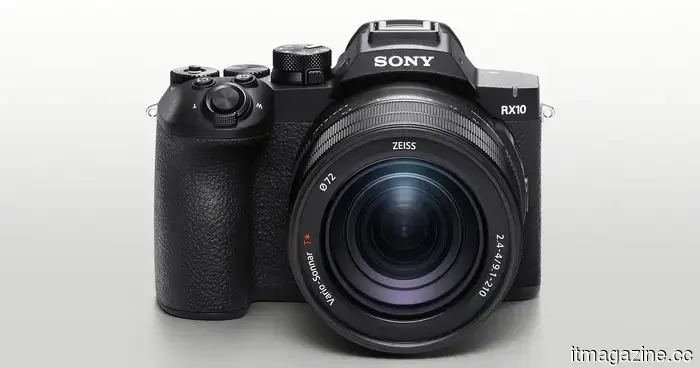
Sony brings back the RX10, now featuring AI autofocus, 4K at 120fps, and an improved battery life.
It features AI that tracks birds in mid-flight and offers 25x optical zoom without the need for lens changes.
Sony has revitalized its most cherished all-in-one body camera, incorporating autofocusing AI from its professional Alpha mirrorless series.
All the elements that made previous versions excellent remain intact. The camera includes the ZEISS Vario-Sonnar T* lens, covering 24mm to 600mm with an aperture of F2.4 to 4.0, along with a 1.0-type stacked sensor and a compact design.
So, what’s different in the RX10 V?
The significant update is the real-time recognition autofocus, powered by an onboard BIONZ XR AI processor, which can automatically recognize people, animals, birds, insects, cars, trains, and airplanes, adapting the camera's performance in real-world situations.
With blackout-free continuous shooting at 30 frames per second and 60 AF/AE calculations each second, the RX10 V can effectively track an egret changing its direction mid-flight.
In addition to photography, video capabilities have seen substantial improvements. The RX10 V can record 4K at 120 fps (with a somewhat narrower field of view), whereas the RX10 IV has a maximum of 4K at 30 fps.
Battery life has been increased by 50% compared to the previous model, with the NP-FZ100 battery providing around 630 shots. The camera also features a new Quad-VGA OLED viewfinder with 3.68 million dots, enhancing composition clarity even in bright sunlight (via Sony).
Is the $2,299 price tag justified for a bridge camera?
That’s a valid question, especially since the RX10 IV was introduced at a lower price of $1,699.99.
Here’s my straightforward assessment: if you engage in wildlife photography, bird watching, sports, or travel, and prefer a single lens that encompasses the full range without constantly switching lenses, then $2,299 gives you a unique option that no mirrorless setup can match in one body.
You're paying for the convenience of not needing to lug around a heavy bag filled with various zoom lenses. In any case, the Sony RX10 V will be available for purchase in the United States starting August 2026.
The RX10 series from Sony has quietly nurtured a loyal community of photographers who favor an all-in-one body over a multi-lens mirrorless kit, and the RX10 V bridges the autofocus gap that previously distinguished it from Alpha cameras.
For over five years, Shikhar has consistently distilled advancements in consumer technology and shared them...
Spotify has finally increased the number of pinned items in your library from four to 20, a feature long awaited by users.
Spotify's long-overdue update has finally arrived, and it’s applicable for free users as well.
For years, Spotify maintained that four pinned items were enough, despite user requests for more. Today, they finally relented. Acknowledgment is due: 20 is a significant increase.
Meta has unveiled new image and video AI tools that can transform Instagram into a creative mood board.
Meta has been developing something, and today, it has finally been revealed. On July 7, 2026, Meta Superintelligence Labs launched Muse Image and Muse Video (in preview), marking its first in-house media generation models. This rollout brings features that are genuinely compelling.
Marshall has updated its Acton and Stanmore speakers with enhanced bass and improved repairability.
Marshall has refreshed two of its most popular wireless speakers, officially introducing the Acton IV and Stanmore IV, which come with a series of notable upgrades beyond just increased volume. Enhanced bass and clearer sound are part of the improvements, and Marshall is also prioritizing repairability, enabling users to replace various external components rather than needing to replace the entire speaker. Better sound, smarter design.




Other articles
 Palo Alto CEO: AI token values need to drop by as much as 90%.
Nikesh Arora highlights that the costs of AI tokens must decrease by as much as 90% for widespread enterprise adoption, stating that OpenAI's 54% efficiency improvement is merely "a good start."
Palo Alto CEO: AI token values need to drop by as much as 90%.
Nikesh Arora highlights that the costs of AI tokens must decrease by as much as 90% for widespread enterprise adoption, stating that OpenAI's 54% efficiency improvement is merely "a good start."
 Sony breathes new life into the RX10 by incorporating AI autofocus, enabling 4K recording at 120fps, and enhancing the battery life.
The fifth-generation RX10 from Sony features AI subject tracking from the Alpha series, 4K recording at 120fps, and an improved battery life that is 50 percent longer.
Sony breathes new life into the RX10 by incorporating AI autofocus, enabling 4K recording at 120fps, and enhancing the battery life.
The fifth-generation RX10 from Sony features AI subject tracking from the Alpha series, 4K recording at 120fps, and an improved battery life that is 50 percent longer.
 Meta’s newest AI model, Muse Spark 1.1, has the capability to operate your computer on your behalf.
Meta is intensifying its focus on AI agents with Muse Spark 1.1, a model that goes beyond just answering questions — it can utilize apps, surf the web, and even control your computer to perform tasks for you.
Meta’s newest AI model, Muse Spark 1.1, has the capability to operate your computer on your behalf.
Meta is intensifying its focus on AI agents with Muse Spark 1.1, a model that goes beyond just answering questions — it can utilize apps, surf the web, and even control your computer to perform tasks for you.
 Meta's newest AI model, Muse Spark 1.1, is capable of operating your computer autonomously.
Meta is reinforcing its commitment to AI agents with Muse Spark 1.1, a model that goes beyond answering questions — it can utilize applications, navigate the internet, and even control your computer to perform tasks for you.
Meta's newest AI model, Muse Spark 1.1, is capable of operating your computer autonomously.
Meta is reinforcing its commitment to AI agents with Muse Spark 1.1, a model that goes beyond answering questions — it can utilize applications, navigate the internet, and even control your computer to perform tasks for you.
 Microdramas are on the rise, and Character.AI is transforming it into a mutual fascination.
Character.AI is pursuing the rapidly growing microdrama market with three AI-supported vertical series, where the characters are accessible for dialogue, inquiries, and new role-playing opportunities following each episode.
Microdramas are on the rise, and Character.AI is transforming it into a mutual fascination.
Character.AI is pursuing the rapidly growing microdrama market with three AI-supported vertical series, where the characters are accessible for dialogue, inquiries, and new role-playing opportunities following each episode.
 I was aware that there was a lot of low-quality AI content on LinkedIn. A startling report indicates that the issue is even more severe than we thought.
In a review of one million posts, LinkedIn accounted for nearly two-thirds of the AI-generated social content that was identified, even though it constituted only one-third of the content examined.
I was aware that there was a lot of low-quality AI content on LinkedIn. A startling report indicates that the issue is even more severe than we thought.
In a review of one million posts, LinkedIn accounted for nearly two-thirds of the AI-generated social content that was identified, even though it constituted only one-third of the content examined.
Sony brings back the RX10, now featuring AI autofocus, 4K at 120fps, and an improved battery life.
Sony's fifth-generation RX10 features AI subject tracking from the Alpha series, 4K recording at 120fps, and an improved battery life that is 50 percent longer.