
The United Nations has stated that AI is advancing more quickly than regulations, and it has a report to support this claim.
The United Nations has consolidated several of its concerns regarding artificial intelligence into a single document, and the main finding is quite clear. According to the organization, the advancements in AI are happening at a pace that far exceeds any government's ability to comprehend, evaluate, or regulate them.
This warning comes as delegates convene in Geneva for the start of the UN Global Dialogue on AI Governance, and it appears in a context where the EU’s AI Act is one of the few enforceable regulatory frameworks in existence.
The report issuing this warning is a preliminary document from the UN's Independent International Scientific Panel on AI, released on July 1, and is described as the first thorough global evaluation of the technology.
The key assertion is the existence of a gap: between the capabilities of current AI systems and the scientific knowledge necessary for effective governance. The panel contends that regulation is falling behind, as is the essential research that policymakers require to establish effective rules.
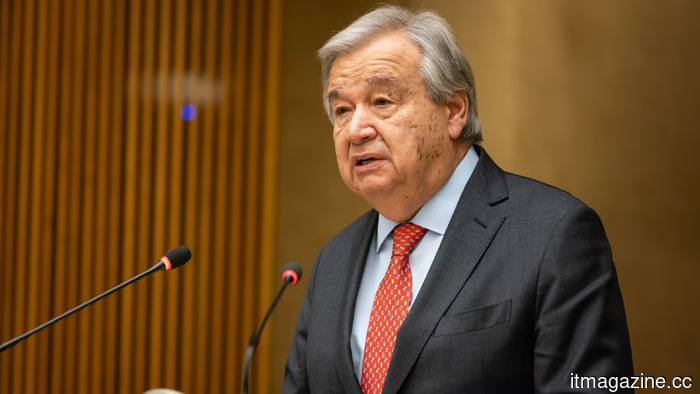
Secretary-General António Guterres conveyed this message in more straightforward terms. “The further AI progresses without agreed-upon rules, the less influence governments and people will have on the outcomes,” he told the press, simplifying his advice to two words: “Do not wait.”
He reiterated the importance of understanding multiple times. “The world cannot regulate what it does not comprehend,” he stated, adding that “the potential is immense, but so are the risks, and the price of inaction is increasing.”
This notion of governance trying to catch up with something it cannot yet quantify gives the report its impact. The panel is not primarily cautioning against any specific catastrophic scenario but is instead highlighting a structural disconnect, where the speed of capability advancement surpasses the slower processes of evaluation, standard creation, and legislation. This is a common concern voiced by researchers studying AI governance, particularly due to the backing of the UN.
A common counterargument is that governments are taking action. The EU has implemented a risk-based regulatory framework, albeit unevenly across its member states. China has taken steps to limit humanlike AI agents, necessitating changes to consumer products already available. Conversely, the United States has faced challenges in establishing robust federal regulations, with critics arguing that this leaves the nation inadequately equipped to regulate the industry it predominantly hosts.
The panel’s argument is that these initiatives are disjointed, and that this fragmentation poses its own risks.
There is also a discussion of equity woven into the assessment. The experts warn that the opportunity to influence AI is diminishing, and if it closes with the technology concentrated in a few companies and countries, it could exacerbate global inequality instead of reducing it. Access to computing resources, data, and talent is not evenly distributed, nor is the ability to govern.
However, the report does not recommend a specific organization or treaty. Instead, it contributes to the Geneva dialogue, which is intended to initiate a process rather than result in immediate decisions.
The UN has been cautious to position the panel as advisory, a scientific entity loosely modeled after the climate assessments that guide intergovernmental discussions without dictating them.
Whether this model can operate at the pace described in the report remains uncertain. Intergovernmental processes are designed to be deliberate, while the panel’s main conclusion is that AI is not.
The climate analogy serves as a valuable reference in both directions: while the assessments have built a common body of evidence, decades of such efforts have not secured decisive actions. The panel is hopeful that having a shared scientific foundation will still be beneficial, even when the political landscape lags behind.
Altri articoli
 Novartis acquista la biotech britannica Myricx per un massimo di 1,5 miliardi di dollari per inseguire una nuova classe di farmaci contro il cancro
Novartis pagherà 1,1 miliardi di dollari in anticipo e fino a 400 milioni di dollari in traguardi per Myricx Bio, un'azienda britannica che sviluppa un nuovo payload per i coniugati anticorpo-farmaco.
Novartis acquista la biotech britannica Myricx per un massimo di 1,5 miliardi di dollari per inseguire una nuova classe di farmaci contro il cancro
Novartis pagherà 1,1 miliardi di dollari in anticipo e fino a 400 milioni di dollari in traguardi per Myricx Bio, un'azienda britannica che sviluppa un nuovo payload per i coniugati anticorpo-farmaco.
 Garvee Rende il Raffreddamento Domestico Premium Più Accessibile Questo Estate
I condizionatori d'aria intelligenti non devono più avere prezzi elevati. L'ultima gamma di Garvee combina funzionalità connesse, prestazioni energetiche efficienti e opzioni di installazione flessibili tra modelli a finestra, mini split e portatili, rendendo più facile trovare la soluzione di raffreddamento giusta per ogni spazio.
Garvee Rende il Raffreddamento Domestico Premium Più Accessibile Questo Estate
I condizionatori d'aria intelligenti non devono più avere prezzi elevati. L'ultima gamma di Garvee combina funzionalità connesse, prestazioni energetiche efficienti e opzioni di installazione flessibili tra modelli a finestra, mini split e portatili, rendendo più facile trovare la soluzione di raffreddamento giusta per ogni spazio.
 Shampoo e biscotti ricevono un restyling AI mentre i giganti dei consumi ristrutturano i loro laboratori
P&G, Unilever e Mondelez stanno utilizzando l'IA per formulare prodotti e gestire campagne, comprimendo tempistiche che una volta richiedevano anni in settimane.
Shampoo e biscotti ricevono un restyling AI mentre i giganti dei consumi ristrutturano i loro laboratori
P&G, Unilever e Mondelez stanno utilizzando l'IA per formulare prodotti e gestire campagne, comprimendo tempistiche che una volta richiedevano anni in settimane.
 L'ampia esperienza nell'IA potrebbe non essere più sufficiente poiché le aziende cercano talenti più specializzati.
Quando il boom dell'IA generativa è esploso alla fine del 2022, dirigenti d'azienda e leader di team di tutto il mondo sono stati catturati dal suo potenziale. Molti leader aziendali hanno rapidamente riconosciuto il potenziale della nuova tecnologia e hanno iniziato a cercare modi per applicarla. Ciò che è seguito è stata una massiccia ondata di assunzioni: le aziende cercavano in lungo e in largo […]
L'ampia esperienza nell'IA potrebbe non essere più sufficiente poiché le aziende cercano talenti più specializzati.
Quando il boom dell'IA generativa è esploso alla fine del 2022, dirigenti d'azienda e leader di team di tutto il mondo sono stati catturati dal suo potenziale. Molti leader aziendali hanno rapidamente riconosciuto il potenziale della nuova tecnologia e hanno iniziato a cercare modi per applicarla. Ciò che è seguito è stata una massiccia ondata di assunzioni: le aziende cercavano in lungo e in largo […]
 Il Biren della Cina raccoglie 892 milioni di dollari per sfidare Nvidia
Shanghai Biren sta vendendo azioni nuove per 7 miliardi di HK$ (circa 892 milioni di dollari) per produrre in massa le sue prossime GPU, mentre le restrizioni statunitensi su Nvidia offrono un'opportunità ai produttori di chip cinesi.
L'ONU afferma che l'IA si sta muovendo più velocemente delle regole e ha un rapporto per dimostrarlo.
Mentre un dialogo delle Nazioni Unite sulla governance dell'IA si apre a Ginevra, António Guterres avverte che l'IA sta avanzando più velocemente di quanto i governi possano misurare o regolare.
Il Biren della Cina raccoglie 892 milioni di dollari per sfidare Nvidia
Shanghai Biren sta vendendo azioni nuove per 7 miliardi di HK$ (circa 892 milioni di dollari) per produrre in massa le sue prossime GPU, mentre le restrizioni statunitensi su Nvidia offrono un'opportunità ai produttori di chip cinesi.
L'ONU afferma che l'IA si sta muovendo più velocemente delle regole e ha un rapporto per dimostrarlo.
Mentre un dialogo delle Nazioni Unite sulla governance dell'IA si apre a Ginevra, António Guterres avverte che l'IA sta avanzando più velocemente di quanto i governi possano misurare o regolare.
The United Nations has stated that AI is advancing more quickly than regulations, and it has a report to support this claim.
With the start of a UN dialogue on AI governance in Geneva, António Guterres cautions that the development of AI is occurring more rapidly than governments can assess or control it.