
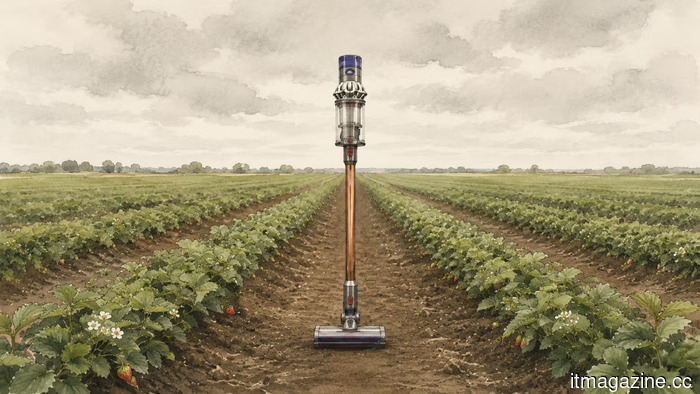
The alternative Dyson empire, assessed in acres.
Within a glasshouse that spans approximately 20 football pitches, on the rich black soil of Lincolnshire, strawberry plants are elevated on a Ferris wheel. These wheels are about 5.5 meters high and each weighs nearly half a tonne. They rotate slowly throughout the day, transporting their rows of fruit through the light like fairground carriages, ensuring that no leaf remains in shadow for long. When a berry reaches maturity, it is not picked by hand.
Instead, sixteen robotic arms are responsible for the harvesting, guided by cameras that assess each strawberry for its color, size, and shape before the secateurs engage. After human pickers leave for the night, other robots navigate the aisles under ultraviolet light, eradicating mold without using any chemicals.
In just one month, the machines harvested 200,000 strawberries. Interestingly, the company behind this technology also manufactures the vacuum cleaner in your home.
Typically, this is where the narrative concludes—highlighting the novelty of a billionaire and his robot-operated fruit picking, presenting it as an intriguing anecdote for a dinner gathering. However, this is not the right endpoint. The vacuum and strawberry are not mere coincidences; they are essentially two sides of the same coin, operating simultaneously.
Dyson is a brand most commonly associated with gadgets—bagless vacuum cleaners, bladeless fans, and expensive hairdryers. Yet, few people are aware that Sir James Dyson, the engineer behind the brand, is also one of the largest landowners in Britain.
His agricultural enterprise, Dyson Farming, manages around 36,000 acres across Lincolnshire, Oxfordshire, Gloucestershire, and Somerset. By its own assertion, it stands as the biggest farming business in the nation. To grasp how someone known for suction ventured into this realm, we need to consider three key factors: engineering, finances, and an almost obsessive desire to control the entire system.
Starting with the engineering—which is Dyson's strong suit—the company is fundamentally not just a vacuum manufacturer; it is a creator of digital motors, batteries, filtration systems, thermal management technologies, and increasingly, vision systems and robotics. The vacuum cleaner is simply the most prominent product of these capabilities.
In 2019, Dyson invested approximately £500 million into an electric vehicle project, which he ultimately abandoned, deeming it commercially unfeasible. He redirected that ambition, along with £2.75 billion in funding, towards advancements in artificial intelligence, robotics, and solid-state batteries. In essence, while he did not succeed in creating a self-driving car, he shifted focus to developing other intelligent technologies.
Revisiting the glasshouse with this perspective reveals the significance of its features: the sixteen robotic arms equipped with machine vision, night robots detecting mold under UV light, digital motors rotating hefty wheels, and an on-site power generation facility.
Each of these represents a Dyson capability applied in agriculture. The glasshouse is arguably the company's most sophisticated product to date, functioning as a single entity that produces its own electricity, regulates its climate, and gathers its output.
It merely cultivates fruit rather than storing it in a cupboard. The farm acts as both a robotics and energy research facility that funds its own fruit-related studies, which is a far more fruitful return than most research and development departments typically experience. Agriculture has quietly emerged as a major frontier for robotics, with AI cameras on tractors and vertical farms intended for space travel; Dyson simply has the financial capacity to undertake the entire project at once.
The quest for land began around 2012 with the establishment of Dyson Farming, accelerating the following year with the acquisition of the Nocton Estate in Lincolnshire, followed by the Churn Estate in Oxfordshire, and it didn’t stop there. Gradually, the family-owned holding company, then operating as Beeswax Farming, spent tens of millions of pounds acquiring prime farmland as opportunities arose. By 2017, the transparency initiative Who Owns England? raised the question: why was Dyson buying up rural land?
The answer lies in the concept of scale, which is the main objective. Dyson Farming touts itself as a top-five producer of malting barley, wheat, oilseeds, and potatoes in the UK, yielding over 100,000 tonnes of food annually. This isn't a recreational estate or an indulgent vineyard; it's an industrial venture driven by the same principles that created the vacuum: identify the challenge, engineer a solution, and then scale it beyond what others would dare.
A strawberry, it seems, has a story. It is cultivated in a season designed to last all year, with heat sourced from grain, light dispersed by a rotating wheel, water from the Lincolnshire sky, and robots determining its ripeness. What it increasingly lacks, however, is human involvement.
There is irony in producing the ideal strawberry in this very location. The UK has gradually lost its enthusiasm for genuine food, consuming more ultra-processed options than any other European nation—over half the national diet
Other articles
 SAP halts hiring and travel to support its AI initiative.
An internal memo reveals that SAP is halting most hiring, pausing non-AI travel, and reducing supplier expenditures to support a "substantial" initiative in AI.
SAP halts hiring and travel to support its AI initiative.
An internal memo reveals that SAP is halting most hiring, pausing non-AI travel, and reducing supplier expenditures to support a "substantial" initiative in AI.
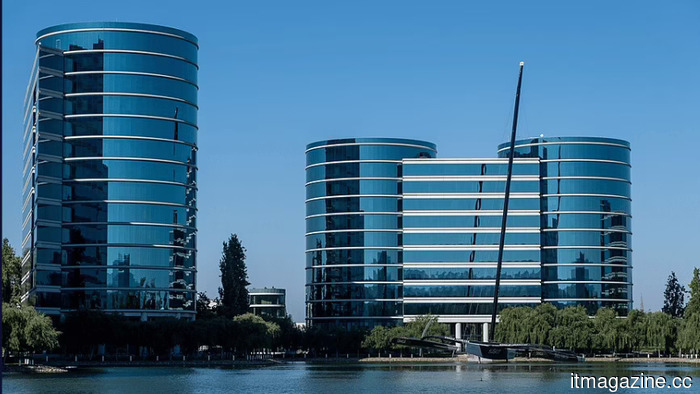 Investors file a lawsuit against Oracle regarding its $300 billion agreement with OpenAI.
A pension fund from Michigan is suing Oracle, claiming that the company concealed risks associated with its $300 billion deal with OpenAI prior to a $25 billion note sale, in a class action under the Securities Act.
Investors file a lawsuit against Oracle regarding its $300 billion agreement with OpenAI.
A pension fund from Michigan is suing Oracle, claiming that the company concealed risks associated with its $300 billion deal with OpenAI prior to a $25 billion note sale, in a class action under the Securities Act.
 Investors are filing a lawsuit against Oracle regarding its $300 billion deal with OpenAI.
A pension fund from Michigan is filing a lawsuit against Oracle, claiming that the company concealed risks related to its $300 billion deal with OpenAI prior to a $25 billion note sale, as part of a class action under the Securities Act.
Investors are filing a lawsuit against Oracle regarding its $300 billion deal with OpenAI.
A pension fund from Michigan is filing a lawsuit against Oracle, claiming that the company concealed risks related to its $300 billion deal with OpenAI prior to a $25 billion note sale, as part of a class action under the Securities Act.
 Europe introduces new regulations aimed at loot boxes and gaming for children.
Europe is formulating regulations to restrict the sale of games to children and focus on loot boxes, and this enforcement may negatively impact game sales globally.
Europe introduces new regulations aimed at loot boxes and gaming for children.
Europe is formulating regulations to restrict the sale of games to children and focus on loot boxes, and this enforcement may negatively impact game sales globally.
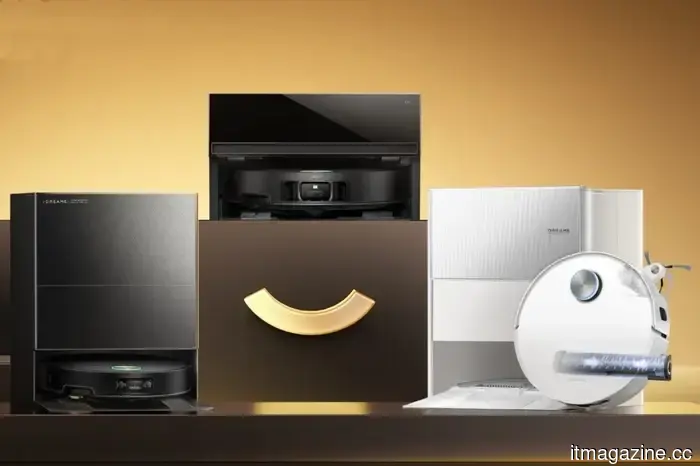 Whoever did not hide from Dreame, we are not to blame.
Dreame, for those who are not aware, has now officially topped the vacuum cleaner sales volumes on the planet. According to IDC, in the first quarter of 2026, the brand surpassed everyone in sales volume and revenue in the robot vacuum category. And this is no joke, but figures that make competitors nervously recalculate their market shares.
Whoever did not hide from Dreame, we are not to blame.
Dreame, for those who are not aware, has now officially topped the vacuum cleaner sales volumes on the planet. According to IDC, in the first quarter of 2026, the brand surpassed everyone in sales volume and revenue in the robot vacuum category. And this is no joke, but figures that make competitors nervously recalculate their market shares.
 Weave Robotics Isaac 1: a home robot priced at $7,999
Weave Robotics' Isaac 1 is a $7,999 wheeled home robot without fingers that can fold laundry and organize spaces, offering a more affordable option compared to humanoid competitors like 1X's Neo.
Weave Robotics Isaac 1: a home robot priced at $7,999
Weave Robotics' Isaac 1 is a $7,999 wheeled home robot without fingers that can fold laundry and organize spaces, offering a more affordable option compared to humanoid competitors like 1X's Neo.
The alternative Dyson empire, assessed in acres.
Dyson's robotic strawberry farm and its renowned vacuum cleaner are essentially the same device: they share the same engineering, the same financial investment, and the same desire for precision.