
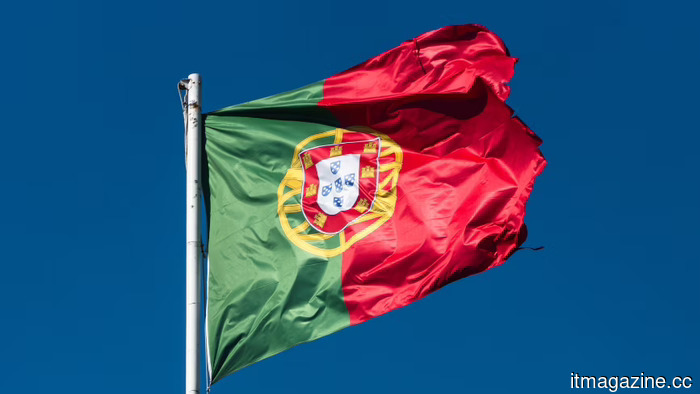
Portugal has made its first national AI model, Amália, available as open source, focusing on European Portuguese.
A nation with just over 10 million inhabitants has introduced a large language model that represents its own variant of the language. Portugal has launched Amália, its inaugural national AI model specifically designed for European Portuguese, implementing this initiative in a remarkably structured manner for a governmental project.
The model, along with its training data and source code, is completely open and available for governments, educational institutions, and businesses to use and expand upon.
The name is significant. Amália is an acronym for Automatic Multimodal Language Assistant with Artificial Intelligence, but it also pays homage to Amália Rodrigues, the fado singer whose voice is deeply intertwined with Portuguese culture.
The model is based on EuroLLM-9B, a European foundational model, which a group of over 60 researchers and students has enhanced with datasets in European Portuguese, a larger context window, improved safety and evaluation systems, and the capability to process images in conjunction with text.
What Amália is not is a competitor to ChatGPT in the way most users would experience. It will not be released as a consumer chat application; instead, it is designed to function as an underlying layer that other software can utilize.
Proposed applications include an AI teaching assistant, a virtual guide for Portuguese museums and historic sites, a digital assistant for citizen services, and decision-support tools for the Portuguese Navy. This distinction clarifies why the government is providing access to the model at no cost rather than charging for it.
The project has secured an initial funding of €5.5 million through Portugal’s Recovery and Resilience Plan, with financial support allocated to NOVA University Lisbon, Instituto Superior Técnico, and the universities of Porto, Minho, and Coimbra, managed in collaboration with the Foundation for Science and Technology.
A test version was completed in September 2025 and showcased at the PROPOR conference in Brazil. Funding is already confirmed through the end of 2027, suggesting a commitment to maintain the project rather than simply launching it.
The term open, in this context, truly means open. Unlike large commercial systems that operate as closed entities accessible only through an interface and a fee, Amália includes its weights, datasets, and code published under an open license, allowing anyone to examine how it was trained, modify it, and run it on their own equipment. This decision is driven by both ideological beliefs and practical needs.
A model that a government intends to integrate into citizen services and naval decision support must be one it can rigorously audit, not merely trust. Open publication ensures this ability.
This launch aligns with Europe’s broader concerns about relying on American and Chinese systems for essential functions like language processing. It follows the OpenEuroLLM alliance, a collaboration aimed at training open models in the continent’s own languages, and includes significant infrastructure investments, such as Nscale’s €695 million data center initiative in Portugal with Microsoft. Whether this adds up to true independence is still debated.
Some have argued that renting GPUs by the hour creates an illusion of sovereignty rather than genuine independence.
Amália’s strongest feature is its specificity. European Portuguese differs from Brazilian Portuguese, and most large commercial models, which are predominantly trained on the latter, often overlook these distinctions.
A system that accurately captures the grammar, idioms, and cultural references of European Portuguese serves a purpose that a broader, less defined model does not, which is particularly important for public services that need to communicate with citizens in their own vernacular rather than a generalized version.
The more challenging issue is encouraging adoption. While making a model publicly available is one aspect, inspiring universities, companies, and government agencies to utilize it effectively is another challenge; this is often where ambitions for sovereign AI falter.
Portugal has pledged funding for Amália through 2027 and has identified the institutions responsible for its advancement. The next two years will reveal whether it develops into actual infrastructure or merely becomes a well-documented research project with an appealing name.
Other articles
 Pie has secured $19.5 million to enhance the visibility of small businesses in AI search.
Pie has secured $19.5 million in funding, led by Lightspeed, to assist small businesses in being discovered on ChatGPT, Google Maps, and Yelp, as well as to manage their phone calls using AI.
Pie has secured $19.5 million to enhance the visibility of small businesses in AI search.
Pie has secured $19.5 million in funding, led by Lightspeed, to assist small businesses in being discovered on ChatGPT, Google Maps, and Yelp, as well as to manage their phone calls using AI.
 Meta's Brain2Qwerty translates typed sentences directly from brain activity.
Meta's Brain2Qwerty v2 translates typed sentences from brain scans with a 61% accuracy rate without the need for implants. However, it's important to note that the setup is room-sized, does not operate in real-time, and is confined to laboratory settings.
Meta's Brain2Qwerty translates typed sentences directly from brain activity.
Meta's Brain2Qwerty v2 translates typed sentences from brain scans with a 61% accuracy rate without the need for implants. However, it's important to note that the setup is room-sized, does not operate in real-time, and is confined to laboratory settings.
 Sony will cease the production of physical PlayStation game discs in January 2028.
Sony has declared that it will cease physical disc production for new PlayStation games beginning in January 2028, as digital downloads currently make up 85 percent of sales.
Sony will cease the production of physical PlayStation game discs in January 2028.
Sony has declared that it will cease physical disc production for new PlayStation games beginning in January 2028, as digital downloads currently make up 85 percent of sales.
 Microsoft seems to have moved on from the appeal of small Windows tablets. Long live the Surface Go!
Microsoft has allegedly ceased the production of Surface Go and Surface Laptop Go devices, with only Surface Pro and Surface Laptop remaining as the company's active Surface PC lines.
Microsoft seems to have moved on from the appeal of small Windows tablets. Long live the Surface Go!
Microsoft has allegedly ceased the production of Surface Go and Surface Laptop Go devices, with only Surface Pro and Surface Laptop remaining as the company's active Surface PC lines.
 GM's sales in the second quarter decreased by four percent due to a decline in electric vehicle demand, while Toyota continued to gain ground.
General Motors sold 714,896 vehicles in the second quarter, surpassing analyst expectations, yet still marking its second consecutive quarterly decline as electric vehicle sales continued to decline.
GM's sales in the second quarter decreased by four percent due to a decline in electric vehicle demand, while Toyota continued to gain ground.
General Motors sold 714,896 vehicles in the second quarter, surpassing analyst expectations, yet still marking its second consecutive quarterly decline as electric vehicle sales continued to decline.
 Pie secures $19.5 million to maintain the visibility of small businesses in AI search results.
Pie has secured $19.5 million in funding, with Lightspeed leading the round, to assist small businesses in gaining visibility on ChatGPT, Google Maps, and Yelp, as well as to manage phone calls using AI technology.
Pie secures $19.5 million to maintain the visibility of small businesses in AI search results.
Pie has secured $19.5 million in funding, with Lightspeed leading the round, to assist small businesses in gaining visibility on ChatGPT, Google Maps, and Yelp, as well as to manage phone calls using AI technology.
Portugal has made its first national AI model, Amália, available as open source, focusing on European Portuguese.
Portugal has unveiled Amália, its inaugural open-source national AI model designed for European Portuguese, contributing to Europe's initiative for AI sovereignty.