
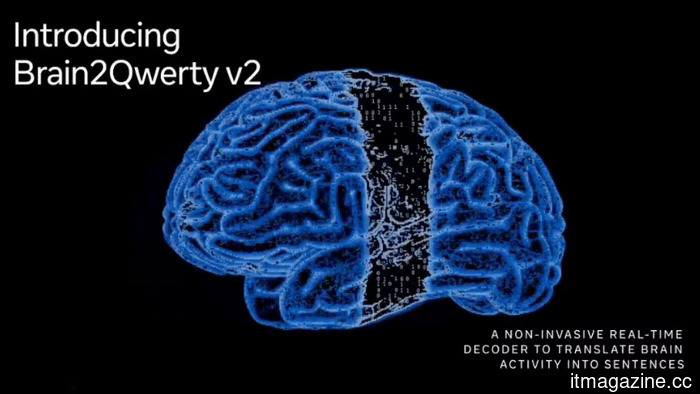
Meta's Brain2Qwerty translates typed sentences directly from brain activity.
Meta claims it can transform brain activity into written sentences without the need for surgical intervention. The progress is significant, but there's a major drawback: the system learns from typing, which is something its target users cannot do.
On Monday, Meta introduced the second version of Brain2Qwerty, a technology that interprets the brain signals generated during typing and reconstructs the corresponding words. It is non-invasive, requiring no surgery or implants. A volunteer wears a magnetoencephalography (MEG) scanner, a helmet-like device that detects the subtle magnetic fields emitted by the brain. An AI system then processes the information.
The results are impressive, with Brain2Qwerty v2 achieving an average word accuracy of 61 percent, reaching as high as 78 percent for the top participant, according to Meta. Earlier non-invasive systems had only achieved single-digit accuracy rates. The first version from last year peaked at around 48 percent accuracy.
To achieve these results, Meta trained the system using approximately 22,000 sentences typed by nine volunteers, each wearing the scanner for about 10 hours. The study was conducted at a research facility in San Sebastián, Spain, as reported by Gizmodo.
The technology relies on principles similar to those of ChatGPT. The process begins by converting the raw signals from the scanner into individual characters. A second model combines these characters into words, and then a large language model, specifically adjusted to the brain data, uses context to infer the intended sentence, much like a smartphone predicting the next word you want to type.
Meta notes that this marks the first occasion an LLM has accurately translated noisy brain activity into complete sentences. The company even employed AI agents to enhance its decoding process, although final decisions were made by engineers.
The choice of scanner proved more significant than initially anticipated. Meta compared both MEG and the more affordable and widely used EEG, finding that MEG performed much better, with a character error rate of 29 percent compared to 65 percent for EEG.
Meta has made the code and dataset publicly available, aligning with a broader effort to conduct AI research transparently. The project is framed as a means to assist the millions who lose their ability to speak due to brain injuries or diseases.
However, there are substantial limitations. The system is far from being a viable product. The MEG scanner is large, extremely expensive, and intended for hospitals, not home use. It also cannot provide real-time feedback, as the models require a complete typing session before generating output.
A fundamental issue remains: Brain2Qwerty learns from the brain signals of individuals who can type, while its target users—those who are paralyzed or suffering from certain diseases—are unable to type at all. Meta acknowledges this limitation. While individuals with some mobility might benefit, those completely locked-in likely will not, suggesting that a different approach, focused on imagining movements instead of actual key presses, would be necessary.
The current system also requires precise timing for key presses, and Meta describes the journey toward continuous, trigger-free decoding as "uncertain."
Currently, invasive methods yield superior results. Implanted systems have achieved much higher accuracy rates, with recent surgical innovations reaching 92 percent accuracy at the sentence level. One of these surgical interfaces enabled a man with ALS to maintain a full-time job by decoding his intended speech with remarkable precision. Companies like Neuralink and its competitors are racing to commercialize such implants.
Meta asserts that it can bridge the gap without surgery, as accuracy improves steadily with more data input. This may indeed be the case, and being transparent about the research could facilitate further testing. However, a brain reader that occupies an entire room, requires completion of a typing session, and relies on the user's ability to type is still far from being a true lifeline. Meta's broader AI ambitions often come in bold and early announcements, but this development represents significant progress in the lab, serving as a realistic reminder of how far from practical application the lab still is.
Other articles
 Sony will cease the production of physical PlayStation game discs in January 2028.
Sony has declared that it will cease the production of physical discs for new PlayStation games beginning in January 2028, as digital downloads represent 85 percent of sales.
Sony will cease the production of physical PlayStation game discs in January 2028.
Sony has declared that it will cease the production of physical discs for new PlayStation games beginning in January 2028, as digital downloads represent 85 percent of sales.
 Pie has secured $19.5 million to enhance the visibility of small businesses in AI search.
Pie has secured $19.5 million in funding, led by Lightspeed, to assist small businesses in being discovered on ChatGPT, Google Maps, and Yelp, as well as to manage their phone calls using AI.
Pie has secured $19.5 million to enhance the visibility of small businesses in AI search.
Pie has secured $19.5 million in funding, led by Lightspeed, to assist small businesses in being discovered on ChatGPT, Google Maps, and Yelp, as well as to manage their phone calls using AI.
 UiPath's stock prices increase as Wall Street shows a positive response to its shift towards AI agents.
UiPath's shares have recovered from a significant decline in 2026 following the automation company's announcement of its first GAAP profit and its shift towards AI agents.
UiPath's stock prices increase as Wall Street shows a positive response to its shift towards AI agents.
UiPath's shares have recovered from a significant decline in 2026 following the automation company's announcement of its first GAAP profit and its shift towards AI agents.
 Meta intends to lease its excess AI computing power, and Wall Street is in favor of the concept.
According to Bloomberg, Meta is developing a cloud business to market surplus AI computing resources, a strategy that would put it in competition with AWS, Google, and Azure.
Meta intends to lease its excess AI computing power, and Wall Street is in favor of the concept.
According to Bloomberg, Meta is developing a cloud business to market surplus AI computing resources, a strategy that would put it in competition with AWS, Google, and Azure.
 Portugal has released Amália, its inaugural national AI model, as an open-source initiative focused on European Portuguese.
Portugal has introduced Amália, its inaugural open-source national AI model designed for European Portuguese, contributing to Europe's efforts for AI sovereignty.
Portugal has released Amália, its inaugural national AI model, as an open-source initiative focused on European Portuguese.
Portugal has introduced Amália, its inaugural open-source national AI model designed for European Portuguese, contributing to Europe's efforts for AI sovereignty.
 Palantir's manifesto on 'AI sovereignty' targets the laboratories.
Palantir's 9-point 'AI sovereignty' message advises institutions to take control of their data and weights while discouraging 'tokenmaxxing' — a concept that effectively promotes Palantir.
Palantir's manifesto on 'AI sovereignty' targets the laboratories.
Palantir's 9-point 'AI sovereignty' message advises institutions to take control of their data and weights while discouraging 'tokenmaxxing' — a concept that effectively promotes Palantir.
Meta's Brain2Qwerty translates typed sentences directly from brain activity.
Meta's Brain2Qwerty v2 translates typed sentences from brain scans with a 61% accuracy rate without the need for implants. However, it's important to note that the setup is room-sized, does not operate in real-time, and is confined to laboratory settings.