
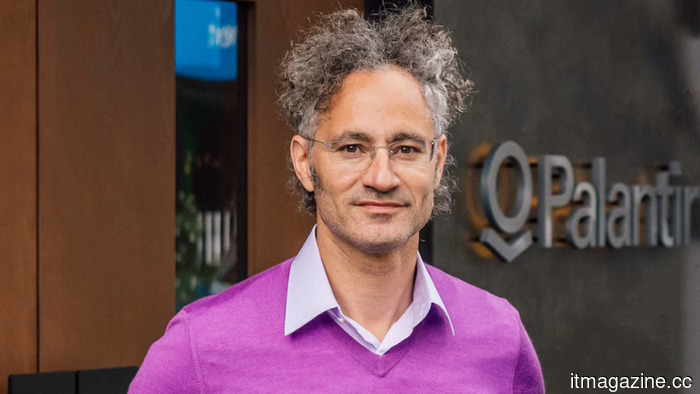
Palantir's manifesto on 'AI sovereignty' targets the laboratories.
Palantir has a new adversary, which is the typical revenue model of the AI industry. Its nine-point manifesto urges organizations to safeguard their data, possess their model weights, and refrain from “tokenmaxxing.” This is a proposal disguised as a principle.
On Tuesday, Palantir shared its “thoughts on the significance of AI sovereignty” on X. The thread comprises nine numbered tenets, initially highlighted by Business Insider. In essence, they convey a unified message to companies, governments, or militaries: the entity that governs your data and models governs your future. Therefore, do not relinquish either to others.
The rhetoric is lofty. The opening point asserts that “your AI sovereignty determines your institution’s future.” The second cautions that “data retention is your treasure.” The fourth point is more direct: “Controlling your weights is controlling your fate.” Weights refer to the figures that represent what a model has learned, and Palantir frames them as an organization’s invaluable assets.
The criticism of tokenmaxxing
The most pointed remark targets the leading labs. Palantir criticizes “tokenmaxxing,” the trend of spending excessively on AI, labeling it “the addictive feeling of false progress.” It argues that excessive token usage favors superficial scripts over reliable software. The key phrase follows: “There is a reason why those selling tokens refuse to charge based on value.”
This is a clear jab at OpenAI, Anthropic, and similar companies. Their business models rely on metered, per-token pricing. CEO Alex Karp made a more blunt observation in a follow-up: “Why are they charging for tokens?” if the value genuinely exists. This complaint has merit, as enterprise AI costs continue to rise even as token prices decrease.
A principle that conveniently promotes Palantir
It’s important to note what Palantir provides. Its service involves implementing software, and increasingly AI models, within a customer’s own environment, including secure systems isolated from external access. This week, it also announced it had received accreditation for NATO’s classified network.
Additionally, it is offering open models from Nvidia for governmental applications under a “sovereign” label. A manifesto urging organizations to maintain ownership of their technology stack conveniently serves as a call to purchase Palantir.
Karp has openly expressed his disdain for competitors. He recently stated to CNBC that AI companies “don’t realize how unappealing they are.” Their products, he remarked, “don’t operate the way” clients anticipate. He has also forecasted the nationalization of AI firms, and the sovereignty manifesto aligns with that perspective. It is confrontational, absolutist, and directed towards states and militaries rather than startups.
Sovereignty is a double-edged sword
The irony lies in the fact that “sovereignty” is now a term used in opposition to Palantir. Europe has adopted the concept as policy, sparking intense debate regarding who truly controls the continent’s AI in Brussels and national capitals. France’s foreign intelligence agency replaced Palantir with a domestic competitor, and Germany’s military has maintained distance from it. For those governments, authentic sovereignty implies not relying on a single American provider, regardless of how fervently it advocates for independence.
When stripped of its grandeur, Palantir’s fundamental assertion is valid. Data and model weights are genuine sources of competitive advantage, and transferring them to a third party poses significant risks.
However, a nine-point scripture about “alpha” and “the means of production” also serves as a brand-building exercise. It captures a moment when every Western institution is suddenly anxious about the locations of their AI operations. Palantir did not create that concern; it is simply adept at marketing the solution.
Other articles
 Meta's Brain2Qwerty interprets typed sentences directly from brain activity.
Meta's Brain2Qwerty v2 is capable of decoding typed sentences from brain scans with a 61% accuracy rate, without the need for an implant. However, it has some limitations: it requires a large room, does not operate in real-time, and is confined to a laboratory setting.
Meta's Brain2Qwerty interprets typed sentences directly from brain activity.
Meta's Brain2Qwerty v2 is capable of decoding typed sentences from brain scans with a 61% accuracy rate, without the need for an implant. However, it has some limitations: it requires a large room, does not operate in real-time, and is confined to a laboratory setting.
 Sony will cease the production of physical PlayStation game discs in January 2028.
Sony has declared that it will cease physical disc production for new PlayStation games beginning in January 2028, as digital downloads currently make up 85 percent of sales.
Sony will cease the production of physical PlayStation game discs in January 2028.
Sony has declared that it will cease physical disc production for new PlayStation games beginning in January 2028, as digital downloads currently make up 85 percent of sales.
 Meta's Brain2Qwerty translates typed sentences directly from brain activity.
Meta's Brain2Qwerty v2 translates typed sentences from brain scans with a 61% accuracy rate without the need for implants. However, it's important to note that the setup is room-sized, does not operate in real-time, and is confined to laboratory settings.
Meta's Brain2Qwerty translates typed sentences directly from brain activity.
Meta's Brain2Qwerty v2 translates typed sentences from brain scans with a 61% accuracy rate without the need for implants. However, it's important to note that the setup is room-sized, does not operate in real-time, and is confined to laboratory settings.
 Pie has secured $19.5 million to enhance the visibility of small businesses in AI search.
Pie has secured $19.5 million in funding, led by Lightspeed, to assist small businesses in being discovered on ChatGPT, Google Maps, and Yelp, as well as to manage their phone calls using AI.
Pie has secured $19.5 million to enhance the visibility of small businesses in AI search.
Pie has secured $19.5 million in funding, led by Lightspeed, to assist small businesses in being discovered on ChatGPT, Google Maps, and Yelp, as well as to manage their phone calls using AI.
 Meta intends to lease its excess AI computing power, and Wall Street is in favor of the concept.
According to Bloomberg, Meta is developing a cloud business to market surplus AI computing resources, a strategy that would put it in competition with AWS, Google, and Azure.
Meta intends to lease its excess AI computing power, and Wall Street is in favor of the concept.
According to Bloomberg, Meta is developing a cloud business to market surplus AI computing resources, a strategy that would put it in competition with AWS, Google, and Azure.
 Sony will cease the production of physical PlayStation game discs in January 2028.
Sony has declared that it will cease the production of physical discs for new PlayStation games beginning in January 2028, as digital downloads represent 85 percent of sales.
Sony will cease the production of physical PlayStation game discs in January 2028.
Sony has declared that it will cease the production of physical discs for new PlayStation games beginning in January 2028, as digital downloads represent 85 percent of sales.
Palantir's manifesto on 'AI sovereignty' targets the laboratories.
Palantir's 9-point 'AI sovereignty' message advises institutions to take control of their data and weights while discouraging 'tokenmaxxing' — a concept that effectively promotes Palantir.