
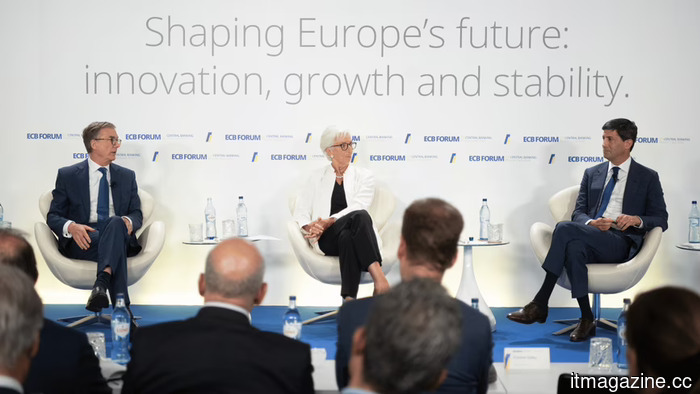
AI's aspirations and concerns dominate the major central bank conference worldwide.
Each summer, the most influential central bankers gather in a hillside town near Lisbon to engage in discussions about the economy in a relatively tranquil setting. This year, the primary topic of debate was not the usual concern of inflation, but rather artificial intelligence. Specifically, there was an unsettling uncertainty among attendees regarding whether AI would simplify their tasks or complicate them significantly.
The event in question was the European Central Bank’s annual Forum on Central Banking, which took place in Sintra from June 29 to July 1, centered on the theme “Shaping Europe’s future: innovation, growth and stability.” During the key policy panel, Fed Chair Kevin Warsh, ECB President Christine Lagarde, Bank of England Governor Andrew Bailey, and Bank of Canada Governor Tiff Macklem convened to explore the implications of AI for growth, pricing, and financial stability. The atmosphere was less about triumph and more about inquiry.
The complex issue they faced was genuinely challenging. AI holds the potential for a productivity surge that could, in principle, enable economies to expand more quickly without accelerating inflation. However, achieving this potential requires an unprecedented level of investment that could be inflationary in the short term.
Major AI companies have pledged around $300 billion for capital expenditures in just 2025, channeling funds into chips, energy, and data centers. This spending manifests as demand on the economy long before any productivity gains are reflected in the data.
To date, the benefits of AI have been tangible yet modest. In the US, productivity per hour increased by approximately 2.2% last year, which appears more as a rebound from a downturn than the transformative change that advocates of the technology envision. Warsh pointed out that inflation remains too high, even as Fed officials have become more receptive to the idea that AI could ultimately lead to deflation.
Many policymakers concurred that easing monetary policy now based on the promise of a productivity surge that has not materialized would be a precarious gamble, especially with demand already strong.
Lagarde took the opportunity to highlight an uncomfortable truth for her region: Europe is falling behind in AI investment and in the cutting-edge companies spearheading innovations. She remarked that Europe and the United States are, in her words, “sort of hostage to each other” regarding progress in this area. This was an unusual acknowledgment of reliance from a central bank leader who has long advocated for European strategic independence.
Underlying this discussion was a focus on the labor market. A recent survey by the Federal Reserve Bank of New York revealed that companies are not planning large-scale layoffs, but are instead quietly reducing their hiring efforts, a change that might already be contributing to the unusually low job creation rate in the US. This subtle form of disruption is less visible than mass redundancies and more challenging for a central bank to track in real time.
These concerns are not merely theoretical. The Bank for International Settlements has warned that a downturn in AI investment could impact credit markets with a severity akin to the 2008 crisis, while Lagarde has suggested that AI could instigate financial crises and has called for governance structures similar to Cold War arms control.
Conversely, some are beginning to view the technology as a solution rather than a risk. The Bank of Italy has initiated discussions with major developers, promoting AI as a remedy for chronic low productivity, while Morgan Stanley now anticipates that European banks will reduce their workforce by 20% due to AI by 2030.
Ultimately, the discussions in Sintra did not yield definitive conclusions but rather a shared apprehension. Those who influence interest rates departed with a consensus on the magnitude of the issue at hand but little clarity on its resolution. The data necessary to address their concerns is still unavailable, and by the time it emerges, interest rates dependent on that information may already be established.
Other articles
 Honda is now producing batteries for data centers at a factory originally intended for electric vehicles that was later canceled.
Honda has started manufacturing energy storage batteries at an Ohio facility that was initially constructed for electric vehicles, which the company abandoned three months ago following a $16 billion loss.
Honda is now producing batteries for data centers at a factory originally intended for electric vehicles that was later canceled.
Honda has started manufacturing energy storage batteries at an Ohio facility that was initially constructed for electric vehicles, which the company abandoned three months ago following a $16 billion loss.
 Honda begins producing batteries for data centers at a factory initially intended for electric vehicles that it decided to cancel.
Honda has started manufacturing energy storage batteries at an Ohio facility that was initially constructed for electric vehicles, which the company discontinued three months ago following a $16 billion loss.
Honda begins producing batteries for data centers at a factory initially intended for electric vehicles that it decided to cancel.
Honda has started manufacturing energy storage batteries at an Ohio facility that was initially constructed for electric vehicles, which the company discontinued three months ago following a $16 billion loss.
 Acer's 1,000Hz gaming monitor is available, costly, and currently pending a release date.
Acer’s 1,000Hz gaming monitor is available on Amazon for $699.99, but it is currently out of stock, and utilizing its fastest mode necessitates a significant reduction from QHD to 720p.
Acer's 1,000Hz gaming monitor is available, costly, and currently pending a release date.
Acer’s 1,000Hz gaming monitor is available on Amazon for $699.99, but it is currently out of stock, and utilizing its fastest mode necessitates a significant reduction from QHD to 720p.
 Acer's 1,000Hz gaming monitor exists, comes with a high price tag, and is currently awaiting a release date.
Acer's 1,000Hz gaming monitor is available on Amazon for $699.99, but it is currently out of stock, and using its fastest mode necessitates a significant reduction in resolution from QHD to 720p.
Acer's 1,000Hz gaming monitor exists, comes with a high price tag, and is currently awaiting a release date.
Acer's 1,000Hz gaming monitor is available on Amazon for $699.99, but it is currently out of stock, and using its fastest mode necessitates a significant reduction in resolution from QHD to 720p.
 Sony's WH-1000XM6 headphones have become more appealing for gamers who dislike traditional gaming headsets.
The update for Sony's WH-1000XM6 introduces Bluetooth GMAP support, which enhances lower-latency audio for gaming. However, this feature is only beneficial if the connected device—be it a phone, PC, tablet, or handheld—also supports the same standard.
Sony's WH-1000XM6 headphones have become more appealing for gamers who dislike traditional gaming headsets.
The update for Sony's WH-1000XM6 introduces Bluetooth GMAP support, which enhances lower-latency audio for gaming. However, this feature is only beneficial if the connected device—be it a phone, PC, tablet, or handheld—also supports the same standard.
AI's aspirations and concerns dominate the major central bank conference worldwide.
During the ECB's Sintra forum, central bankers evaluated the potential of AI to enhance productivity in relation to an investment surge that fuels inflation.