
Visa states that investments in AI and digital commerce are driving the global economy.
The payment giant’s midyear predictions anticipate a 2.4% global growth in 2026, attributing this to a surge in investment and online price competition that helps mitigate the impact of rising energy costs.
As a company that processes a significant portion of card transactions worldwide, Visa has insight into economic trends, and its outlook is cautiously optimistic. According to its Business and Economic Insights, Visa forecasts a 2.4% growth in the global economy in 2026. This expected growth is supported by increased business investment in artificial intelligence and clean energy, which is offsetting the financial pressure that rising energy prices exert on consumers.
This figure is based on Visa’s own data derived from its proprietary transaction information and economic modeling, positioning it at the more conservative end of the forecasting spectrum. The IMF’s April forecast predicted a 3.1% global growth for 2026 based on purchasing power parity, while the World Bank, using a different calculation approach, estimated a growth rate of 2.5%, which is close to Visa’s prediction.
The difference between these figures mainly comes from methodological variations rather than fundamental disagreements, but it’s important to note that this represents one company’s perspective, grounded in its own network insights.
Visa indicates that it sees an adjustment in consumer behavior rather than a retreat. Wayne Best, the company’s chief economist, noted that as digital commerce changes how consumers shop and pay, individuals are discovering new ways to compare prices and manage their budgets, which helps keep inflation manageable.
He remarked that there is a significant increase in business investments as companies develop AI technology, pursue clean energy initiatives, and strengthen supply chains at levels reminiscent of 2010.
The report identifies three key factors supporting the economy: first, the consumer, whom Visa views as adapting rather than failing. Despite the financial pressures from higher costs, Visa’s data shows that discretionary spending remains relatively stable, with early signs of solidifying.
Consumer behavior has shifted towards seeking deals, with more of this activity taking place online, where comparing prices and finding lower-cost alternatives has become easier than ever before.
This leads to the second factor, which is Visa's unique assertion: that digital commerce is actively helping to control inflation. In smaller cities, online adoption has nearly doubled since the pandemic, rising from around 31% to 56% in nearly 600 analyzed locations, including a range of markets from Bern to San Juan.
Visa argues that in regions with higher online penetration, price competition intensifies, leading to lower inflation and providing some relief to households amid rising energy expenses.
The third factor, likely to resonate with those following the technology sector, is a broad investment boom that Visa describes as the most significant industrial investment cycle since 2010. Capital expenditure from the world's three largest economies—the US, the EU, and China—is increasing simultaneously as companies strive to enhance AI capabilities, transition to cleaner energy sources, and secure essential supply chains.
This point is backed by broader data: capital expenditure from hyperscalers is projected to exceed $690 billion in 2026, over a third higher than the previous year, largely focused on data centers and the energy needed to operate them.
The magnitude of this expansion is testing electricity grids from Denmark to China, highlighting that the clean energy transition, which Visa integrates into its optimistic narrative, is colliding with the very AI demand fueling this investment.
The same dynamics affect the digital commerce aspect. Online shopping is not only expanding geographically; its operational dynamics are evolving, with AI increasingly determining which stores consumers see, complicating Visa’s relatively straightforward connection between online presence and price competition.
This forecast comes with the usual caveats of corporate predictions: it reflects the perspectives of Visa’s economics team rather than company management and relies on proprietary data that the public cannot verify.
Considering these qualifications, the overall message is clear. Visa believes consumers are adapting rather than faltering, that online competition is helping to alleviate price pressures, and that an unprecedented investment wave, not observed in the last 15 years, is propelling the economy forward.
Other articles
 Following Harvey, the next $10B success for vertical AI could potentially be in the agriculture sector.
Harvey demonstrated that vertical AI is effective in the legal sector, valued at $11 billion. The $500 billion data gap in agriculture, coupled with a $300 million signal from the USDA and GrowersTech's agronomic ontology, indicates that the next leading category is likely to emerge from the agricultural field.
Following Harvey, the next $10B success for vertical AI could potentially be in the agriculture sector.
Harvey demonstrated that vertical AI is effective in the legal sector, valued at $11 billion. The $500 billion data gap in agriculture, coupled with a $300 million signal from the USDA and GrowersTech's agronomic ontology, indicates that the next leading category is likely to emerge from the agricultural field.
 Panasonic is set to localize battery production for data centers in the US, according to the CEO.
Panasonic intends to begin mass production of battery cells for data centers in Kansas by fiscal 2028, as part of a 500 billion yen initiative focused on AI infrastructure targeting a rapidly expanding storage market.
Panasonic is set to localize battery production for data centers in the US, according to the CEO.
Panasonic intends to begin mass production of battery cells for data centers in Kansas by fiscal 2028, as part of a 500 billion yen initiative focused on AI infrastructure targeting a rapidly expanding storage market.
 China's Meituan announced that its latest AI model was developed using domestic chips for training.
According to China, Meituan's LongCat-2.0, which has 1.6 trillion parameters, is the first model of its scale to be trained comprehensively on a domestic cluster consisting of 50,000 chips, in light of US export restrictions.
China's Meituan announced that its latest AI model was developed using domestic chips for training.
According to China, Meituan's LongCat-2.0, which has 1.6 trillion parameters, is the first model of its scale to be trained comprehensively on a domestic cluster consisting of 50,000 chips, in light of US export restrictions.
 Visa states that investment in AI and digital commerce are driving the global economy.
Visa's midyear outlook for the VBEI anticipates a 2.4% expansion in the global economy by 2026, attributing this growth to an investment surge driven by AI and competitive online pricing that helps balance out increased energy expenses.
Visa states that investment in AI and digital commerce are driving the global economy.
Visa's midyear outlook for the VBEI anticipates a 2.4% expansion in the global economy by 2026, attributing this growth to an investment surge driven by AI and competitive online pricing that helps balance out increased energy expenses.
 Leaked cases offer us the most detailed glimpse so far at Samsung's forthcoming foldable devices.
The leaked cases provide us with the clearest glimpse so far of the Galaxy Z Fold 8, Z Fold 8 Wide, and Z Flip 8 in anticipation of Samsung's Unpacked event in July.
Leaked cases offer us the most detailed glimpse so far at Samsung's forthcoming foldable devices.
The leaked cases provide us with the clearest glimpse so far of the Galaxy Z Fold 8, Z Fold 8 Wide, and Z Flip 8 in anticipation of Samsung's Unpacked event in July.
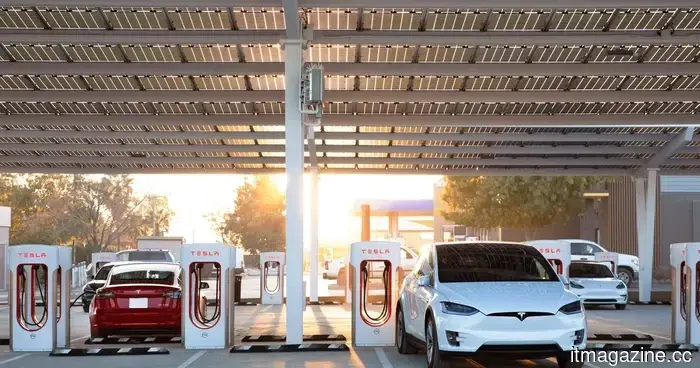 Tesla is facing an issue with battery theft.
A WIRED investigation has uncovered that organized gangs have repeatedly pilfered Tesla battery shipments from its facility in Nevada, leading to enhanced security measures and increased worries regarding supply chain weaknesses.
Tesla is facing an issue with battery theft.
A WIRED investigation has uncovered that organized gangs have repeatedly pilfered Tesla battery shipments from its facility in Nevada, leading to enhanced security measures and increased worries regarding supply chain weaknesses.
Visa states that investments in AI and digital commerce are driving the global economy.
Visa's midyear outlook for the VBEI predicts a 2.4% growth in the global economy by 2026, attributing this to an investment surge fueled by AI and online price competition that are mitigating the impact of rising energy expenses.