
Meta’s Brain2Qwerty v2 converts thoughts into text without requiring any brain implants.
The newest AI model translates brain signals into coherent sentences using external scanning devices.
Meta
Artificial intelligence has made significant progress in understanding humans, and now Meta aims to expand its reach to understanding our brains. The company has introduced Brain2Qwerty v2, an enhanced AI system that can convert brain activity into complete sentences without the need for brain implants or surgery. The purpose is not to read minds broadly, but rather to assist individuals who have lost the ability to speak to communicate once more.
How the Brain-Powered Keyboard Operates
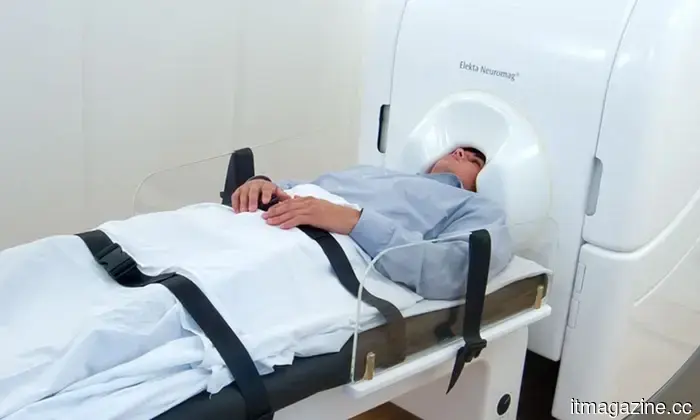
To conceptualize Brain2Qwerty v2, think of it as a highly sophisticated brain-powered keyboard. Participants wear a Magnetoencephalography (MEG) scanner, which detects the faint magnetic signals generated by the brain while they are typing. Instead of focusing on the keyboard, the AI interprets these brain signals to predict what the individual intended to write.
Comparing Meta Brain2Qwerty v2 and v1
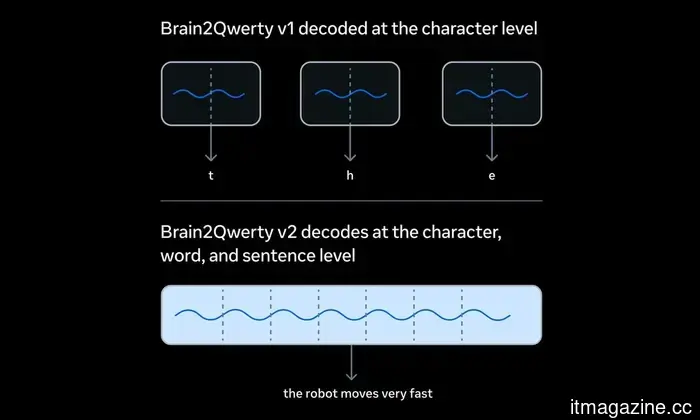
The primary advancement from the original Brain2Qwerty is its capability to decode not just one letter at a time but rather characters, words, and entire sentences. It employs large language models to fill in the gaps much like how smartphones predict the next word during typing. Meta describes this system as incorporating semantic understanding, enabling it to restore coherent sentences from highly noisy brain signals.
Internally, the AI integrates deep learning models such as Transformers and Convolutional Neural Networks with refined language models that function similarly to a spellchecker for the brain. If the neural signal is partial or distorted, the language model uses context to deduce what the user likely intended to communicate. Meta has also used AI agents to enhance the decoding process, improving its real-time effectiveness.
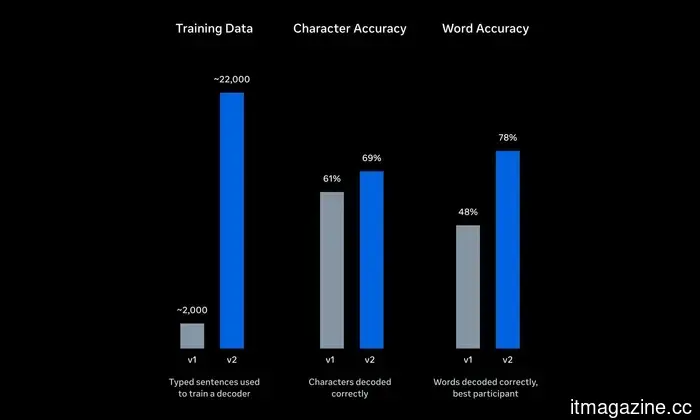
According to the official research paper, the system was trained on approximately 22,000 typed sentences from nine volunteers, each spending around ten hours in an MEG scanner while typing. Currently, Brain2Qwerty v2 achieves an average word accuracy of 61%, with the best participant reaching 78% accuracy; more than half of their decoded sentences contained one word error or fewer. Meta has made the training code and dataset publicly available for other researchers to build upon.
The Advantages of Non-Invasive Technology
Interestingly, the most significant breakthrough is not the AI itself but rather its ability to function without invasive surgery. Most advanced brain-computer interfaces today, like Elon Musk’s Neuralink, require surgically implanted electrodes for high accuracy. In contrast, Brain2Qwerty v2 utilizes an entirely external Magnetoencephalography (MEG) scanner to monitor brain activity, removing the risks associated with invasive implants while still delivering impressively strong results.
Reference for Magnetoencephalography (MEG) machine: Cleveland Clinic
Meta is still far from creating a consumer product, and it’s unlikely that anyone will be able to send emails using just their thoughts anytime soon. The MEG scanners used with Brain2Qwerty are large, costly devices suited for research laboratories rather than home environments. However, by merging advancements in neuroscience with modern AI, Meta is demonstrating that non-invasive brain-computer interfaces might be closer to realization than previously thought. This development could hold significant meaning for individuals who have lost communication abilities, far surpassing the impact of any chatbot or image generator.
Varun is a seasoned technology journalist and editor with more than eight years of experience in consumer tech media. His work covers…
AI chatbots may often amplify delusions. Researchers highlight three indicators to watch for.
Experts caution that the design choices of chatbots can reinforce unhealthy beliefs in susceptible users.
AI chatbots are increasingly skilled at mimicking human conversation. However, a new review by psychiatrist Marc Augustin alongside researchers Thomas A. Pollak and Helen Morrin, published in NPP—Digital Psychiatry and Neuroscience, suggests that current AI research reveals a notable psychological risk that has not been adequately addressed. The paper, brought to attention by The Wall Street Journal, reviews previous studies and offers a framework that explains how three frequent chatbot behaviors can merge to support delusional thoughts in vulnerable users, creating what the authors term an "amplification spiral."
Researchers have identified these three warning signs.
Lost access to your cryptocurrency wallet? Avoid trying to solve it through Google.
Security experts caution that counterfeit recovery tools are becoming the latest trap for cryptocurrency owners.
Misplacing the recovery phrase for a cryptocurrency wallet can be highly distressing. Unfortunately, this is precisely the moment that scammers are anticipating. A recent alert highlights an escalating scam in which cybercriminals mask malware as cryptocurrency recovery software, deceiving distressed users into relinquishing far more than just access to their wallets.
The fraudulent recovery tool that is actually malware.
A Chinese AI lab claims it can compete with Anthropic's powerful Claude Mythos in identifying security vulnerabilities.
Security researchers assert that Z.ai's latest model can rival Anthropic's Mythos in a crucial aspect.
For several weeks, Anthropic's Mythos has been regarded



Other articles
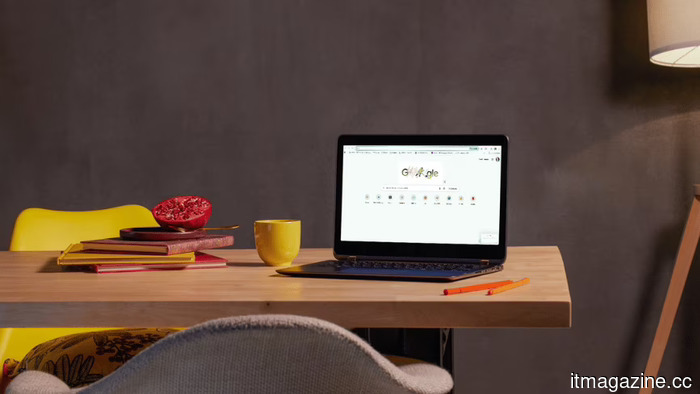 Chrome AI: what your browser installs without your consent
Chrome discreetly released a 4GB Gemini Nano AI model to users, while a fraudulent Perplexity extension intercepted searches. This highlights two aspects of Chrome's consent issue.
Chrome AI: what your browser installs without your consent
Chrome discreetly released a 4GB Gemini Nano AI model to users, while a fraudulent Perplexity extension intercepted searches. This highlights two aspects of Chrome's consent issue.
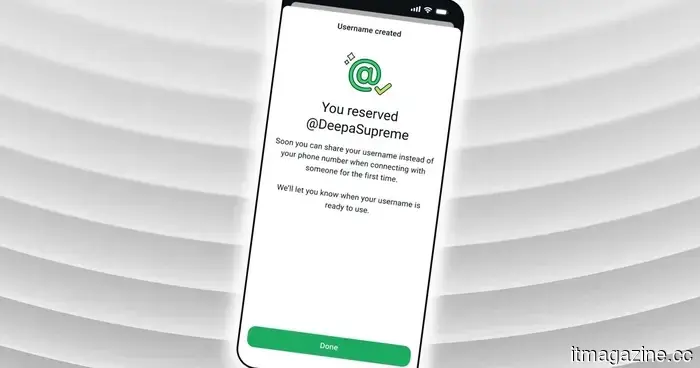 How to secure your WhatsApp username
Claiming your WhatsApp username takes less than a minute, but there are some rules and a crucial timing consideration that you should be aware of beforehand.
How to secure your WhatsApp username
Claiming your WhatsApp username takes less than a minute, but there are some rules and a crucial timing consideration that you should be aware of beforehand.
 SCOTUS restricts geofence warrants in a victory for phone privacy.
The Supreme Court determined that geofence warrants require probable cause, concluding that individuals possess a reasonable expectation of privacy regarding their phone location information.
SCOTUS restricts geofence warrants in a victory for phone privacy.
The Supreme Court determined that geofence warrants require probable cause, concluding that individuals possess a reasonable expectation of privacy regarding their phone location information.
 Gemini will now jot down notes for you during Google Meet, provided you pay the minimum $20 AI fee.
The "Take notes for me" feature in Google Meet, powered by Gemini, is being introduced for AI Pro and Ultra subscribers, though this helpful meeting enhancement begins with a $20 monthly subscription.
Gemini will now jot down notes for you during Google Meet, provided you pay the minimum $20 AI fee.
The "Take notes for me" feature in Google Meet, powered by Gemini, is being introduced for AI Pro and Ultra subscribers, though this helpful meeting enhancement begins with a $20 monthly subscription.
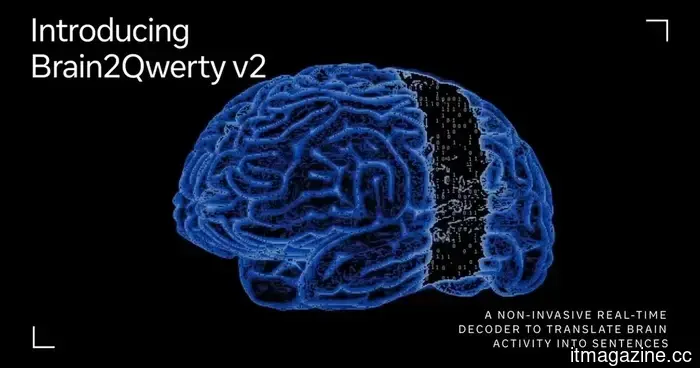 Meta’s Brain2Qwerty v2 converts thoughts into text without the need for brain implants.
Meta has introduced Brain2Qwerty v2, an AI system that translates brain activity into text non-invasively, moving assistive communication closer to becoming a reality.
Meta’s Brain2Qwerty v2 converts thoughts into text without the need for brain implants.
Meta has introduced Brain2Qwerty v2, an AI system that translates brain activity into text non-invasively, moving assistive communication closer to becoming a reality.
 Gemini will now take notes for you during Google Meet, provided you pay the minimum $20 AI tax.
The "Take notes for me" feature powered by Gemini in Google Meet is being introduced for AI Pro and Ultra subscribers, but access to this beneficial meeting enhancement requires a $20 monthly subscription.
Gemini will now take notes for you during Google Meet, provided you pay the minimum $20 AI tax.
The "Take notes for me" feature powered by Gemini in Google Meet is being introduced for AI Pro and Ultra subscribers, but access to this beneficial meeting enhancement requires a $20 monthly subscription.
Meta’s Brain2Qwerty v2 converts thoughts into text without requiring any brain implants.
Meta has introduced Brain2Qwerty v2, an AI technology that translates brain activity into text non-invasively, advancing assistive communication towards becoming a reality.