
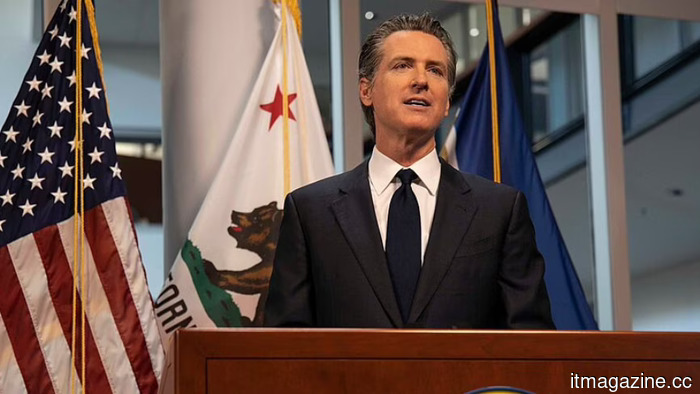
California will impose a tax on downloaded software for the first time as a component of a $351.7 billion budget agreement.
**TL;DR** California has introduced a $351.7 billion budget that includes a sales tax on downloaded software for the first time, projected to generate $2 billion annually. A ballot initiative would enable the state to retain more revenue from AI IPO gains.
Governor Gavin Newsom and leading Democratic lawmakers have reached an agreement on a $351.7 billion state budget that expands sales tax to include prewritten software downloaded online. This tax is anticipated to yield $900 million for the state and an additional $1.1 billion for local governments starting in fiscal year 2028 and continuing annually, as reported by Bloomberg.
Previously, this software was only taxed when purchased on a physical disc. During a legislative discussion on June 18, state Senator John Laird noted, “Most of us don’t acquire prewritten software on a physical disc anymore. The entire world has moved on, but our tax code hasn’t.”
Republicans contended that the new measure increases expenses for businesses that utilize software ranging from basic office applications to electronic medical records. State Senator Suzette Martinez Valladares remarked, “For millions of Californians, this isn’t theoretical. This affects real individuals and real businesses. This tax could determine whether payroll can be met or not.”
The budget also includes a measure for the November ballot that would enable California to save additional funds from revenue surges, such as the anticipated IPOs of California-based OpenAI and Anthropic. The state’s highly progressive tax system results in financial vulnerability during market declines, leaving $35.2 billion in savings accounts and $4.5 billion in the regular reserve.
This spending plan marks Newsom’s final budget as governor and comes amid financial gains attributed to the AI boom. However, despite stronger-than-expected tax revenues, the budget does not include significant new spending priorities. Lawmakers are conserving resources in anticipation of substantial federal funding cuts to healthcare stemming from the Trump administration. The deal allocates $90 million for struggling hospitals and $250 million for public hospitals, which is less than half the amount requested by hospital systems to address over $3 billion in annual federal reductions.
Additionally, the budget maintains existing restrictions on business tax credits and sets a permanent cap for 2030, limiting companies to either a maximum of $5 million in credits annually or 70% of their tax liability. A separate proposal for a one-time tax on billionaires, supported by a labor union, is advancing to the ballot despite Newsom’s efforts to negotiate a compromise. Although the AI boom has transformed California’s fiscal environment, the state is prioritizing reserves over spending the surplus, preparing for the likelihood of a sharp market correction that could impact its financial health.
Other articles
 Researchers developed an AI therapist that analyzes data from your smartwatch and earbuds to identify signs of distress before you seek assistance.
The UbiMyTherapist program at the University of Ottawa utilizes heart rate, speech tone, and text data from wearables to create a digital twin and provide proactive mental health assistance.
Micron momentarily exceeded Meta and Tesla in terms of market value. Its stock has risen by 236% in a single month.
Micron's market capitalization reached $1.27 trillion, with revenue increasing fourfold to $41.45 billion due to heightened demand for AI memory. The company has finalized 16 long-term supply agreements to prevent a downturn in the market cycle.
Researchers developed an AI therapist that analyzes data from your smartwatch and earbuds to identify signs of distress before you seek assistance.
The UbiMyTherapist program at the University of Ottawa utilizes heart rate, speech tone, and text data from wearables to create a digital twin and provide proactive mental health assistance.
Micron momentarily exceeded Meta and Tesla in terms of market value. Its stock has risen by 236% in a single month.
Micron's market capitalization reached $1.27 trillion, with revenue increasing fourfold to $41.45 billion due to heightened demand for AI memory. The company has finalized 16 long-term supply agreements to prevent a downturn in the market cycle.
 Windows 11 will introduce a new Screen Tint mode, and your eyes could appreciate Microsoft for it.
Microsoft is experimenting with a new Screen Tint accessibility option in Windows 11 designed to lessen eye strain through adjustable color overlays.
Windows 11 will introduce a new Screen Tint mode, and your eyes could appreciate Microsoft for it.
Microsoft is experimenting with a new Screen Tint accessibility option in Windows 11 designed to lessen eye strain through adjustable color overlays.
 Auto repair is among the least digitized sectors in America. AI is transforming the economic reasons behind this.
There are still 280,000 independent repair shops in the US that rely on phone scheduling and paper orders. AI receptionists, predictive scheduling, and PE rollups are coming together.
Auto repair is among the least digitized sectors in America. AI is transforming the economic reasons behind this.
There are still 280,000 independent repair shops in the US that rely on phone scheduling and paper orders. AI receptionists, predictive scheduling, and PE rollups are coming together.
 OpenAI's poaching of talent from Apple suggests that ChatGPT-powered wearables may soon be designed for facial use.
The engineering leader of Apple's Vision Pro is departing for OpenAI, suggesting that the company's aspirations in AI hardware could reach far beyond just ChatGPT.
OpenAI's poaching of talent from Apple suggests that ChatGPT-powered wearables may soon be designed for facial use.
The engineering leader of Apple's Vision Pro is departing for OpenAI, suggesting that the company's aspirations in AI hardware could reach far beyond just ChatGPT.
 It seems that Apple Books is facing a similar issue with knockoffs as Amazon does.
Joanna Stern notes that unauthorized AI-generated versions of her book continue to show up on Apple Books, which underscores an escalating issue with digital bookstores.
It seems that Apple Books is facing a similar issue with knockoffs as Amazon does.
Joanna Stern notes that unauthorized AI-generated versions of her book continue to show up on Apple Books, which underscores an escalating issue with digital bookstores.
California will impose a tax on downloaded software for the first time as a component of a $351.7 billion budget agreement.
California's revised budget expands sales tax to include downloads of prewritten software, projected to generate $900 million for the state. A proposed ballot measure aims to preserve the gains from AI IPOs.