
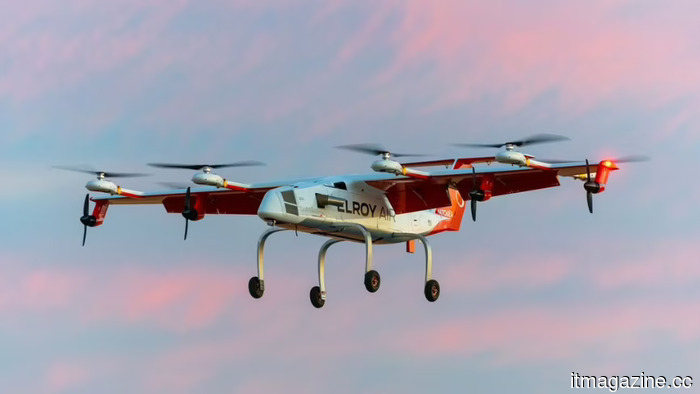
Cargo drone company Elroy Air is close to finalizing an $800 million SPAC agreement.
The creator of the autonomous Chaparral is engaged in advanced negotiations to go public via a blank-check merger, which would value the combined entity at approximately $1 billion. The SPAC, often declared moribund in recent years, continues to find new applications, with the latest being a cargo drone.
Elroy Air, a California-based startup aiming to replace certain delivery trucks with autonomous aircraft, is in in-depth discussions to merge with a blank-check company to facilitate its public listing. This merger would result in a firm valued at about $1 billion, with a potential announcement possible as soon as today.
The counterpart in this transaction is Columbus Circle Capital Corp. II, a special-purpose acquisition company backed and led by the management team from Inflection Point Asset Management. The fundraising tied to the merger is approximately $800 million, although the exact structure was not disclosed during the discussions.
The product from Elroy Air accounts for the growing interest in the company. Established in 2017 by David Merrill and Clint Cope, Elroy Air manufactures the Chaparral, which is a hybrid-electric drone engineered for what logistics companies categorize as middle-mile delivery. This aircraft is designed to transport 300 pounds of cargo autonomously over 300 miles, serving the distance between a distribution center and a local depot that is too far for a van to cost-effectively cover and too short for a traditional aircraft.
This drone competes in the heavier-payload category compared to grocery and parcel drones that are currently operational in Europe. The existing order book provides support for the company’s valuation. Elroy Air reports approximately 1,500 preorders from clients such as FedEx and Bristow Group, in addition to ongoing contracts and interest from U.S. and allied military forces.
In January 2026, it entered into a $200 million joint venture with Abu Dhabi’s Barq Group to produce the Chaparral, with aims for commercial deployment this year. The defense aspect of the business has gained more attention. Earlier this year, Elroy Air was chosen to facilitate autonomous aerial cargo delivery for a new White House program, and there is active demand from U.S. and allied military forces, in addition to the commercial backlog.
There is a keen military interest in developing autonomous logistics in contested or hard-to-reach areas, similarly to how Europe’s first licensed cargo drone is nearing operational status. A drone designed to carry 300 pounds without a pilot serves both military applications and middle-mile parcel delivery effectively.
Taking a hardware company that is pre-revenue or early-revenue public through a merger with a blank-check firm allows it to raise funds and secure a public listing without the rigorous review of a traditional IPO presentation. This method explains why such mergers surged in popularity, only to later fall out of favor among cash-hungry aerospace and mobility startups.
The broader drone-delivery sector has spent a decade hinting at imminent deployment that has mostly remained in the future. Elroy Air’s manufacturing goals are costly, and going public is one avenue for financing the anticipated rollout. However, preorders do not equate to revenue, and setting a target for commercial deployment in 2026 is more of an aspiration than a guarantee.
As described, the deal is still in negotiation and has not been finalized, with the terms likely to change before any official announcement. Currently, the discussion centers around a valuation of roughly $1 billion for a company whose aircraft is approaching deployment, but hasn’t yet achieved that milestone, promoted by a vehicle whose backers are taking a risk. The forthcoming indication will be whether the deal proceeds as planned or experiences delays.
Other articles
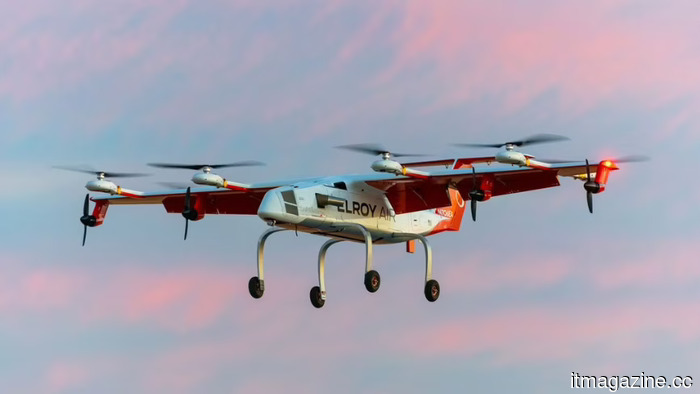 Cargo drone company Elroy Air is approaching an $800 million agreement with a SPAC.
Elroy Air, the company behind the autonomous Chaparral cargo drone, is in advanced discussions to become public through a SPAC merger, which would value the company at around $1 billion.
Cargo drone company Elroy Air is approaching an $800 million agreement with a SPAC.
Elroy Air, the company behind the autonomous Chaparral cargo drone, is in advanced discussions to become public through a SPAC merger, which would value the company at around $1 billion.
 Italy launches an antitrust investigation into the price increase of Microsoft 365's AI features.
Italy's antitrust authority is investigating Microsoft's increase in Microsoft 365 prices following the inclusion of Copilot and Designer AI tools.
Italy launches an antitrust investigation into the price increase of Microsoft 365's AI features.
Italy's antitrust authority is investigating Microsoft's increase in Microsoft 365 prices following the inclusion of Copilot and Designer AI tools.
 The US government requests that OpenAI delays the launch of its upcoming model.
The Trump administration has requested that OpenAI delay the release of GPT-5.6, granting access to customers individually due to security concerns.
SpaceX aims to market Starlink phone service directly to consumers in the United States.
SpaceX has informed investors of its intention to launch a Starlink mobile service targeting US consumers, which will directly compete with Verizon, AT&T, and T-Mobile.
The US government requests that OpenAI delays the launch of its upcoming model.
The Trump administration has requested that OpenAI delay the release of GPT-5.6, granting access to customers individually due to security concerns.
SpaceX aims to market Starlink phone service directly to consumers in the United States.
SpaceX has informed investors of its intention to launch a Starlink mobile service targeting US consumers, which will directly compete with Verizon, AT&T, and T-Mobile.
 Samsung's $647 billion home investment is set to move toward the chip-deficient southwest.
Samsung is anticipated to announce an investment of 1,000 trillion won ($647.5 billion) over the next decade in South Korea, with plans for chip manufacturing facilities located outside of Seoul.
Samsung's $647 billion home investment is set to move toward the chip-deficient southwest.
Samsung is anticipated to announce an investment of 1,000 trillion won ($647.5 billion) over the next decade in South Korea, with plans for chip manufacturing facilities located outside of Seoul.
 Samsung’s $647 billion home investment is directed toward the chip-deficient southwest.
Samsung is anticipated to announce a 1,000 trillion won ($647.5 billion) investment plan over the next decade in South Korea, with chip manufacturing facilities planned for locations outside of Seoul.
Samsung’s $647 billion home investment is directed toward the chip-deficient southwest.
Samsung is anticipated to announce a 1,000 trillion won ($647.5 billion) investment plan over the next decade in South Korea, with chip manufacturing facilities planned for locations outside of Seoul.
Cargo drone company Elroy Air is close to finalizing an $800 million SPAC agreement.
Elroy Air, the producer of the autonomous Chaparral cargo drone, is in deep discussions to become a public company through a SPAC merger, which would value the company at approximately $1 billion.