
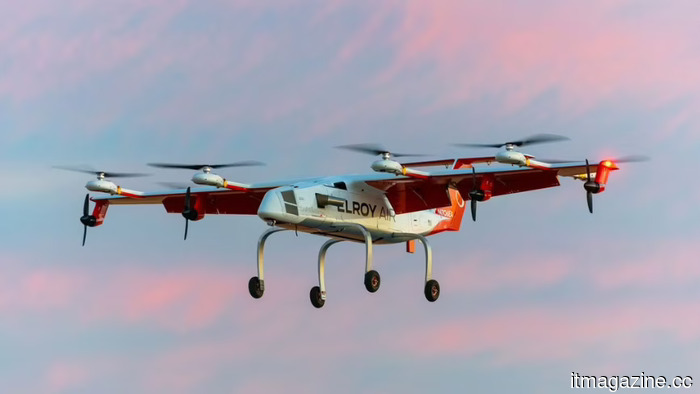
Cargo drone company Elroy Air is approaching an $800 million SPAC agreement.
The developer of the autonomous Chaparral is in advanced negotiations to go public via a merger with a blank-cheque company, which would value the merged entity at around $1 billion. The SPAC, which has been deemed irrelevant several times in recent years, is finding new opportunities, with the latest being a cargo drone.
Elroy Air, a California-based startup aiming to replace some delivery trucks with autonomous aircraft, is in discussions to go public through a merger with a special-purpose acquisition company. This agreement would establish a business with an enterprise value of roughly $1 billion and could be announced as soon as today.
The partner in this deal is Columbus Circle Capital Corp. II, a SPAC that is led and supported by the management team of Inflection Point Asset Management. The funding connected to the transaction is approximately $800 million, although the exact structure was not disclosed at the time the negotiations were reported.
The appeal of Elroy Air's product lies in its innovation. Founded in 2017 by David Merrill and Clint Cope, the company develops the Chaparral, a hybrid-electric drone designed for what logistics companies refer to as middle-mile delivery, featuring vertical take-off and landing capabilities. This aircraft is designed to autonomously transport 300 pounds of cargo over a distance of 300 miles, bridging the gap between distribution centers and local depots, which are too far for vans to service cost-effectively and too short for traditional aircraft.
It serves as a higher-capacity counterpart to the grocery and parcel drones currently in commercial use in Europe. The order book supports the valuation; Elroy Air claims to have approximately 1,500 preorders from clients such as FedEx and Bristow Group, along with active contracts and interest from U.S. and allied military forces.
In January 2026, Elroy Air entered into a $200 million joint venture with Abu Dhabi's Barq Group to produce the Chaparral, with plans for commercial deployment this year. The defense aspect has become increasingly significant, as Elroy Air was chosen earlier this year to contribute autonomous aerial cargo delivery to a new White House initiative, complementing the commercial order backlog with interest from U.S. and allied militaries.
The military interest reflects a desire to develop autonomous logistics for challenging or remote environments, much like Europe’s first licensed cargo drone is progressing toward operation. A drone capable of carrying 300 pounds without a pilot meets both military needs and the requirements for middle-mile parcel delivery.
Bringing a pre-revenue or early-revenue hardware company public through a merger with a blank-cheque vehicle allows it to secure funding and achieve a listing without the pressures of a traditional IPO roadshow, which is why such deals initially became popular but later declined among cash-hungry aerospace and mobility startups.
The broader drone delivery industry has spent ten years promising deployment that often remains just out of reach. Elroy Air's manufacturing goals require significant investment, and a public listing could provide the necessary capital for progressing towards its promised deployment.
Preorders do not equate to revenue, and the aim for commercial deployment in 2026 is more of a goal than a certainty. As outlined, the deal is still in negotiations and has not yet been finalized, meaning the terms could change before any official announcement. Currently, what is being proposed is a valuation of about $1 billion for a company that is approaching deployment but has not yet achieved it, facilitated by a vehicle whose backers are making a gamble. The next indicator will be whether the deal is announced as planned or experiences delays.
Other articles
 The US government requests that OpenAI delays the launch of its upcoming model.
The Trump administration has requested OpenAI to delay the release of GPT-5.6, granting customer access in a staggered manner due to security issues.
The US government requests that OpenAI delays the launch of its upcoming model.
The Trump administration has requested OpenAI to delay the release of GPT-5.6, granting customer access in a staggered manner due to security issues.
 Italy initiates an antitrust investigation into the price increase of Microsoft 365's AI services.
Italy’s competition authority is investigating the increase in Microsoft 365 prices that occurred following the inclusion of Copilot and Designer AI tools.
Italy initiates an antitrust investigation into the price increase of Microsoft 365's AI services.
Italy’s competition authority is investigating the increase in Microsoft 365 prices that occurred following the inclusion of Copilot and Designer AI tools.
 Samsung's $647 billion home investment is set to move toward the chip-deficient southwest.
Samsung is anticipated to announce an investment of 1,000 trillion won ($647.5 billion) over the next decade in South Korea, with plans for chip manufacturing facilities located outside of Seoul.
Samsung's $647 billion home investment is set to move toward the chip-deficient southwest.
Samsung is anticipated to announce an investment of 1,000 trillion won ($647.5 billion) over the next decade in South Korea, with plans for chip manufacturing facilities located outside of Seoul.
 The US government has requested that OpenAI delay the launch of its upcoming model.
The Trump administration has requested that OpenAI gradually release GPT-5.6, granting access to each customer individually due to security issues.
The US government has requested that OpenAI delay the launch of its upcoming model.
The Trump administration has requested that OpenAI gradually release GPT-5.6, granting access to each customer individually due to security issues.
 Italy initiates an antitrust investigation into the price increase of Microsoft 365's AI features.
Italy's competition authority is investigating how Microsoft increased prices for Microsoft 365 following the integration of Copilot and Designer AI tools.
SpaceX aims to market Starlink phone service directly to consumers in the United States.
SpaceX has informed investors of its intention to launch a Starlink mobile service targeting US consumers, which will directly compete with Verizon, AT&T, and T-Mobile.
Italy initiates an antitrust investigation into the price increase of Microsoft 365's AI features.
Italy's competition authority is investigating how Microsoft increased prices for Microsoft 365 following the integration of Copilot and Designer AI tools.
SpaceX aims to market Starlink phone service directly to consumers in the United States.
SpaceX has informed investors of its intention to launch a Starlink mobile service targeting US consumers, which will directly compete with Verizon, AT&T, and T-Mobile.
Cargo drone company Elroy Air is approaching an $800 million SPAC agreement.
Elroy Air, the producer of the autonomous Chaparral cargo drone, is engaged in advanced discussions to become a public company through a SPAC merger that would value it at approximately $1 billion.