
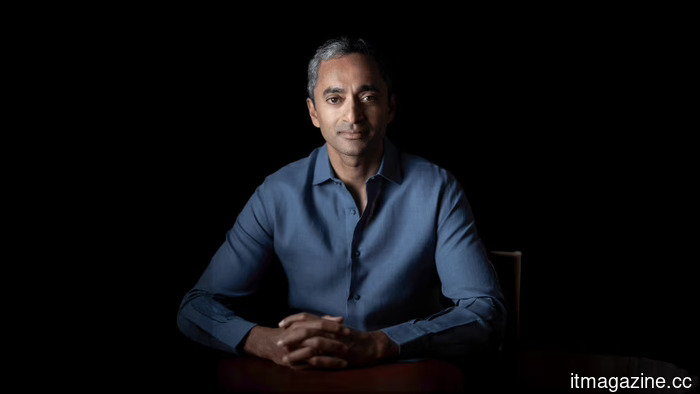
Chamath Palihapitiya: Meta mishandled its position in AI.
On The Axios Show, Chamath Palihapitiya stated that Meta “fumbled” its opportunity in AI, dismissed concerns about a jobs apocalypse, and described his SPAC incentives as “grossly misaligned.” Here’s what the investor conveyed to Axios.
Chamath Palihapitiya is not one for subdued interviews. On The Axios Show, the investor and co-host of the All-In podcast discussed Meta’s AI misstep, the future of work, his regrets regarding SPACs, and the limitations of online privacy. His opinions are significant, resonating in the White House and with hundreds of thousands of podcast listeners. Few investors navigate as freely through the realms of technology, markets, and politics.
Palihapitiya stands out as an atypical spokesperson. As an immigrant, a Trump supporter, and a former Facebook executive involved in building the platform, his background added a unique dynamic to the discussion. He was critical of his former employer.
His strongest criticism was aimed at Facebook, stating the company “completely fumbled” a major opportunity to lead in AI during his conversation with Axios’ Dan Primack. He even remarked that Meta had “profoundly failed.”
This critique carries weight due to his past perspective. In 2022, prior to the launch of ChatGPT, Palihapitiya believed Meta was in a strong position in AI given its extensive user data and reach.
However, when the moment to seize the opportunity came, Meta fell short. As chatbot enthusiasm surged, Facebook possessed the ability to distribute AI products to billions simultaneously. He argued it could have become a leader in open-weight AI, but instead, Nvidia and Jensen Huang capitalized on the moment and created an ecosystem centered around open models.
He categorized the AI market into three main pillars. The first includes closed American labs like OpenAI and Anthropic. The second consists of China’s lower-cost open-weight competitors, led by DeepSeek. The third was available for Meta to dominate: the open-source, open-weight American lab. While Meta's Llama models are classified as open-weight, they aren’t fully open source. He believes the company failed to establish itself in that area and is now leaning toward proprietary models.
Palihapitiya refrained from speculating on the reasons behind this failure, admitting he lacks insight into Meta’s internal decisions and can only observe the outcomes.
The stakes are high. Meta has invested billions into AI research and talent. However, his argument focuses on positioning rather than expenditure. He contended that the company, which excelled in social distribution, did not translate that advantage into AI leadership.
No jobs apocalypse
Regarding employment, he strongly opposed the apocalyptic narrative. He suggested that the notion of AI eliminating jobs makes for an “incredible headline” but overlooks historical patterns.
When Primack suggested a future where robots might handle plumbing, Palihapitiya simply questioned who would run those plumbing and robotics companies, emphasizing the continued need for shelter, food, clothing, and bathrooms.
“I think it’s great to spark a debate,” he stated. Nonetheless, he argued that the fear disregards the “patterns of the past,” asserting that past technologies allowed humans to do more, not less.
“I suspect if you trend it, 35 things now could increase to 300 things over the next thousand years,” he remarked. “There will be more ways for us to allocate our time.” When Primack expressed concern for his teenage daughter’s future, Palihapitiya countered whether he truly believed she would end up “unemployed and a ward of the state.”
Others share a similar perspective. Sam Altman from OpenAI has indicated that a jobs apocalypse is improbable, revising earlier warnings. He acknowledges, however, that some sectors, like customer support, will likely see significant reductions. The conversation has shifted broadly within Big Tech, with CEOs moving from fear to reassurance. Researchers at MIT have characterized AI automation as a “rising tide” rather than a “crashing wave.” The sentiment among AI leaders has transitioned from panic to caution.
A rare SPAC mea culpa
One of the most notable moments was personal. Palihapitiya, once known as the “SPAC King,” acknowledged his critics.
“The most important thing I learned was that my incentives were grossly misaligned,” he admitted, confessing he had resisted this realization for years due to insecurity. The core issue was that he could close a deal and still be compensated, regardless of the outcome.
He did not completely renounce his previous deals. “I don’t believe I made bad deals in how I underwrote them,” he explained. “But the stock performance is what it is, and that’s undeniable.” His SPACs yielded one success, SoFi, alongside dismal performers like Virgin Galactic and Clover Health.
This marks a shift in his stance. In 2022, he attributed poor SPAC results to a market distorted
Other articles
 Airwallex secures $320 million at a valuation of $11 billion.
Airwallex has secured $320 million at an $11 billion valuation, an increase from its previous valuation of $8 billion, and is shifting its focus towards autonomous finance and AI agents that conduct transactions on your behalf.
Airwallex secures $320 million at a valuation of $11 billion.
Airwallex has secured $320 million at an $11 billion valuation, an increase from its previous valuation of $8 billion, and is shifting its focus towards autonomous finance and AI agents that conduct transactions on your behalf.
 At the core of the AI revolution lies a significant human issue.
Afrozy Ara, the founder of LuminaData, contends that the $675 billion AI infrastructure surge will not yield benefits until companies cease automating flawed workflows and begin reengineering the foundational processes, starting with financial operations.
At the core of the AI revolution lies a significant human issue.
Afrozy Ara, the founder of LuminaData, contends that the $675 billion AI infrastructure surge will not yield benefits until companies cease automating flawed workflows and begin reengineering the foundational processes, starting with financial operations.
 At the core of the AI revolution lies a genuine human issue.
Afrozy Ara, the founder of LuminaData, contends that the $675 billion surge in AI infrastructure will not yield benefits until companies discontinue the automation of flawed workflows and begin to restructure the underlying processes, starting with financial operations.
At the core of the AI revolution lies a genuine human issue.
Afrozy Ara, the founder of LuminaData, contends that the $675 billion surge in AI infrastructure will not yield benefits until companies discontinue the automation of flawed workflows and begin to restructure the underlying processes, starting with financial operations.
 At the core of the AI revolution lies a significant human issue.
Afrozy Ara, the founder of LuminaData, contends that the $675 billion surge in AI infrastructure won't yield benefits until companies cease automating flawed workflows and instead focus on reengineering the underlying processes, starting with financial operations.
At the core of the AI revolution lies a significant human issue.
Afrozy Ara, the founder of LuminaData, contends that the $675 billion surge in AI infrastructure won't yield benefits until companies cease automating flawed workflows and instead focus on reengineering the underlying processes, starting with financial operations.
 The Kremlin is seeking clarification from Apple following the removal of VK applications from the App Store.
Apple removed VK's applications in Russia, referencing sanctions. VK claims it has not been sanctioned. The Kremlin is seeking clarification and is considering an alternative operating system.
The Kremlin is seeking clarification from Apple following the removal of VK applications from the App Store.
Apple removed VK's applications in Russia, referencing sanctions. VK claims it has not been sanctioned. The Kremlin is seeking clarification and is considering an alternative operating system.
 Alan secures €480 million in funding, led by Prosus, with a valuation of €5.5 billion.
Alan has secured €480 million, spearheaded by Prosus, at a €5.5 billion valuation, just months following its previous funding round, as the French insurtech focuses on AI-driven prevention.
Alan secures €480 million in funding, led by Prosus, with a valuation of €5.5 billion.
Alan has secured €480 million, spearheaded by Prosus, at a €5.5 billion valuation, just months following its previous funding round, as the French insurtech focuses on AI-driven prevention.
Chamath Palihapitiya: Meta mishandled its position in AI.
Chamath Palihapitiya stated on The Axios Show that Meta mismanaged its advantage in AI, the notion of a jobs apocalypse is a misconception, and his SPAC incentives were not properly aligned.