
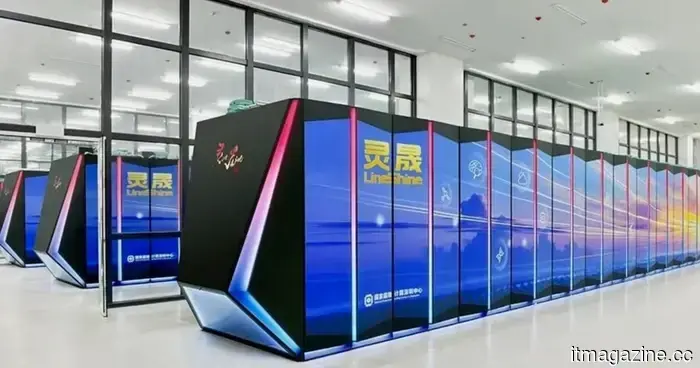
A new supercomputer has surpassed the U.S. — here’s why this is significant.
**LineShine**
The competition to create the fastest supercomputer has been largely led by the United States, but China has made a strong comeback. The newly ranked system known as LineShine has taken the top spot on the latest Top500 list, which monitors the world's most powerful supercomputers. Situated in Shenzhen, LineShine surpassed the U.S. government's El Capitan system, becoming the first Chinese supercomputer to reach this rank since 2017. This is already significant, but what makes LineShine particularly noteworthy is the method it used to achieve this.
The tortoise has outpaced the rocket
Most of the current advancements in computing, especially those related to artificial intelligence, are centered around powerful graphics processors (GPUs). These chips drive everything from ChatGPT to state-of-the-art AI developments. However, LineShine chose a different path. Rather than relying on thousands of specialized AI processors, the system is based entirely on conventional CPUs. Despite this seemingly outdated choice, it delivered over 2.1 exaflops of performance — sufficient to execute more than two quintillion calculations every second.
This serves as a reminder that while AI hardware often steals the spotlight, there are still various methods to achieve substantial computing power. It's important to note that this isn't merely about showing off; supercomputers play a vital role in diverse areas like medical research, climate modeling, advanced scientific simulations, and national security. Reaching the top of the list has been seen as a marker of technological prowess.
The world’s fastest computers face a surprisingly sluggish challenge
The timing is also intriguing. Governments across the globe are investing billions into next-generation computing infrastructure. Europe is making substantial investments in large AI-centric facilities intended to train upcoming models and boost research in healthcare, robotics, biotechnology, and various industries.
At the same time, worries regarding energy consumption are becoming more pronounced. These enormous systems require vast quantities of electricity, and many facilities also need significant water resources for cooling. Therefore, while LineShine’s emergence alters the rankings, it also underscores a broader reality: the global race in computing is speeding up. Increasingly, the contention isn't only about who can construct the fastest machine but also about who can create the future sustainably.
Shimul is a contributor at Digital Trends, bringing over five years of technical expertise.
**Gemini in Chrome now recognizes exactly what you're viewing on screen**
Google's new "Select from screen" feature simplifies how users can inquire about text and images using Gemini in a web browser tab.
Google has enhanced Gemini's awareness of activities within Chrome. The company has begun deploying a new "Select from screen" option that allows users to highlight particular text or images from a webpage and send them directly to Gemini, making interactions with the AI assistant much more contextual. Gemini can now concentrate on precisely what users wish to inquire about.
**Microsoft’s new Surface PCs come at a lower cost — but there’s a catch**
The tech industry's ongoing balancing act is becoming increasingly challenging. Component prices are escalating, memory costs remain high, and laptop manufacturers are struggling to control price increases. Microsoft’s latest refresh of the Surface line seems to address this issue directly. The company has unveiled new entry-level versions of its 12-inch Surface Pro and 13-inch Surface laptop, presenting lower starting prices without altering the processor or storage. On the surface, this appears to be positive news for those on a budget. However, a close examination reveals a compromise that is hard to ignore.
**I’ve compiled the best Prime Day 2026 laptop discounts — and here are five I’d recommend**
With rising memory costs leading to higher laptop prices, Prime Day 2026 may be the ideal opportunity to make a purchase before prices rise further.
If you’ve been following recent laptop releases, you've likely noticed how steeply prices have increased. Laptop costs have been on the rise for the past year, and there is little sign of a downturn soon. This makes the ongoing Prime Day 2026 sales an excellent time to buy a new laptop. Many of the discounts apply to devices priced close to their original launch prices, which makes the savings more significant. I've reviewed several deals from Amazon Prime Day for laptops, but only these five are worth emphasizing at their discounted prices. To simplify matters, I’ve ordered them from the most affordable to the most expensive.





Other articles
 Micron's revenue increased fourfold as the demand for AI memory drives gross margins over 81 percent.
Micron reported $41 billion in revenue for Q3, marking a fourfold increase compared to the previous year, as HBM4 chips for Nvidia and Google propelled gross margins above 81 percent for the first time.
Micron's revenue increased fourfold as the demand for AI memory drives gross margins over 81 percent.
Micron reported $41 billion in revenue for Q3, marking a fourfold increase compared to the previous year, as HBM4 chips for Nvidia and Google propelled gross margins above 81 percent for the first time.
 Micron's revenue increased fourfold as the demand for AI memory drives gross margins over 81 percent.
Micron reported $41 billion in revenue for Q3, a fourfold increase compared to the previous year, as HBM4 chips for Nvidia and Google pushed gross margins above 81 percent for the first time.
Micron's revenue increased fourfold as the demand for AI memory drives gross margins over 81 percent.
Micron reported $41 billion in revenue for Q3, a fourfold increase compared to the previous year, as HBM4 chips for Nvidia and Google pushed gross margins above 81 percent for the first time.
 Save the date, Batman: Caped Crusader Season 2 is set to launch in a single big binge drop this July.
The first trailer for Season 2 of Batman: Caped Crusader highlights The Riddler and concludes with a short glimpse of The Joker.
Save the date, Batman: Caped Crusader Season 2 is set to launch in a single big binge drop this July.
The first trailer for Season 2 of Batman: Caped Crusader highlights The Riddler and concludes with a short glimpse of The Joker.
 Micron's revenue increased fourfold as the demand for AI memory has driven gross margins to surpass 81 percent.
Micron reported $41 billion in revenue for Q3, marking a fourfold increase compared to the previous year, as HBM4 chips for Nvidia and Google pushed gross margins over 81 percent for the first time.
Micron's revenue increased fourfold as the demand for AI memory has driven gross margins to surpass 81 percent.
Micron reported $41 billion in revenue for Q3, marking a fourfold increase compared to the previous year, as HBM4 chips for Nvidia and Google pushed gross margins over 81 percent for the first time.
 Qualcomm secures Meta as its first identified customer for the Dragonfly data centre chips.
Qualcomm announced its Dragonfly C1000 data center chip, with Meta being its first specified customer, and confirmed its acquisition of AI startup Modular for $3.9 billion.
Qualcomm secures Meta as its first identified customer for the Dragonfly data centre chips.
Qualcomm announced its Dragonfly C1000 data center chip, with Meta being its first specified customer, and confirmed its acquisition of AI startup Modular for $3.9 billion.
 Micron's revenue increased fourfold due to the demand for AI memory, resulting in gross margins surpassing 81 percent.
Micron reported $41 billion in revenue for Q3, a fourfold increase compared to the previous year, as HBM4 chips for Nvidia and Google contributed to gross margins exceeding 81 percent for the first time.
Micron's revenue increased fourfold due to the demand for AI memory, resulting in gross margins surpassing 81 percent.
Micron reported $41 billion in revenue for Q3, a fourfold increase compared to the previous year, as HBM4 chips for Nvidia and Google contributed to gross margins exceeding 81 percent for the first time.
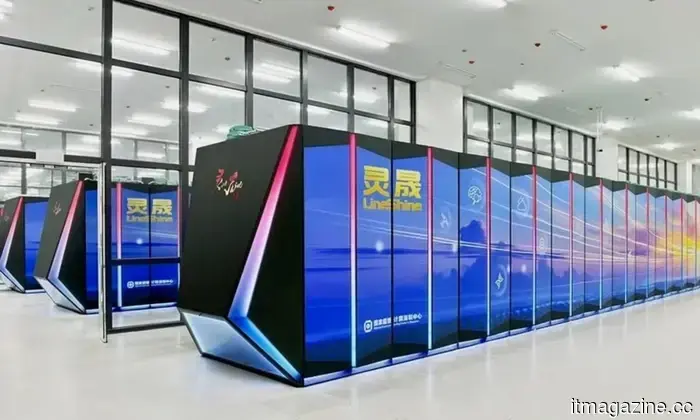
A new supercomputer has surpassed the U.S. — here’s why this is significant.
China has regained the leading position in supercomputing after almost ten years. Its latest LineShine system has surpassed the top American machine—achieving this without depending on AI-oriented GPUs.