
Tissium secures €60M for nerve repair without sutures.
Tissium has secured €60 million to introduce the world’s only FDA-approved sutureless nerve repair system into US operating rooms. The Paris-based medtech company aims to replace the surgeon’s needle with a small amount of light-cured adhesive.
The traditional approach to repairing a severed nerve has remained largely unchanged for decades. Surgeons typically stitch the two damaged ends together using a microscope, hoping to avoid causing harm to the tissue intended for repair. However, outcomes can be inconsistent, with a recent meta-analysis revealing that only 54% of patients regain significant function post-surgery.
Tissium believes it has a superior solution. The company has finalized a €60 million funding round, which will facilitate the introduction of its sutureless system to US markets. Its initial product is already available for sale in the country.
The funding is divided into two parts. The first is a €30 million Series D2 round, completed at the end of 2025 and led by an undisclosed family-owned investor from the US. Participation also came from new family offices, wealthy individuals, and existing investors. The second part consists of a credit line up to €30 million from the European Investment Bank, delivered in three €10 million tranches based on commercial, clinical, and financial milestones. This deal combines dilutive equity and venture debt, with Tissium planning to access the first tranche before the end of June.
With this latest funding, the company’s total capital raised since 2013 exceeds €200 million. Cathay Health led Tissium's previous funding round, a €50 million Series C, in 2024, with support from the French life-sciences investor Sofinnova.
The challenges with conventional suturing methods are significant. Nerve surgery is a meticulous process, and each stitch creates a minor wound that can lead to scarring in the fibers that need to regenerate. This is part of why recovery rates can be disappointing.
Tissium proposes a solution that avoids piercing the nerve. Its leading product, COAPTIUM CONNECT, involves placing a small 3D-printed chamber around the severed ends without damaging them. A surgeon applies a liquid polymer at the connection point, which is then solidified with a blue-light pen. This seal maintains the nerve’s position during healing and dissolves over the following months, leaving no residue.
The strength of Tissium lies in its proprietary material, referred to as a biomorphic programmable polymer. This synthetic adhesive contains no human or animal tissue, unlike competing products that depend on donors. Theoretically, its platform can be adapted for various types of repairs.
Preliminary clinical results, although limited in scale, are encouraging. In a study involving 12 patients with digital nerve injuries, all participants regained complete movement, and none reported pain a year post-surgery. This evidence enabled COAPTIUM CONNECT to receive FDA De Novo authorization and begin selling in the US as of November 2025.
The company claims to offer the only FDA-cleared sutureless nerve repair system currently available, which is central to its sales strategy and a reason why investors are willing to support a device with a relatively short operational history.
Tissium was founded in 2013 by Christophe Bancel and Maria Pereira, who developed the core polymer during her PhD in the MIT Portugal Program, working in the labs of prominent scientists like Robert Langer and Jeffrey Karp. The company is headquartered in Paris, with a US office in Cambridge, Massachusetts, and a production facility in Roncq, northern France.
“We are now executing our transition to becoming a commercial-stage medtech company,” stated Christophe Bancel, the CEO and co-founder. This lengthy development period is typical for medical devices, where regulatory processes are slow and validation takes years, which also explains the structure of this funding round. Tissium is no longer in the invention phase; it is focused on sales.
The potential market is substantial and expanding. The global market for peripheral nerve repair devices was valued at approximately $13.4 billion in 2025 and could reach $30.5 billion by 2033, with an annual growth rate of around 15%. As trauma cases increase, surgeons are favoring gentler, absorbable repair methods.
However, Tissium will face competition. The US company Axogen currently dominates the market, with a valuation near $1.67 billion. Its primary nerve graft product received full FDA biologics approval in December 2025. Additionally, Integra LifeSciences maintains strong positions in nerve conduits and wraps, but both rely on donor-derived materials and still require sutures to complete the process. Tissium bets that surgeons will prefer a synthetic device that doesn't penetrate the inside of the nerve.
The structure of the financing highlights trends in European medtech funding. The EIB has become a consistent supporter of health and deep tech firms in the region, investing in companies developing brain protection and cancer treatments.
Other articles
 Qualcomm secures Meta as its first identified customer for the Dragonfly data centre chips.
Qualcomm announced its Dragonfly C1000 data center chip, with Meta being its first specified customer, and confirmed its acquisition of AI startup Modular for $3.9 billion.
Qualcomm secures Meta as its first identified customer for the Dragonfly data centre chips.
Qualcomm announced its Dragonfly C1000 data center chip, with Meta being its first specified customer, and confirmed its acquisition of AI startup Modular for $3.9 billion.
 Qualcomm secures Meta as the first named client for its Dragonfly data center chips.
Qualcomm introduced its Dragonfly C1000 data center chip, with Meta as its initial named customer, and announced its acquisition of AI startup Modular for $3.9 billion.
Qualcomm secures Meta as the first named client for its Dragonfly data center chips.
Qualcomm introduced its Dragonfly C1000 data center chip, with Meta as its initial named customer, and announced its acquisition of AI startup Modular for $3.9 billion.
 Micron's revenue increased fourfold as the demand for AI memory drives gross margins over 81 percent.
Micron reported $41 billion in revenue for Q3, marking a fourfold increase compared to the previous year, as HBM4 chips for Nvidia and Google propelled gross margins above 81 percent for the first time.
Micron's revenue increased fourfold as the demand for AI memory drives gross margins over 81 percent.
Micron reported $41 billion in revenue for Q3, marking a fourfold increase compared to the previous year, as HBM4 chips for Nvidia and Google propelled gross margins above 81 percent for the first time.
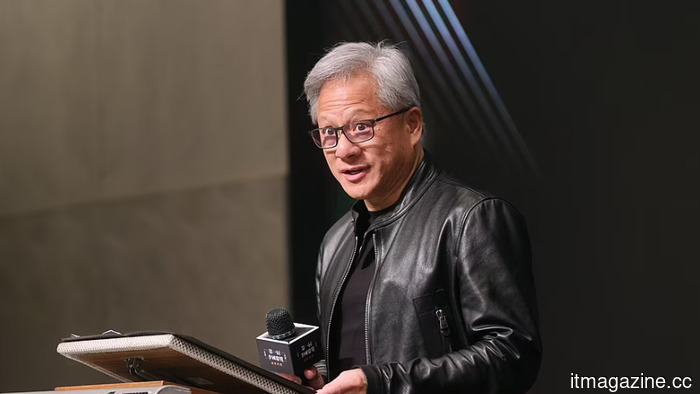 Nvidia's CEO Jensen Huang states that illicit data centers are futile and emphasizes the priority of national security.
Jensen Huang informed shareholders that Nvidia would focus on US national security rather than sales and described smuggled chip data centers as impractical.
Anthropic claims that Alibaba is conducting the largest distillation campaign aimed at Claude.
Anthropic informed US senators that Alibaba's Qwen lab utilized 25,000 fraudulent accounts to conduct nearly 29 million interactions with Claude from April to June.
Nvidia's CEO Jensen Huang states that illicit data centers are futile and emphasizes the priority of national security.
Jensen Huang informed shareholders that Nvidia would focus on US national security rather than sales and described smuggled chip data centers as impractical.
Anthropic claims that Alibaba is conducting the largest distillation campaign aimed at Claude.
Anthropic informed US senators that Alibaba's Qwen lab utilized 25,000 fraudulent accounts to conduct nearly 29 million interactions with Claude from April to June.
Tissium secures €60M for nerve repair without sutures.
France's Tissium has secured €60M to introduce COAPTIUM CONNECT, the sole FDA-approved sutureless nerve repair system, into operating rooms across the United States.