

The lovable CEO indicates that European AI startups face a confidence issue rather than a talent issue.
TL;DR: Lovable's CEO Anton Osika argues that the issue facing European AI startups is a lack of confidence rather than a shortage of talent, as his Stockholm-based company reaches $500 million in annual recurring revenue (ARR). In a post on X over the weekend, Osika emphasized that founders have been advised to relocate to San Francisco to establish reputable AI companies, but he contends that the real obstacle is not the availability of engineers. "The talent was never the problem," he stated. "The belief that you could build from here was."
His comments are significant as Lovable serves as a strong counterexample, having achieved rapid growth and surpassing $500 million in ARR with only 146 employees. The company has secured $653 million through four funding rounds and is now valued at over six billion dollars after a $330 million Series B led by CapitalG and Menlo Ventures. Osika noted that millions globally, with many in Europe, have utilized Lovable to transform ideas into products and businesses, although the U.S. is still its largest market. He highlighted that many engineers are choosing to return to Europe for meaningful work.
Data from Revelio Labs, which analyzes migration patterns through public immigration data, supports this perspective. It found that by the end of 2024, more tech workers are migrating from the U.S. to Europe than vice versa, reversing a long-standing trend. Since 2021, the proportion of U.S. workers taking jobs abroad has increased from less than three percent to nearly six percent, with IT consulting roles experiencing the greatest growth.
This shift has been bolstered by stricter U.S. immigration policies and heightened scrutiny of work visas, making career opportunities in America less reliable for foreign nationals. The “Built in Europe” campaign by Balderton Capital, supported by over 100 founders from companies like Revolut, Mistral, Wayve, and Lovable, recently launched in five European cities, emphasizing that the necessary talent, capital, and ambition are already present in Europe.
However, not everyone is convinced that the problem has been resolved. Y Combinator co-founder Paul Graham, speaking in Stockholm in May, stressed that ambitious founders should consider spending time in Silicon Valley due to its concentration of investors and chance encounters. While he believes Stockholm could become “the Silicon Valley of Europe,” he also noted that the original still provides unique opportunities that no European hub has replicated.
Osika acknowledged that one critical component is still lacking: Europe requires regional AI infrastructure to meet existing demand and talent, referring to the continent's reliance on U.S. cloud services and its limited domestic computing capacity.
This debate is no longer purely theoretical. Companies like Lovable, ElevenLabs in London, and Mistral in Paris have reached billion-dollar valuations without moving to the Bay Area. The challenge now for European tech is to determine whether these instances signify a lasting change or merely a temporary trend.
Other articles
 Two wireless massagers designed for those who work at a desk: Available at a discount for Prime Day.
This post is sponsored by SKG. If you’ve ever purchased a gadget that was ultimately neglected in a drawer, these two items are designed to prevent that outcome. The SKG W9 Ultra 2.0 Lower Back Massager and G7 Pro Fold 3.0 Neck Massager are currently available on sale on Amazon, and both are crafted to […]
Two wireless massagers designed for those who work at a desk: Available at a discount for Prime Day.
This post is sponsored by SKG. If you’ve ever purchased a gadget that was ultimately neglected in a drawer, these two items are designed to prevent that outcome. The SKG W9 Ultra 2.0 Lower Back Massager and G7 Pro Fold 3.0 Neck Massager are currently available on sale on Amazon, and both are crafted to […]
 A Tesla operating on Autopilot crashed into a house in Texas, resulting in the death of the woman inside.
A 76-year-old woman from Texas lost her life when a Tesla Model 3, operated in Autopilot mode, collided with her residence. The NHTSA is initiating a special investigation into the crash.
A Tesla operating on Autopilot crashed into a house in Texas, resulting in the death of the woman inside.
A 76-year-old woman from Texas lost her life when a Tesla Model 3, operated in Autopilot mode, collided with her residence. The NHTSA is initiating a special investigation into the crash.
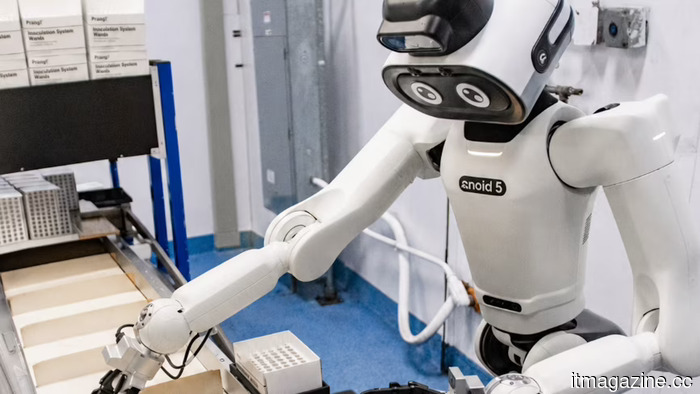 Delivery robot startup Robot.com is placing its next bet on wheeled humanoid robots designed for kitchens and warehouses.
Robot.com, previously known as Kiwibot, has introduced R-noid, a wheeled humanoid equipped with Physical Intelligence's AI, designed to pack orders and load boxes.
Delivery robot startup Robot.com is placing its next bet on wheeled humanoid robots designed for kitchens and warehouses.
Robot.com, previously known as Kiwibot, has introduced R-noid, a wheeled humanoid equipped with Physical Intelligence's AI, designed to pack orders and load boxes.
 AirPods Max 2 are currently available for $399 ahead of Prime Day, and I strongly suggest you take advantage of this deal.
The AirPods Max 2 are discounted by $150 ahead of Prime Day, bringing the price down to $399 for the first time since their launch in March.
AirPods Max 2 are currently available for $399 ahead of Prime Day, and I strongly suggest you take advantage of this deal.
The AirPods Max 2 are discounted by $150 ahead of Prime Day, bringing the price down to $399 for the first time since their launch in March.
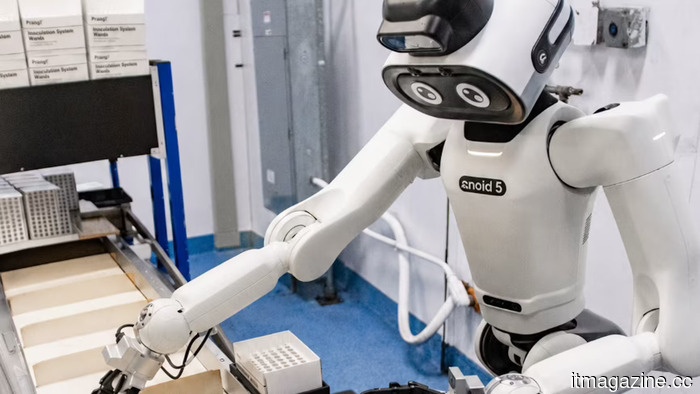 Delivery robot startup Robot.com is placing its future on wheeled humanoid robots designed for use in kitchens and warehouses.
Robot.com, previously known as Kiwibot, has introduced R-noid, a wheeled humanoid equipped with Physical Intelligence's AI that is capable of packing orders and loading boxes.
Delivery robot startup Robot.com is placing its future on wheeled humanoid robots designed for use in kitchens and warehouses.
Robot.com, previously known as Kiwibot, has introduced R-noid, a wheeled humanoid equipped with Physical Intelligence's AI that is capable of packing orders and loading boxes.
 Kodak Charmera is launching a new $30 keychain camera that features a flip screen for taking selfies.
Yashica’s Funtastic Keychain Camera is a compact digital camera featuring a 180-degree flip screen, a 1MP sensor, USB-C charging, and a variety of character-themed designs.
Kodak Charmera is launching a new $30 keychain camera that features a flip screen for taking selfies.
Yashica’s Funtastic Keychain Camera is a compact digital camera featuring a 180-degree flip screen, a 1MP sensor, USB-C charging, and a variety of character-themed designs.
The lovable CEO indicates that European AI startups face a confidence issue rather than a talent issue.
Anton Osika from Lovable claims that European entrepreneurs do not require Silicon Valley to establish global AI firms, using his own startup, which has achieved $500M in annual recurring revenue, as evidence.