
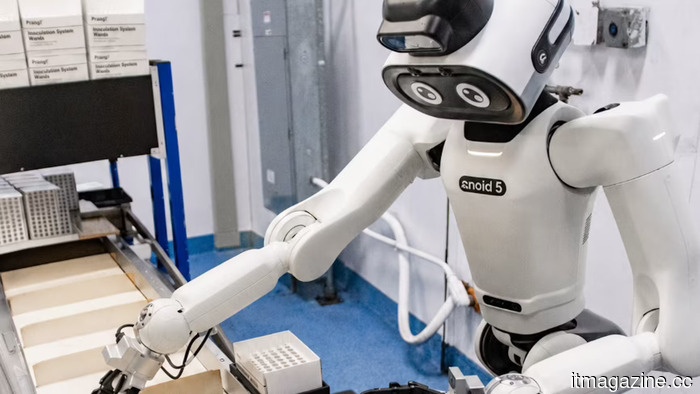
Delivery robot startup Robot.com is placing its future on wheeled humanoid robots designed for use in kitchens and warehouses.
TL;DRRobot.com has introduced R-noid, a wheeled humanoid robot intended for kitchens and warehouses, utilizing the AI model from Physical Intelligence.
The San Francisco-based startup, previously known as Kiwibot, is transitioning from campus delivery robots to workplace humanoids. According to Business Insider, R-noid is designed to package orders, load and unload boxes, and set up workstations in food service, logistics, and healthcare environments.
CEO Felipe Chavez mentioned that this shift has been in the works for nearly two years. “We already have a presence with our delivery robots,” he stated, emphasizing that expanding into manipulation solutions is a logical progression for a company that has over 500 robots in operation and has achieved more than two and a half million tasks.
R-noid operates on a holonomic wheeled base rather than legs and features dual seven-degree-of-freedom arms and an articulated torso, allowing a vertical reach of almost two meters. It is part of a growing trend among robotics companies that prefer wheels over legs for workplace applications, opting for stability, reduced costs, and expedited market entry instead of stair-climbing capabilities.
The dexterity of R-noid is powered by Physical Intelligence, a prominent AI lab in the robotics sector. The robot utilizes Physical Intelligence’s vision-language-action model, which interprets natural-language commands, assesses the environment, and generates the necessary arm and hand movements to execute tasks. Chavez added that the company has been collaborating with Physical Intelligence on customized models since the previous year.
Additionally, a partnership with FieldAI supplies the necessary navigation and autonomy features. So far, the startup has deployed fewer than 40 R-noids across approximately twelve clients, including at Harbor Links Golf Course in New York, where an R-noid assists in loading food into delivery robots and aids staff with order packing.
Deployment typically spans eight to twelve weeks, involving visits to customer facilities to identify automation tasks and gathering extensive robot data to refine the model before actual operation begins. Some tasks may require up to 50 hours of data collection for a robot to operate autonomously. Teleoperation and remote support play a crucial role in the deployment strategy, with the startup aiming for about 70 percent autonomy during the initial phases. Chavez noted that the immediate goal is not to replace employees but to help businesses adopt robotics and enhance worker satisfaction by relieving them of repetitive physical tasks.
R-noid is being launched across five primary categories: restaurant assistant, packer, picker, folder, and host. The overall humanoid market is currently unstable, with more than 150 companies pursuing commercialization and buyer satisfaction rates as low as 23 percent in some enterprise deployments.
The startup is marketing R-noid as a practical, task-oriented tool rather than a multipurpose humanoid, a differentiation that could be significant as the industry distinguishes between commercially viable products and those fueled by venture capital. Founded in 2017 as Kiwibot, the company rebranded in October 2025 and has attracted investments from Headline, Sodexo VC, and the UC Berkeley SkyDeck Fund. R-noid will be presented at Automate 2026 in Chicago this week.
Other articles
 The lovable CEO indicates that European AI startups face a confidence issue rather than a talent issue.
Anton Osika from Lovable claims that European entrepreneurs do not require Silicon Valley to establish global AI firms, using his own startup, which has achieved $500M in annual recurring revenue, as evidence.
Anthropic's updated privacy policy gathers biometric data from users identified as flagged on Claude.
Anthropic revised its privacy policy, now necessitating that certain Claude users provide scans of government-issued IDs and selfies, which has raised concerns surrounding biometric data.
The lovable CEO indicates that European AI startups face a confidence issue rather than a talent issue.
Anton Osika from Lovable claims that European entrepreneurs do not require Silicon Valley to establish global AI firms, using his own startup, which has achieved $500M in annual recurring revenue, as evidence.
Anthropic's updated privacy policy gathers biometric data from users identified as flagged on Claude.
Anthropic revised its privacy policy, now necessitating that certain Claude users provide scans of government-issued IDs and selfies, which has raised concerns surrounding biometric data.
 The lovable CEO states that European AI startups are facing an issue with confidence rather than a lack of talent.
Anton Osika from Lovable states that European founders can establish global AI companies without relying on Silicon Valley, using his own startup, which has a $500M ARR, as evidence.
The lovable CEO states that European AI startups are facing an issue with confidence rather than a lack of talent.
Anton Osika from Lovable states that European founders can establish global AI companies without relying on Silicon Valley, using his own startup, which has a $500M ARR, as evidence.
 A Tesla operating on Autopilot crashed into a house in Texas. The woman inside did not make it.
A 76-year-old woman from Texas passed away after a Tesla Model 3, operated on Autopilot, collided with her house. The NHTSA is initiating a special investigation into the crash.
A Tesla operating on Autopilot crashed into a house in Texas. The woman inside did not make it.
A 76-year-old woman from Texas passed away after a Tesla Model 3, operated on Autopilot, collided with her house. The NHTSA is initiating a special investigation into the crash.
 Google is venturing into the film industry with significant financial investments, and indeed, AI plays a role in this.
Google is investing approximately $75 million in A24 as part of a new collaboration with Google DeepMind focused on creating filmmaking tools through AI research.
Google is venturing into the film industry with significant financial investments, and indeed, AI plays a role in this.
Google is investing approximately $75 million in A24 as part of a new collaboration with Google DeepMind focused on creating filmmaking tools through AI research.
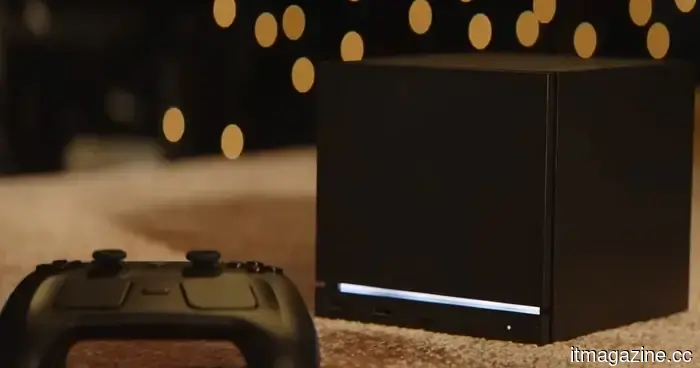 Valve clarifies the reasons behind the high cost of the Steam Machine, and the antagonist is all too recognizable.
Valve indicates that increasing costs for RAM and storage rendered its initial pricing target for Steam Machines unattainable, as well as restricted launch availability.
Valve clarifies the reasons behind the high cost of the Steam Machine, and the antagonist is all too recognizable.
Valve indicates that increasing costs for RAM and storage rendered its initial pricing target for Steam Machines unattainable, as well as restricted launch availability.
Delivery robot startup Robot.com is placing its future on wheeled humanoid robots designed for use in kitchens and warehouses.
Robot.com, previously known as Kiwibot, has introduced R-noid, a wheeled humanoid equipped with Physical Intelligence's AI that is capable of packing orders and loading boxes.