
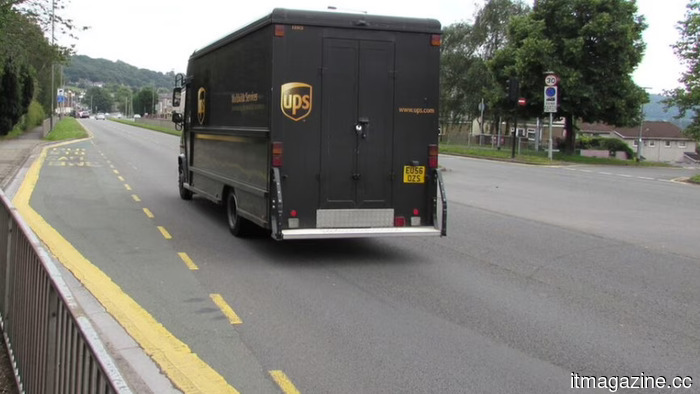
UPS is creating a real-time digital replica of its complete logistics network, refreshed every 10 minutes.
**Summary:** UPS has unveiled comprehensive AI initiatives that include a digital twin of its entire global network, agentic control towers, RFID tracking, and an AI customs clearance system achieving 97% first-day clearance rates.
On Wednesday, UPS showcased a range of AI-enhanced logistics initiatives, featuring a real-time digital twin of its global network that updates every 10 minutes. This system creates a virtual representation of facilities, air and ground networks, as well as end-to-end package flows. It monitors performance continuously, allowing the network to adapt and, as UPS describes, "self-heal in real time."
The company states that its AI-powered network planning tools can perform analyses in just one afternoon, a task that used to take engineering teams months. According to Supply Chain Dive, forecast accuracy has increased by up to 40%, which has led to reduced buffer capacity and a 9.9% decrease in labor hours in the U.S. amid recent volume drops.
"After 118 years of reinventing logistics, we find ourselves at a pivotal moment, harnessing AI to streamline our operations," said Carol B. Tomé, CEO of UPS. "We are combining the extensive expertise of our workforce with AI's capabilities to facilitate faster decision-making and enhance customer experience globally."
UPS is also rolling out what it refers to as agentic "control tower" capabilities directly at customer sites. These systems integrate data, predictive models, and connected services to enhance shipment tracking. They identify, prioritize, and assist in resolving disruptions within complex, multi-carrier networks. The move of agentic AI from concept to practical use is growing across businesses, and UPS's implementation is one of the largest in the logistics sector to date.
Regarding tracking, UPS has installed RFID sensors in all U.S. delivery vehicles and facilities, as well as on each package processed through more than 5,500 The UPS Store locations. The company claims misloads have decreased by nearly 70% since the initiative began three years ago. When coupled with AI, the RFID data provides near real-time visibility at the package level.
UPS’s AI customs brokerage is reportedly clearing 97% of shipments on the first day of entry, utilizing AI and cross-border data to understand global customs requirements, with the company indicating it outpaces competitors in clearance speed. A separate offering, UPS Export Assure, employs AI for more precise product classifications, minimizing errors and speeding up processing times.
Happy Returns, the reverse logistics firm acquired by UPS, is utilizing AI to tackle returns fraud. This system captures images of return items and compares them against expected product images using its "Return Vision" AI tool. Happy Returns tested the system with companies like Everlane, Revolve, and Under Armour. Returns fraud constitutes a $76.5 billion issue for U.S. retailers, according to the firm.
UPS reported revenues of $88.7 billion for 2025 and employs around 460,000 people worldwide. The company’s "Network of the Future" initiative is supported by a planned $9 billion investment over five years, anticipated to yield $3 billion in annual recurring savings. The use of digital twins and AI-driven operational planning is proliferating across various industries, but UPS’s approach, encompassing every mode of transport in over 200 countries, stands as one of the most ambitious.
Other articles
 General Intuition is securing $300 million for AI developed using gaming data.
The startup declined OpenAI's offer of $500 million for its gaming video data. It is now seeking to raise $300 million at a valuation of $2 billion to train AI agents using 2 billion video game clips annually.
General Intuition is securing $300 million for AI developed using gaming data.
The startup declined OpenAI's offer of $500 million for its gaming video data. It is now seeking to raise $300 million at a valuation of $2 billion to train AI agents using 2 billion video game clips annually.
 FERC accelerates connections for data centers to the grid.
FERC instructed grid operators to expedite data center connections to the grid. Simultaneously, the Trump administration disbursed $765 million to terminate offshore wind leases.
FERC accelerates connections for data centers to the grid.
FERC instructed grid operators to expedite data center connections to the grid. Simultaneously, the Trump administration disbursed $765 million to terminate offshore wind leases.
 Honor's latest Watch 6 offers battery life that Apple Watch users can only wish for.
The Honor Watch 6 is set to launch worldwide, boasting a battery life of 35 days, a vibrant display, wet touch controls, and specific tracking modes for football and badminton.
Honor's latest Watch 6 offers battery life that Apple Watch users can only wish for.
The Honor Watch 6 is set to launch worldwide, boasting a battery life of 35 days, a vibrant display, wet touch controls, and specific tracking modes for football and badminton.
 GTA 6 might still be a while off, so Rockstar has given GTA 5 a new makeover.
Rockstar has launched a complimentary update for GTA 5 owners, which introduces improved graphics, quicker loading times, additional vehicles, and next-generation features for PC players in anticipation of GTA 6.
GTA 6 might still be a while off, so Rockstar has given GTA 5 a new makeover.
Rockstar has launched a complimentary update for GTA 5 owners, which introduces improved graphics, quicker loading times, additional vehicles, and next-generation features for PC players in anticipation of GTA 6.
 General Intuition is securing $300 million for AI developed using gaming data.
The startup turned down OpenAI's $500 million offer for its gaming video data. It is now seeking to raise $300 million at a $2 billion valuation to train AI agents using 2 billion video game clips annually.
General Intuition is securing $300 million for AI developed using gaming data.
The startup turned down OpenAI's $500 million offer for its gaming video data. It is now seeking to raise $300 million at a $2 billion valuation to train AI agents using 2 billion video game clips annually.
 A mutual bank that has been in operation for 201 years has recently established an AI Center of Excellence in collaboration with a startup partner.
Liberty Bank, the oldest mutual bank in the United States with $9 billion in assets, has established an AI Center of Excellence in collaboration with enterprise AI partner Flare AI.
A mutual bank that has been in operation for 201 years has recently established an AI Center of Excellence in collaboration with a startup partner.
Liberty Bank, the oldest mutual bank in the United States with $9 billion in assets, has established an AI Center of Excellence in collaboration with enterprise AI partner Flare AI.
UPS is creating a real-time digital replica of its complete logistics network, refreshed every 10 minutes.
UPS elaborated on its AI initiatives, which include a digital twin of its worldwide network, autonomous control towers for clients, and RFID-enabled tracking for all vehicles in the United States.