
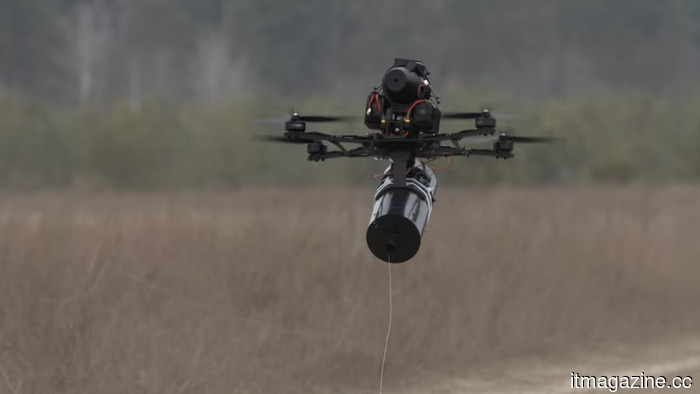
A Czech AI startup claims it can identify drones through sound for €150 per sensor, and it aims to connect power grids initially.
TL;DR: Czech startup Neuron Soundware has developed Sound Shield, an AI-based acoustic detection system that identifies drones using microphone sensors priced between €100 and €150, each consuming only 1 watt. The system serves as a low-cost, passive alternative to radar for detecting low-flying drones over urban areas, critical infrastructure, and military sites. The company has spent the past decade leveraging AI to monitor industrial machinery for clients like Airbus, Siemens, and BMW, and is now applying this acoustic technology for airspace defense.
Sound Shield utilizes small sensors known as nEdge Minis, which continuously listen for drone engine sounds. These sensors connect to a computing platform powered by Nvidia’s Jetson modules that run neural networks to compare incoming audio with a library of known drone sound profiles. Once a threat is detected, it notifies a central command platform with the drone’s estimated speed, altitude, and direction.
The system takes advantage of a key limitation in drone technology. While radar-absorbing materials and stealth designs can render drones nearly undetectable by traditional methods, the noise generated by rotors and engines is still present. Each drone emits a unique acoustic signature that Neuron Soundware claims its AI can identify in real-time across multiple sensor locations.
Pavel Konečný, founder and CEO of Neuron Soundware, is marketing Sound Shield as a dual-use system for electrical transformer stations. “They can continuously monitor the health of the transformer and other critical components while the microphones also listen for drones,” Konečný explained.
This dual-use proposition is significant commercially, as it suggests integrating drone detection into existing infrastructure that already requires acoustic monitoring, thereby minimizing the need for additional sensors and providing governments with a comprehensive air defense layer at lower installation and power costs.
European governments are in urgent need of affordable drone detection solutions after recent conflicts have shown how inexpensive UAVs can cause significant damage to military equipment. For example, Ukraine's Operation Spiderweb in June 2025 utilized $2,000 drones to destroy an estimated $7 billion worth of Russian bombers, although Russia provided a much lower estimate of losses. The disparity between drone costs and the destruction they can inflict has made counter-drone systems a rapidly growing area in defense procurement.
The counter-drone market is projected to increase from approximately $6.6 billion in 2025 to $20 billion by 2030. Startups across Europe are raising funds to develop national counter-drone capabilities, and NATO allies bordering Russia have agreed to build a drone detection network from Norway to Poland. Sound Shield aims to complement radar and radio-frequency detection rather than replace them.
Economically, the case is clear: modern radar systems capable of detecting small drones are vastly more expensive than a network of nEdge Minis, which operate passively without emitting signals that adversaries could detect or jam.
However, there are trade-offs in terms of range and reliability. Acoustic detection has established limitations not addressed in the source material. Most systems can effectively detect drones within about 300-500 meters under ideal conditions, with performance diminishing in poor weather or noisy environments. Background noise from various sources can lead to false alarms.
Additionally, newer drones are being designed with quieter motors, reducing their acoustic signatures. Neuron Soundware asserts that its nEdge PRO computing module can gather data from sensors within a 20-kilometer radius, though independent verification of this range has yet to be published.
The company has secured around €7.4 million in funding from investors such as Inven Capital, J&T Ventures, and Lead Ventures, along with €7 million from the European Innovation Council. With over 130 industrial installations monitoring machinery acoustically across four continents, it remains to be seen whether the transition from monitoring industrial equipment to tracking hostile drones in contested airspace is as feasible as the company claims in real-world scenarios.
Other articles
 I was part of the inaugural intern group at OpenAI. Here’s what I learned about becoming an engineer native to AI.
Following his experience in OpenAI's inaugural intern cohort, Hamza Mostafa discovered that while AI can enhance engineers' speed, it does not inherently improve their quality. The crucial skill lies in judgment: understanding what to trust, test, and challenge.
I was part of the inaugural intern group at OpenAI. Here’s what I learned about becoming an engineer native to AI.
Following his experience in OpenAI's inaugural intern cohort, Hamza Mostafa discovered that while AI can enhance engineers' speed, it does not inherently improve their quality. The crucial skill lies in judgment: understanding what to trust, test, and challenge.
 Qualcomm introduces Snapdragon Reality Elite along with a white-label toolkit for AI glasses, predicting that the future platform will not be a smartphone.
Snapdragon Reality Elite, START, smart eyewear, AI-enabled wearables, XREAL, Project Aura, Play for Dream, Inspecs, mixed reality, XR, NPU, Cristiano Amon, white label, AR1+.
Qualcomm introduces Snapdragon Reality Elite along with a white-label toolkit for AI glasses, predicting that the future platform will not be a smartphone.
Snapdragon Reality Elite, START, smart eyewear, AI-enabled wearables, XREAL, Project Aura, Play for Dream, Inspecs, mixed reality, XR, NPU, Cristiano Amon, white label, AR1+.
 According to reports, Apple’s 2027 roadmap includes AirPods featuring a built-in camera.
The much-speculated camera-enabled AirPods from Apple may launch in 2027, allowing Siri to comprehend a user's surroundings and respond to inquiries about the environment.
According to reports, Apple’s 2027 roadmap includes AirPods featuring a built-in camera.
The much-speculated camera-enabled AirPods from Apple may launch in 2027, allowing Siri to comprehend a user's surroundings and respond to inquiries about the environment.
 Google launches Android 17 featuring Gemini Intelligence, a foldable gaming mode, and enhanced privacy controls.
Android 17 begins its rollout to Pixel phones today, featuring Bubbles multitasking, gaming on foldables, Gemini Intelligence, and updated security defaults.
Google launches Android 17 featuring Gemini Intelligence, a foldable gaming mode, and enhanced privacy controls.
Android 17 begins its rollout to Pixel phones today, featuring Bubbles multitasking, gaming on foldables, Gemini Intelligence, and updated security defaults.
 According to reports, Apple plans to include AirPods with an integrated camera in their 2027 roadmap.
Apple's long-speculated AirPods with cameras might debut in 2027, enabling Siri to comprehend a user's environment and respond to inquiries about their surroundings.
According to reports, Apple plans to include AirPods with an integrated camera in their 2027 roadmap.
Apple's long-speculated AirPods with cameras might debut in 2027, enabling Siri to comprehend a user's environment and respond to inquiries about their surroundings.
 A brain implant developed at UC Davis enables an ALS patient to communicate with 99% accuracy and maintain full-time employment, all without the need for researchers.
Researchers at UC Davis published a study in Nature Medicine indicating that a BCI implant enabled an ALS patient to achieve 99% accurate speech over two years of independent daily usage.
A brain implant developed at UC Davis enables an ALS patient to communicate with 99% accuracy and maintain full-time employment, all without the need for researchers.
Researchers at UC Davis published a study in Nature Medicine indicating that a BCI implant enabled an ALS patient to achieve 99% accurate speech over two years of independent daily usage.
A Czech AI startup claims it can identify drones through sound for €150 per sensor, and it aims to connect power grids initially.
Neuron Soundware's Sound Shield utilizes AI-enabled microphones, priced between €100 and €150 each, to detect drones through audio, offering a more affordable option compared to radar.