
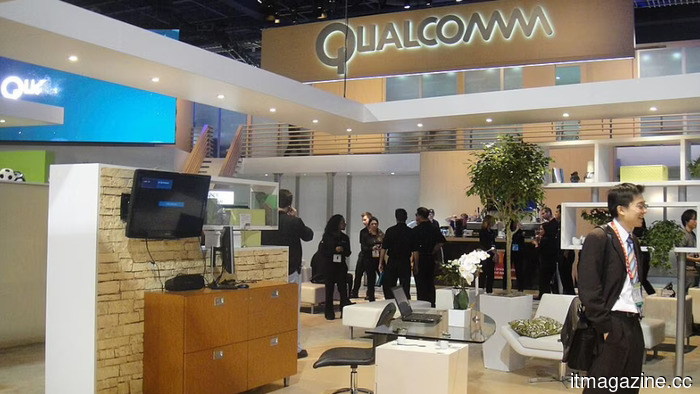
Qualcomm introduces Snapdragon Reality Elite along with a white-label toolkit for AI glasses, predicting that the future platform will not be a smartphone.
Qualcomm announced two products on Tuesday aimed at establishing the company as the chip supplier for future computing devices that could replace smartphones. The first product is the Snapdragon Reality Elite, a mixed reality chip platform with enhanced AI processing capabilities for headsets and tethered glasses. The second product is START, a comprehensive smart glasses toolkit that allows eyewear manufacturers to create branded and customized designs without having to develop the underlying technology themselves.
During the announcements, CEO Cristiano Amon mentioned to CNBC that Qualcomm is working on over 40 AI wearable devices, including jewelry, camera-equipped earbuds, pins, and watches. He noted that there will be considerable experimentation with various form factors, emphasizing the concept of wearable technology that is consistently present and able to perceive the surrounding world.
The Snapdragon Reality Elite boasts performance enhancements, offering up to 60% higher GPU performance, 30% greater CPU performance, and 160% improved NPU performance compared to the previous XR2+ Gen 2 platform. Its neural processing unit can achieve 48 TOPS, sufficient to execute a 3-billion-parameter language model at a rate of 45 tokens per second on the device. Additionally, the platform provides up to 20% longer battery life and operates up to 12 degrees Celsius cooler under identical workloads.
The display capability supports 4.4K per-eye resolution at 90 frames per second, which is a slight increase from the XR2+ Gen 2's 4.3K per-eye resolution. Qualcomm claims that the chip enhances head and hand tracking and improves see-through performance, which is crucial for minimizing motion sickness and eye strain that have historically impacted the usage duration of mixed reality headsets.
Reality Elite is intended to support two types of devices: standalone video-see-through headsets that overlay digital content onto a real-world camera feed, similar to devices like the Meta Quest, and lightweight, tethered optical-see-through glasses that seamlessly incorporate digital images into the wearer’s field of vision.
Among the initial products utilizing this platform are XREAL’s Project Aura, featuring Android XR glasses showcased at Google I/O, which offer a 70-degree field of view and binocular displays, along with an upcoming device from Play for Dream. Qualcomm, however, has not revealed pricing details or timelines for when consumer products will become available.
START, or Scalable Turnkey AI-Ready Toolkit, adopts a different market entry strategy by providing a hardware module based on Qualcomm’s AR1+ chip, alongside a software platform, companion apps for iOS and Android, an AI cloud solution, and three white-label reference designs. The designs include an audio-and-camera setup similar to Meta’s Ray-Ban smart glasses, a monocular variant, and a binocular variant.
The first partners in this endeavor are eyewear manufacturer Inspecs and O’Neill, which is owned by TitanFlex. Qualcomm has made a $10 million strategic equity investment in Inspecs, purchasing 7.5 million new shares at £1 each, indicating that Qualcomm is not just licensing silicon but also taking a financial interest in the supply chain responsible for manufacturing and distributing these devices.
The strategic rationale behind this move is that traditional eyewear companies possess the design expertise, retail distribution, and consumer trust necessary to sell smart glasses as fashion items, but they lack the technical capability to create the chips, AI software, and sensor integrations themselves. START represents Qualcomm’s effort to bridge this gap and is reminiscent of the reference design program the company launched in the early 2010s to assist manufacturers in creating smartphones using its Snapdragon platform. Qualcomm states that START will eventually broaden its scope beyond smart glasses to include other form factors, although specific details have not been provided.
The competitive landscape is densely packed and rapidly evolving. Meta has sold over seven million pairs of Ray-Ban smart glasses and controls approximately 82% of the market, with plans to scale annual production capacity to 10 million units by 2026. Snap recently introduced its $2,195 Specs AR glasses.
Apple is reportedly experimenting with various frame designs for a potential 2027 introduction, while Google is releasing Android XR audio glasses this fall in collaboration with Samsung, Warby Parker, and Gentle Monster. Many of these devices already utilize Qualcomm silicon; however, the company is now focusing on providing a complete technology stack rather than waiting for partners to assemble it on their own.
Qualcomm is betting that no single company will dominate the smart glasses market, similar to how the smartphone market fragmented with numerous manufacturers leveraging a common platform. This allows the supplier of foundational silicon to capture value, irrespective of which brand emerges as the winner. This approach mirrors Qualcomm’s earlier strategy with mobile phones, and Amon’s pipeline of 40 devices indicates that the company anticipates a faster transition than the public market perceives.
Nevertheless, the claims remain largely speculative. The performance metrics, including the 48 TOPS figure and performance percentages, are based solely on Qualcomm’s own measurements against its earlier generation, and independent benchmarks have
Other articles
 Rivian has terminated hundreds of employees just a week after initiating R2 deliveries in its pursuit of achieving its first profitability.
Rivian reduced its workforce in service and customer teams by just under 2%, a week following the commencement of R2 deliveries. The company incurred a loss of $3.6 billion in 2025, having delivered 42,247 vehicles.
Rivian has terminated hundreds of employees just a week after initiating R2 deliveries in its pursuit of achieving its first profitability.
Rivian reduced its workforce in service and customer teams by just under 2%, a week following the commencement of R2 deliveries. The company incurred a loss of $3.6 billion in 2025, having delivered 42,247 vehicles.
 Android 17 is set to significantly enhance the gaming experience on foldable devices.
Android 17 is committing further to mobile gaming by introducing a layout designed for foldable devices, customizable controller settings, and performance enhancements aimed at minimizing stutter.
Android 17 is set to significantly enhance the gaming experience on foldable devices.
Android 17 is committing further to mobile gaming by introducing a layout designed for foldable devices, customizable controller settings, and performance enhancements aimed at minimizing stutter.
 Your smart home devices may unknowingly be involved in a cybercrime network.
Certain internet-enabled devices might have concealed software backdoors that enable cybercriminals to direct traffic through home networks, commit fraud, and initiate cyberattacks without the owner's awareness.
Your smart home devices may unknowingly be involved in a cybercrime network.
Certain internet-enabled devices might have concealed software backdoors that enable cybercriminals to direct traffic through home networks, commit fraud, and initiate cyberattacks without the owner's awareness.
 Snap has unveiled its SPECS AR glasses, which surprisingly have a stylish design and come with a high price tag.
Offered in 47mm and 52mm sizes, the Snap SPECS feature a unique liquid crystal on silicon display, providing a 51-degree field of view and the capability to generate 16 million colors.
Snap has unveiled its SPECS AR glasses, which surprisingly have a stylish design and come with a high price tag.
Offered in 47mm and 52mm sizes, the Snap SPECS feature a unique liquid crystal on silicon display, providing a 51-degree field of view and the capability to generate 16 million colors.
 A Czech AI startup claims it can identify drones through sound for €150 per sensor and intends to prioritize wiring up power grids.
Neuron Soundware's Sound Shield employs AI-driven microphones priced between €100 and €150 each to identify drones through sound, presenting an affordable substitute for radar technology.
A Czech AI startup claims it can identify drones through sound for €150 per sensor and intends to prioritize wiring up power grids.
Neuron Soundware's Sound Shield employs AI-driven microphones priced between €100 and €150 each to identify drones through sound, presenting an affordable substitute for radar technology.
 Android 17 is set to enhance the gaming experience on foldable devices significantly.
Android 17 is reinforcing its commitment to mobile gaming by introducing a new layout that is compatible with foldable devices, options for customizable controller configurations, and enhancements designed to minimize stuttering.
Android 17 is set to enhance the gaming experience on foldable devices significantly.
Android 17 is reinforcing its commitment to mobile gaming by introducing a new layout that is compatible with foldable devices, options for customizable controller configurations, and enhancements designed to minimize stuttering.
Qualcomm introduces Snapdragon Reality Elite along with a white-label toolkit for AI glasses, predicting that the future platform will not be a smartphone.
Snapdragon Reality Elite, START, smart eyewear, AI-enabled wearables, XREAL, Project Aura, Play for Dream, Inspecs, mixed reality, XR, NPU, Cristiano Amon, white label, AR1+.