
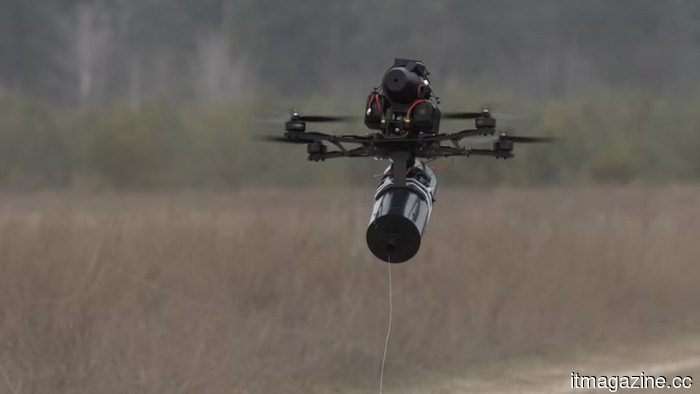
A Czech AI startup claims it can identify drones through sound for €150 per sensor and intends to prioritize wiring up power grids.
Czech startup Neuron Soundware has developed an AI-based acoustic drone detection system named Sound Shield, which utilizes microphone sensors priced between €100 and €150 each to identify drones by their engine sounds. This system serves as a cost-effective, passive alternative to radar for spotting low-flying drones over urban areas, critical infrastructure, and military sites. The company has leveraged a decade of AI experience in monitoring industrial machinery for clients like Airbus, Siemens, and BMW, and is now applying this acoustic analysis technology to airspace security.
Sound Shield operates through small sensors called nEdge Minis, each drawing only 1 watt of power, that constantly listen for the specific sounds produced by drone engines. These sensors communicate with a computing platform that uses Nvidia’s Jetson modules to run neural networks, enabling real-time matching of audio against a database of known drone acoustic signatures. When a potential threat is detected, the system notifies a centralized control platform with information about the drone’s estimated speed, altitude, and direction.
This method takes advantage of a significant limitation in drone design. While radar-absorbing coatings and stealth shapes can render a drone largely undetectable to conventional systems, no technology can completely eliminate the mechanical noise generated by rotors and engines. Each drone emits a unique acoustic signature that, according to Neuron Soundware, can be identified in real time by their AI across multiple sensor locations.
Pavel Konečný, the founder and CEO of Neuron Soundware, is promoting Sound Shield as a dual-use system that could first be implemented at electrical transformer stations. “They can continuously monitor the health of the transformer and other vital components of the distribution network, identifying internal discharges, oil leaks, or other operational issues,” Konečný explained. “At the same time, their microphones are attuned to the sky.”
The dual-use aspect has significant commercial implications. Instead of relying on government funds to establish a separate drone detection network, Neuron Soundware is suggesting the integration of their system into existing infrastructure that already requires acoustic monitoring. This strategy could minimize the number of sensors needed while providing governments with a comprehensive air defense layer at minimal additional installation and power costs.
In light of the wars in Ukraine and Iran, European governments are urgently seeking affordable drone detection solutions, given the potential for inexpensive UAVs to inflict substantial damage on military assets. For instance, during Ukraine's Operation Spiderweb in June 2025, $2,000 drones reportedly destroyed around $7 billion in Russian strategic bombers, although Russian officials contest the extent of these losses. The disparity in cost between drones and the destruction they cause has rapidly propelled counter-drone systems into one of the fastest-growing segments of defense procurement.
The counter-drone market is projected to surge from about $6.6 billion in 2025 to $20 billion by 2030. Numerous startups across Europe are securing funding to develop national counter-drone capabilities, and NATO members bordering Russia have consented to establish a drone detection barrier extending from Norway to Poland. Sound Shield aims to complement radar and radio-frequency detection rather than replace them.
From an economic perspective, the advantages are clear. Advanced radar systems capable of spotting small drones come at a significantly higher cost than a network of nEdge Minis, and they actively broadcast their position with each sweep. In contrast, Sound Shield's sensors are passive, emitting no signals that could be detected or jammed by adversaries.
However, there is a trade-off regarding range and reliability. Acoustic drone detection has known limitations that the original source does not cover. Most acoustic systems work effectively within approximately 300-500 meters under optimal conditions, with their performance declining considerably in windy, rainy, or noisy urban settings. Background noise from traffic, wildlife, and industrial activities can lead to false positive alerts.
Newer drone designs are also incorporating quieter motors to lessen their detectable acoustic signatures. Neuron Soundware asserts that its nEdge PRO computing module can gather data from sensors up to a 20-kilometer range, although independent verification of this claim has not yet been published.
To date, the company has raised about €7.4 million from investors, including Inven Capital, J&T Ventures, and Lead Ventures, alongside €7 million from the European Innovation Council. It operates over 130 industrial installations across four continents for acoustic monitoring of machinery. Whether the transition from monitoring pumps and turbines to tracking hostile drones in contested airspace is as feasible as the company claims remains to be seen in practical scenarios.
Other articles
 A newly discovered Android trojan named Rokarolla is designed to target 217 banking applications and has the ability to capture your PIN, SMS verification codes, and funds from cryptocurrency wallets.
Zimperium's zLabs discovered Rokarolla, an Android banking trojan featuring 137 commands that captures PINs, intercepts SMS messages, hijacks cryptocurrency payments, and disables Play Protect.
A newly discovered Android trojan named Rokarolla is designed to target 217 banking applications and has the ability to capture your PIN, SMS verification codes, and funds from cryptocurrency wallets.
Zimperium's zLabs discovered Rokarolla, an Android banking trojan featuring 137 commands that captures PINs, intercepts SMS messages, hijacks cryptocurrency payments, and disables Play Protect.
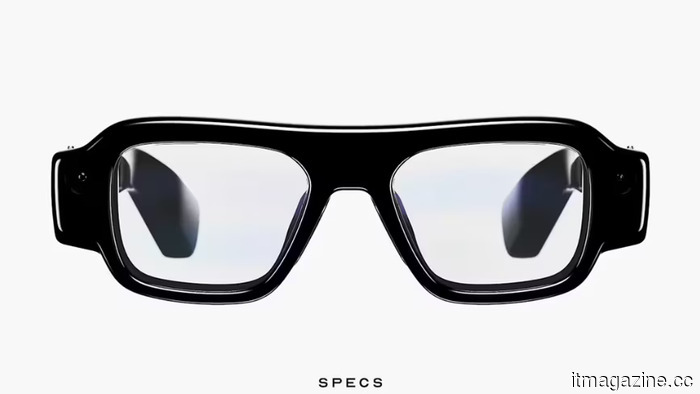 Snap has introduced its AR glasses priced at $2,195 as a consumer product, placing the company's bets on augmented reality.
Snap's Specs AR glasses are priced at $2,195 and will be shipped this fall. They feature a 4-hour battery life, a 51° field of view, and AI technology from OpenAI and Google. Preorders are available with a $200 deposit.
Snap has introduced its AR glasses priced at $2,195 as a consumer product, placing the company's bets on augmented reality.
Snap's Specs AR glasses are priced at $2,195 and will be shipped this fall. They feature a 4-hour battery life, a 51° field of view, and AI technology from OpenAI and Google. Preorders are available with a $200 deposit.
 According to reports, Apple’s 2027 roadmap includes AirPods featuring a built-in camera.
The much-speculated camera-enabled AirPods from Apple may launch in 2027, allowing Siri to comprehend a user's surroundings and respond to inquiries about the environment.
According to reports, Apple’s 2027 roadmap includes AirPods featuring a built-in camera.
The much-speculated camera-enabled AirPods from Apple may launch in 2027, allowing Siri to comprehend a user's surroundings and respond to inquiries about the environment.
 Qualcomm introduces Snapdragon Reality Elite along with a white-label toolkit for AI glasses, predicting that the future platform will not be a smartphone.
Snapdragon Reality Elite, START, smart eyewear, AI-enabled wearables, XREAL, Project Aura, Play for Dream, Inspecs, mixed reality, XR, NPU, Cristiano Amon, white label, AR1+.
Qualcomm introduces Snapdragon Reality Elite along with a white-label toolkit for AI glasses, predicting that the future platform will not be a smartphone.
Snapdragon Reality Elite, START, smart eyewear, AI-enabled wearables, XREAL, Project Aura, Play for Dream, Inspecs, mixed reality, XR, NPU, Cristiano Amon, white label, AR1+.
 Google has launched Android 17 for Pixel devices.
Android 17 is rolling out to Pixel devices today, featuring Bubbles, creator tools, and security enhancements, while Gemini Intelligence will launch later this summer.
Google has launched Android 17 for Pixel devices.
Android 17 is rolling out to Pixel devices today, featuring Bubbles, creator tools, and security enhancements, while Gemini Intelligence will launch later this summer.
 According to reports, Apple plans to include AirPods with an integrated camera in their 2027 roadmap.
Apple's long-speculated AirPods with cameras might debut in 2027, enabling Siri to comprehend a user's environment and respond to inquiries about their surroundings.
According to reports, Apple plans to include AirPods with an integrated camera in their 2027 roadmap.
Apple's long-speculated AirPods with cameras might debut in 2027, enabling Siri to comprehend a user's environment and respond to inquiries about their surroundings.
A Czech AI startup claims it can identify drones through sound for €150 per sensor and intends to prioritize wiring up power grids.
Neuron Soundware's Sound Shield employs AI-driven microphones priced between €100 and €150 each to identify drones through sound, presenting an affordable substitute for radar technology.