
London Tech Week 2026: The AI Billions and a Royal Milestone
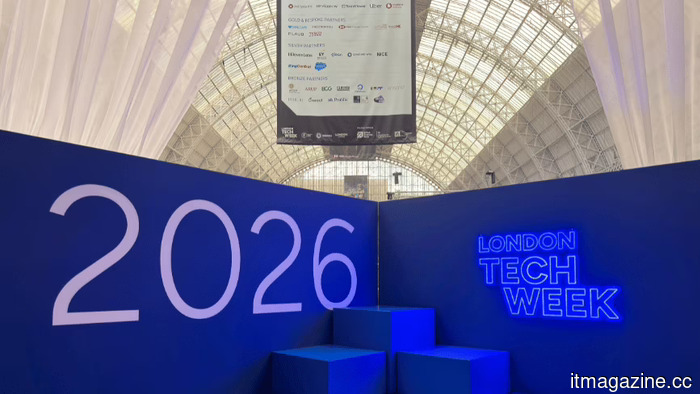
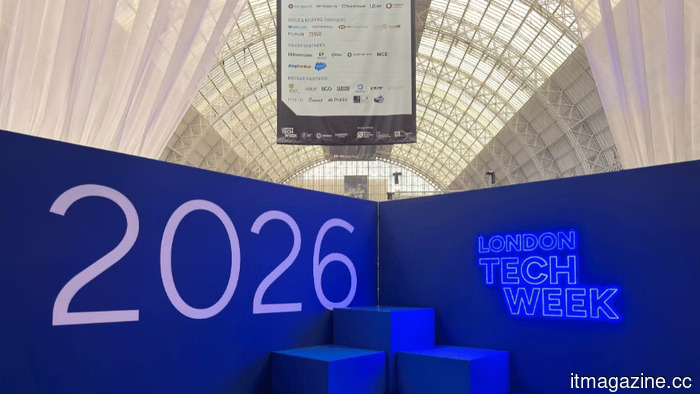
London Tech Week concluded its 12th edition this week, featuring three days of main-stage events at Olympia from June 8 to 10, alongside various fringe activities throughout the city until Friday. The festival attracted over 30,000 attendees from more than 130 countries, showcasing over 600 speakers.
One dominant theme emerged: AI, which was a focus in nearly half of the sessions. The consistent message was that this technology has transitioned from being "conceptual" to something that every company must implement.
Despite broader market fluctuations, the atmosphere was vibrant and well-capitalized. The week commenced just after the Nasdaq 100 experienced its worst trading session in over a year. Inside the venue, attendance lines were longer than the previous year, with a Williams F1 car drawing crowds, and AWS presenting a robot alongside a smoothie bar.
Here’s a summary of what transpired, centered around the four most significant threads.
The government invested significantly
Prime Minister Keir Starmer set the agenda on the opening day, announcing a national push for computing that includes £400 million for the purchase of specialized AI chips, aimed at ensuring that British companies can "start here, scale here, and stay here." This initiative formed part of a broader set of commitments introduced by Technology Secretary Liz Kendall throughout the week.
The primary focus of this plan is a £1.1 billion AI Hardware Plan, which includes a £750 million national supercomputer expected to be operational by 2030, £150 million for next-generation inference chips to be purchased from British companies this summer, £120 million for chip design, and £45 million dedicated to training engineers. The strategy aims for the UK to capture 5% of the global chip market and is specifically designed to prevent the loss of UK chip manufacturers following Graphcore’s sale to SoftBank and Alphawave’s acquisition by Qualcomm.
A separate £200 million adoption initiative emphasized diffusion over hardware, featuring an expanded Bridge AI program, a skills initiative boasting 1.7 million course completions, and the establishment of an AI Economics Institute led by Nobel laureate Simon Johnson. Deputy Prime Minister David Lammy integrated AI into the justice system.
London Mayor Sadiq Khan announced an additional £12 million to assist the capital's small businesses in adopting AI. The government also introduced an “AI Work Assistant” to support jobseekers and tech training for up to 400,000 students.
Major investments came from American companies
The bulk of investment originated from the private sector. AMD pledged up to £2 billion over five years, with CEO Lisa Su speaking at the AI Arena stage, supporting high-performance computing initiatives with Cambridge and Imperial, investing in UK startups, and establishing a Sovereign AI Innovation Lab with Dell.
Other notable speakers included Microsoft UK chief Darren Hardman and Perplexity co-founder Aravind Srinivas. Cloud provider Nebius promised approximately £1.7 billion to enhance UK AI capabilities, financing three Nvidia implementations projected to produce 65 megawatts by 2027.
This encapsulates the week’s main tension: a significant portion of the UK’s expansion relies on American technology, specifically AMD’s chips and Nvidia's hardware utilized in Nebius’s data centers. The UK's domestically developed “Lumen Sovereign” frontier-model project is intended to reduce this reliance, but it remains in the early stages.
Enhancing capacity in Britain does not equate to owning the entire stack. London’s attraction for the US AI sector was undeniable, with companies like Anthropic, OpenAI, and quickly growing startups such as Lovable, Cursor, Legora, and ElevenLabs announcing expansions in London, drawn by the city’s rich talent pool. However, this appeal is reciprocal; investors noted that British startups, which are less funded than their American counterparts, continue to lose talent to the US.
A powerful state with limitations
Kendall addressed the funding disparity on Bloomberg TV, proposing a plan to direct pension fund investments into UK companies through legal reforms that could release approximately £25 billion, positioning it as part of a "more active, more muscular government that takes bets on Britain's strengths."
Meanwhile, American firms continued to secure the largest public contracts, with Anthropic developing an assistant for GOV.UK and Palantir managing key defense and health contracts, even as lawmakers work to overturn its £330 million NHS agreement.
Not every governmental announcement was focused on funding; Starmer issued a three-month ultimatum to tech companies to prevent children from accessing nude images by default, a request that the encrypted messaging app Signal criticized as dangerous and impractical.
Continued momentum in deals
The backdrop was a UK tech sector valued at £1.2 trillion by Tech Nation, with British AI startups raising over £8.2 billion in venture capital during the first half of 2026, accounting for nearly half of all tech investments in Europe according to the government. London ranks third globally in terms of venture
Other articles
 India's Avataar AI has introduced a video model that is priced at $0.005 per second, making it 27 times more affordable than competitors.
Avataar AI has introduced Varya, an open-weight video model tailored for India, priced at $0.005 per second. It depicts Indian attire, cuisine, and festivals that are often overlooked by Western models.
India's Avataar AI has introduced a video model that is priced at $0.005 per second, making it 27 times more affordable than competitors.
Avataar AI has introduced Varya, an open-weight video model tailored for India, priced at $0.005 per second. It depicts Indian attire, cuisine, and festivals that are often overlooked by Western models.
 London Tech Week 2026: the AI billions and a royal milestone
London Tech Week 2026 summary: a £1.1 billion hardware initiative for the UK, AMD's £2 billion investment, Nebius's £1.7 billion project, expansion of US giants, and Prince William's inaugural Homewards panel.
London Tech Week 2026: the AI billions and a royal milestone
London Tech Week 2026 summary: a £1.1 billion hardware initiative for the UK, AMD's £2 billion investment, Nebius's £1.7 billion project, expansion of US giants, and Prince William's inaugural Homewards panel.
 Windows 11 introduces a useful upgrade that allows for simultaneous audio streaming on two devices.
Windows 11 Shared Audio allows two users to listen from a single PC via Bluetooth LE Audio, but you'll require compatible Copilot+ hardware, updated drivers, and suitable accessories for the feature to be accessible.
Windows 11 introduces a useful upgrade that allows for simultaneous audio streaming on two devices.
Windows 11 Shared Audio allows two users to listen from a single PC via Bluetooth LE Audio, but you'll require compatible Copilot+ hardware, updated drivers, and suitable accessories for the feature to be accessible.
 India's Avataar AI has introduced a video model priced at $0.005 per second, which is 27 times less expensive than competitors.
Avataar AI introduced Varya, an open-weight video model for India priced at $0.005 per second. It showcases Indian clothing, cuisine, and festivals that are often overlooked by Western models.
India's Avataar AI has introduced a video model priced at $0.005 per second, which is 27 times less expensive than competitors.
Avataar AI introduced Varya, an open-weight video model for India priced at $0.005 per second. It showcases Indian clothing, cuisine, and festivals that are often overlooked by Western models.
 Five cloud security errors that originate at the architectural level.
Nodir Safarov, a Cloud Architect at SOTI Inc., highlights the five architectural shortcomings that contribute to the prevalent security vulnerabilities in enterprise cloud systems, ranging from the issues of post-deployment patching to configuration drift, along with the design principles that can avert these problems.
Five cloud security errors that originate at the architectural level.
Nodir Safarov, a Cloud Architect at SOTI Inc., highlights the five architectural shortcomings that contribute to the prevalent security vulnerabilities in enterprise cloud systems, ranging from the issues of post-deployment patching to configuration drift, along with the design principles that can avert these problems.
 Eighty residents of Texas are filing a lawsuit against SpaceX, claiming that the rocket launches are actually damaging their homes.
A class-action lawsuit claims that the launches of SpaceX's Starship resulted in foundation cracks, broken pipes, and distorted floors in residences near Starbase. Housing prices have increased twofold.
Eighty residents of Texas are filing a lawsuit against SpaceX, claiming that the rocket launches are actually damaging their homes.
A class-action lawsuit claims that the launches of SpaceX's Starship resulted in foundation cracks, broken pipes, and distorted floors in residences near Starbase. Housing prices have increased twofold.
London Tech Week 2026: The AI Billions and a Royal Milestone
London Tech Week 2026 summary: a £1.1 billion hardware initiative in the UK, AMD's £2 billion investment, Nebius's £1.7 billion project, expansion of American tech giants, and Prince William's inaugural Homewards panel.