
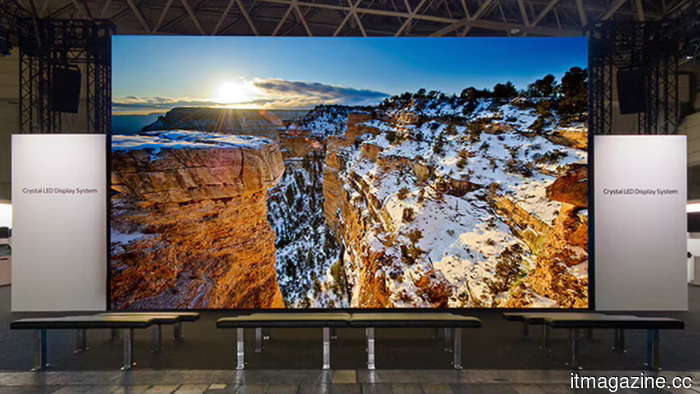
Sony's 135-inch Crystal LED UNIFY is a boardroom display that can be set up in just an hour.
**Summary:** Sony has introduced the Crystal LED UNIFY, a 135-inch all-in-one dvLED display for boardrooms, which can be installed by two people in about one hour, set to ship in early 2027.
Sony Electronics has unveiled the Crystal LED UNIFY, a 135-inch all-in-one direct-view LED display aimed at corporate boardrooms and university lecture halls. This display, identified as model ZRL-135SG, consists of five pre-assembled panels and a control unit, enabling installation by two individuals in roughly one hour without any electrical work. Sony plans to showcase it at InfoComm in Las Vegas from June 17 to 19, with availability anticipated in early 2027.
The UNIFY marks Sony’s first all-in-one model in its Crystal LED series, which previously comprised modular panels requiring professional AV integrators for assembly, calibration, and maintenance. Modular installations of Crystal LED can surpass $200,000 before installation costs, which typically add an additional $25,000 to $50,000. While Sony has not revealed pricing for the UNIFY, it is described as a "cost-effective" option, positioned below its current Crystal LED S Series, which begins at around $220,000.
The display offers a 1.5mm pixel pitch, a maximum brightness of 800 cd/m², and incorporates Sony’s Anti-Reflection Surface Technology, allowing for visibility even in well-lit rooms with large windows. With a Full HD resolution on its 135-inch diagonal, the pixel density is comparatively low, which means the UNIFY is intended for viewing distances of several meters rather than close-up use at a desk. Once mounted on a wall, the display protrudes less than 100mm from the wall, adhering to Americans with Disabilities Act standards.
Rich Ventura, Vice President of Professional Display Solutions at Sony Electronics, stated, “Sony has a strong ecosystem of display solutions built on our extensive background in imaging and visual technology. By adding a 135-inch all-in-one model to our portfolio, we are responding to customer needs and simplifying the specification and deployment of our solutions.” The UNIFY utilizes the same device management platform and remote interface as Sony’s BRAVIA professional displays, enabling IT teams to manage both systems jointly.
This announcement comes amid a rapidly growing dvLED market, as corporations replace projectors and LCD video walls with seamless LED panels. According to industry analysts, the corporate AV segment is experiencing approximately 14.7% year-over-year growth in 2026, and dvLED prices have declined by 40 to 50% over the past three years. Sony faces competition in this transition; for example, LG’s 136-inch MAGNIT Active is priced around $300,000, while Samsung has recently reorganized its display division as Chinese competitor TCL gains ground in the broader screen market.
Hisense has aggressively priced its 136-inch 136MX model at $100,000, which is about 60 to 70% lower than similar offerings from Samsung and LG. This competitive pressure raises the stakes for the UNIFY. Sony is not underpricing Chinese manufacturers but is banking on the appeal of simplified installation and integration with its existing professional display ecosystem to attract corporate clients who already utilize BRAVIA screens in smaller meeting rooms.
The timing also aligns with Sony’s overall business direction. The company’s FY26 forecast, released in May, projected an operating profit of ¥1.6 trillion, with music and image sensors contributing significantly while gaming hardware absorbs increasing memory costs. Although the professional display segment is a smaller revenue stream, the UNIFY represents an effort to expand it by lowering entry barriers for a technology that has typically catered to organizations willing to invest six figures and employ specialized installers.
Whether the UNIFY can compete broadly will depend on two undisclosed factors: its price and resolution strategy. Full HD on a 135-inch screen suffices for standard presentations and video conferencing at typical boardroom distances, but while the UNIFY's control unit supports 4K input, it does not enhance the native panel resolution. Buyers considering it against a high-end 98-inch LCD, which can deliver true 4K at a lower cost, will carefully evaluate that trade-off. The UNIFY's strengths lie in its size and seamless design rather than pixel density.
Sony will exhibit the Crystal LED UNIFY at booth C8301 during InfoComm, alongside its Crystal LED S Series, which was launched at ISE in Barcelona earlier this year. The S Series features the same Anti-Reflection Surface Technology and 800 cd/m² brightness in a modular format, with finer pixel pitches of 1.25mm and 1.56mm. Together, these two lines indicate that Sony is aiming to serve the corporate display market from mid-range all-in-one setups to custom video walls, a strategy that makes sense if the pricing aligns with buyer expectations.
Other articles
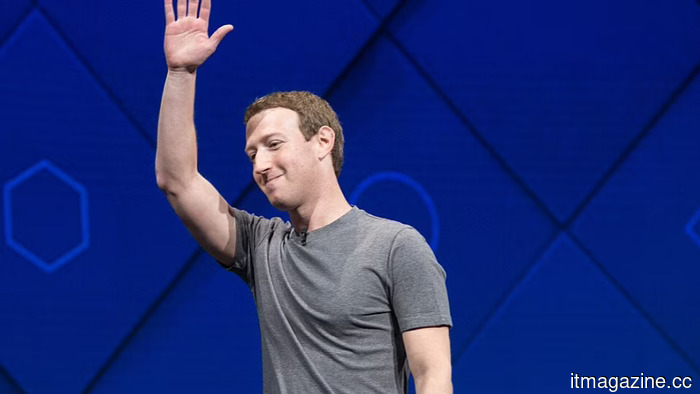 Meta removed the facial recognition code from its smart glasses app a day after WIRED discovered it.
Meta has eliminated the NameTag facial recognition code from its AI application after WIRED discovered biometric software present on 50 million devices, which Meta claimed "does not exist."
Meta removed the facial recognition code from its smart glasses app a day after WIRED discovered it.
Meta has eliminated the NameTag facial recognition code from its AI application after WIRED discovered biometric software present on 50 million devices, which Meta claimed "does not exist."
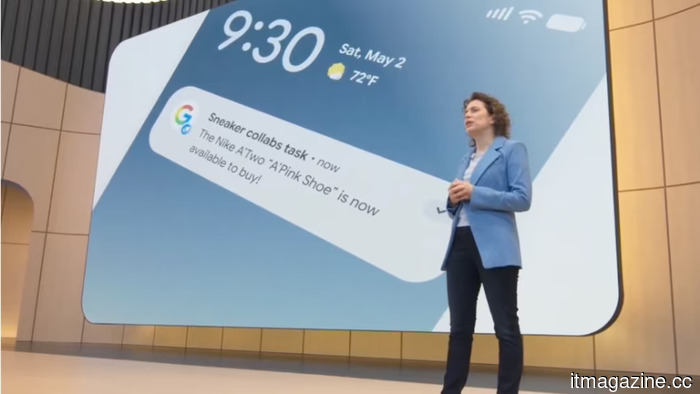 Both Apple and Google aim to track the web on your behalf.
In close succession, Google and Apple revealed features that monitor web pages and notify users when changes occur. Searching is evolving into a continuous process rather than a one-off inquiry.
Both Apple and Google aim to track the web on your behalf.
In close succession, Google and Apple revealed features that monitor web pages and notify users when changes occur. Searching is evolving into a continuous process rather than a one-off inquiry.
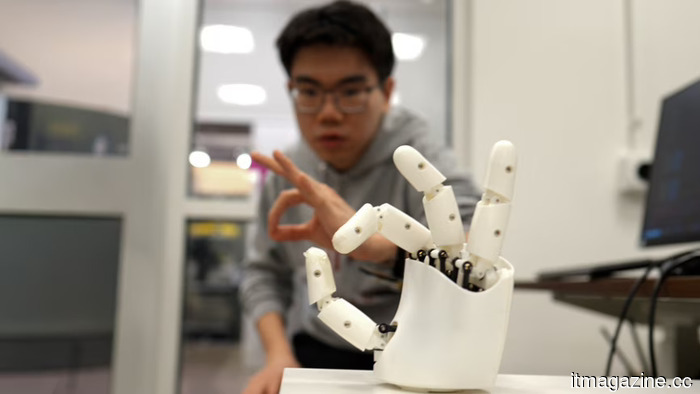 The ultrasound wristband developed by MIT monitors the movements of each finger and enables real-time control of a robotic hand.
MIT engineers developed a wristband that uses ultrasound to monitor 22 degrees of hand movement with a latency of 120ms, allowing for real-time control of robotic hands and sign language.
The ultrasound wristband developed by MIT monitors the movements of each finger and enables real-time control of a robotic hand.
MIT engineers developed a wristband that uses ultrasound to monitor 22 degrees of hand movement with a latency of 120ms, allowing for real-time control of robotic hands and sign language.
 Rivian launches R2 deliveries, viewing the declining US EV market as a chance for growth.
On Tuesday, Rivian began delivering R2 SUVs to customers, aiming for 20,000 to 25,000 deliveries by the end of the year, as there are fewer new electric vehicles competing in a challenging US market.
Rivian launches R2 deliveries, viewing the declining US EV market as a chance for growth.
On Tuesday, Rivian began delivering R2 SUVs to customers, aiming for 20,000 to 25,000 deliveries by the end of the year, as there are fewer new electric vehicles competing in a challenging US market.
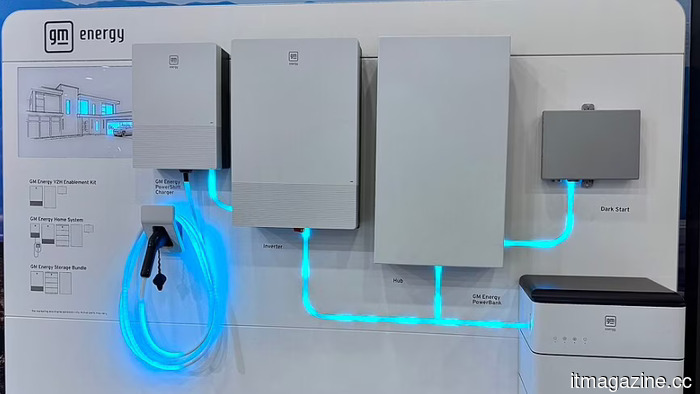 From automobiles to data centers, GM advances into energy storage through three new battery agreements.
GM collaborated with Peak Energy on sodium-ion batteries and broadened its agreement with Redwood Materials to provide energy storage solutions for data centers and the grid.
From automobiles to data centers, GM advances into energy storage through three new battery agreements.
GM collaborated with Peak Energy on sodium-ion batteries and broadened its agreement with Redwood Materials to provide energy storage solutions for data centers and the grid.
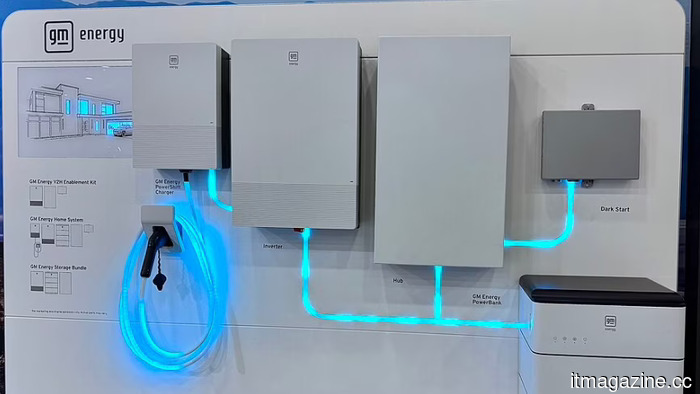 From automobiles to data centers, GM expands into energy storage through three new battery agreements.
GM collaborated with Peak Energy on sodium-ion batteries and extended its agreement with Redwood Materials to provide energy storage solutions for data centers and the grid.
From automobiles to data centers, GM expands into energy storage through three new battery agreements.
GM collaborated with Peak Energy on sodium-ion batteries and extended its agreement with Redwood Materials to provide energy storage solutions for data centers and the grid.
Sony's 135-inch Crystal LED UNIFY is a boardroom display that can be set up in just an hour.
Sony introduced the Crystal LED UNIFY, a 135-inch dvLED screen designed for boardrooms that can be set up by two individuals within an hour. It is scheduled to ship in early 2027.