
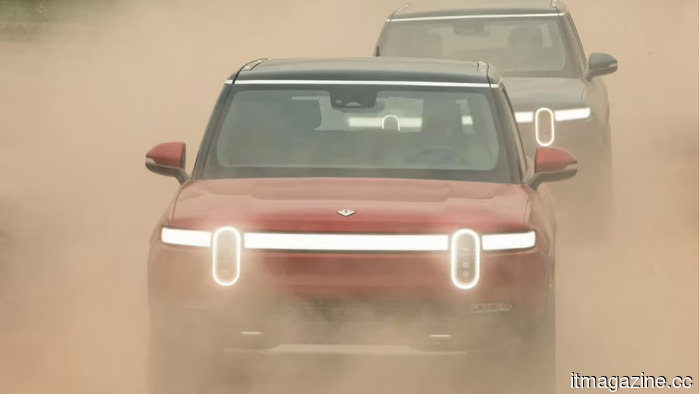
Rivian launches R2 deliveries, viewing the declining US EV market as a chance for growth.
Rivian commenced deliveries of its R2 SUVs on Tuesday, aiming for 20,000 to 25,000 sales by the end of the year as it anticipates fewer competitors in the US EV market and a potential future in robotaxis. The company started giving customers their first R2 SUVs, marking a significant moment for Rivian, which has spent billions attempting to demonstrate it can manufacture electric vehicles at scale. The R2 starts at $57,990 for the Performance trim with Launch Package, significantly higher than the $45,000 price point initially suggested in 2024. A more affordable version below $50,000 is not expected until 2027, with a base model around $45,000 planned for that year, leaving the most budget-friendly options unavailable as affordable EVs are becoming scarce in the US market.
Rivian aims to deliver between 20,000 and 25,000 R2 units by the end of 2026, which would represent one of the fastest EV launches in US history if realized. Production is underway at the company’s Normal, Illinois factory, starting with a single shift, while a second shift is anticipated later in the year. The overall delivery guidance for 2026 is set between 62,000 and 67,000 vehicles, suggesting steady R1 and commercial van volumes at about 42,000 units, with the R2 expected to drive growth.
Founder and CEO RJ Scaringe has called the R2 “possibly the most crucial product we’ve launched to date” while framing the challenging US EV landscape as an opportunity. Recent rollbacks of environmental regulations by the Trump administration and the removal of the $7,500 federal EV tax credit, effective September 2025, have left the market with little federal support for electric vehicles, and even Tesla is experiencing sales declines.
This narrowing competitive landscape is the opportunity Scaringe is relying on. With fewer new EVs entering American showrooms, the R2 could attract buyers with limited choices, particularly in the mid-size SUV market where it competes with the Tesla Model Y. However, its success hinges on whether consumers are willing to spend $58,000 on an electric SUV without a federal tax credit in a market where the average new car price exceeds $48,000.
The R2 is also pivotal for Rivian's autonomous driving goals. In December, the company introduced a specialized 5nm autonomy processor capable of performing up to 1,600 trillion operations per second, alongside plans to integrate lidar sensors into upcoming R2 models. Rivian’s Autonomy+ system, offered with the Launch Package, provides hands-free assisted driving across 3.5 million miles of roads in the US and Canada.
The company anticipates the R2 will eventually possess autonomous driving capability, an effort bolstered by a $1.25 billion agreement with Uber announced in March. This partnership involves an initial investment of $300 million and the procurement of 10,000 fully autonomous R2 robotaxis, with an option for an additional 40,000 vehicles. Commercial deployment is expected in San Francisco and Miami by 2028, scaling to 25 cities by 2031, a target considered ambitious given that Rivian has yet to showcase a fully autonomous vehicle and that regulations for robotaxi operations are incomplete in most US cities.
Additionally, Rivian is constructing a new factory in Stanton Springs, Georgia, after renegotiating its Department of Energy loan from $6.57 billion to $4.5 billion during a review of Biden-era EV commitments. The Georgia plant’s initial capacity has been increased to 300,000 vehicles annually by condensing the previous two-phase build into a single phase, with production slated to begin in late 2028, focusing on the R2, the smaller R3, and robotaxis for the Uber collaboration.
However, Rivian's financial situation remains precarious. Although the company recorded its first full-year positive gross profit of $144 million in 2025, it still faced a net loss of $3.63 billion. Revenues for the first quarter of 2026 reached about $1.4 billion, reflecting an 11% year-on-year increase, with $119 million in gross profit, but an adjusted EBITDA loss of $329 million and negative free cash flow of $526 million.
By the end of the first quarter, Rivian held $4.83 billion in cash, helped by a $1 billion share purchase from Volkswagen, which surpassed Amazon to become Rivian’s largest shareholder in May with a 15.9% stake linked to a software joint venture. The R2’s launch is critical for Rivian’s survival, as the company needs to prove it can sell vehicles in numbers that have eluded every EV startup except Tesla. So far, Rivian has not achieved more than 51,579 vehicles delivered in a year.
Achieving 25,000 R2 deliveries within approximately six
Other articles
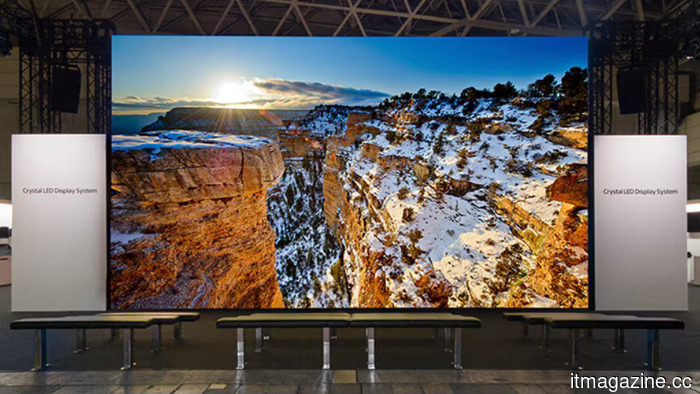 Sony's 135-inch Crystal LED UNIFY is a boardroom display that can be set up in just one hour.
Sony has introduced the Crystal LED UNIFY, a 135-inch dvLED screen designed for boardrooms that can be set up by two individuals in just one hour. It is scheduled for release in early 2027.
Sony's 135-inch Crystal LED UNIFY is a boardroom display that can be set up in just one hour.
Sony has introduced the Crystal LED UNIFY, a 135-inch dvLED screen designed for boardrooms that can be set up by two individuals in just one hour. It is scheduled for release in early 2027.
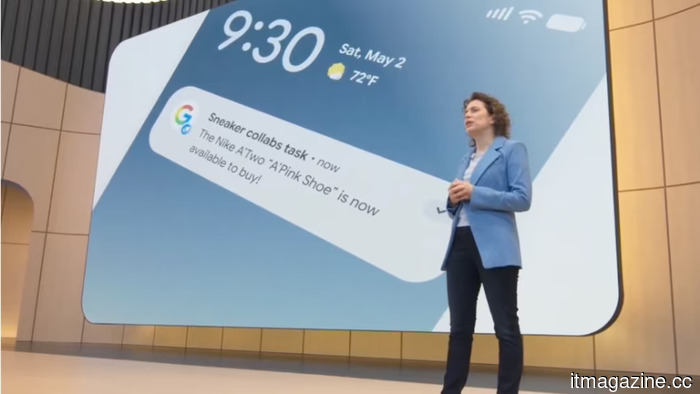 Both Apple and Google aim to track the web on your behalf.
In close succession, Google and Apple revealed features that monitor web pages and notify users when changes occur. Searching is evolving into a continuous process rather than a one-off inquiry.
FCC documents indicate that Valve's Steam Machine might be released prior to June 29.
FCC regulatory documents indicate that Valve's Steam Machine may be shipped prior to June 29, following a trend observed in the Steam Controller's filing.
Both Apple and Google aim to track the web on your behalf.
In close succession, Google and Apple revealed features that monitor web pages and notify users when changes occur. Searching is evolving into a continuous process rather than a one-off inquiry.
FCC documents indicate that Valve's Steam Machine might be released prior to June 29.
FCC regulatory documents indicate that Valve's Steam Machine may be shipped prior to June 29, following a trend observed in the Steam Controller's filing.
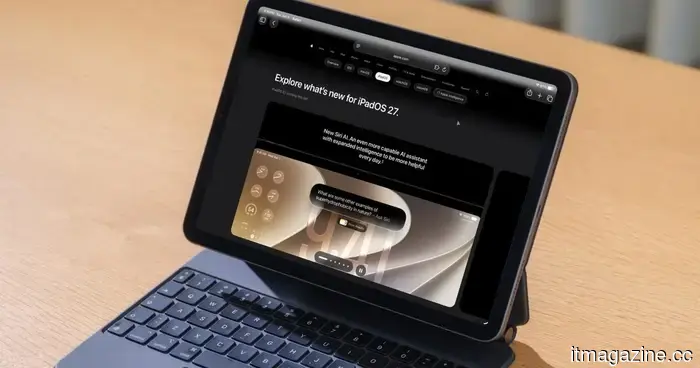 iPadOS 27: All the details about the new features coming to your iPad.
iPadOS 27 will be released this fall, featuring a brand-new Siri AI, enhanced photo tools, simplified Shortcuts, and a more organized Safari. Here’s all the information we have so far regarding the upcoming updates for your iPad.
iPadOS 27: All the details about the new features coming to your iPad.
iPadOS 27 will be released this fall, featuring a brand-new Siri AI, enhanced photo tools, simplified Shortcuts, and a more organized Safari. Here’s all the information we have so far regarding the upcoming updates for your iPad.
 Meta removed the facial recognition code from its smart glasses app a day after WIRED discovered it.
Meta has eliminated the NameTag facial recognition code from its AI application after WIRED discovered biometric software present on 50 million devices, which Meta claimed "does not exist."
Meta removed the facial recognition code from its smart glasses app a day after WIRED discovered it.
Meta has eliminated the NameTag facial recognition code from its AI application after WIRED discovered biometric software present on 50 million devices, which Meta claimed "does not exist."
 Anthropic has launched Claude Fable 5, marking its first Mythos-class model available to the public.
On Tuesday, Anthropic introduced Claude Fable 5, a model of the Mythos class that includes safeguards preventing inquiries related to cybersecurity and biology, with a cost of $10 for every million input tokens.
Anthropic has launched Claude Fable 5, marking its first Mythos-class model available to the public.
On Tuesday, Anthropic introduced Claude Fable 5, a model of the Mythos class that includes safeguards preventing inquiries related to cybersecurity and biology, with a cost of $10 for every million input tokens.
Rivian launches R2 deliveries, viewing the declining US EV market as a chance for growth.
On Tuesday, Rivian began delivering R2 SUVs to customers, aiming for 20,000 to 25,000 deliveries by the end of the year, as there are fewer new electric vehicles competing in a challenging US market.