
Both Apple and Google aim to track the web on your behalf.
Two of the leading tech companies are now looking to monitor the web on your behalf. In just a month, both Google and Apple revealed features that track web pages and notify you when updates occur. They both assert that they will leverage AI to inform you when specific conditions are met while minimizing false alerts.
During its Worldwide Developers Conference on June 8, Apple presented Notify Me, a Safari feature that observes a selected page and notifies you upon any updates. At Google I/O in May, Google introduced information agents that offer similar capabilities across the open web.
"We’re entering the era of search agents now," stated Elizabeth Reid, Google's VP of Search, during the I/O keynote.
Neither feature is widely available yet. Google’s information agents are set to be released this summer for AI Pro and Ultra subscribers in the US, whereas Apple’s Notify Me will be available this fall with iOS 27 and macOS 27.
However, the convergence of these announcements signals an important shift. The concept of software monitoring the web so you don’t have to has actually existed for more than two decades. What’s noteworthy is that two major companies influencing how most individuals search online are pursuing this feature at the same time.
Page monitoring is not intended to replace the traditional search experience; instead, it transforms search into a continuous, ongoing process rather than a single query. Tools for watching the web, like Google Alerts and price and stock trackers, have been available for twenty years. The difference now is that Google and Apple are integrating these features into the platforms where users currently search and browse, providing a straightforward setup.
Google incorporates persistent instructions within its Search platform while Apple offers a more limited version within Safari. The goal is to eliminate the need for constant refreshing to check if a listing, price, or policy page has changed. Instead, users set what matters to them once, and the software will notify them when there’s an update.
Explaining What These Agents Do
Traditional searches involve a one-time transaction: you input a question, receive results, and the engagement ends. In contrast, Apple’s Notify Me and Google’s information agents function differently. You specify what you wish to track once, and the application continues to monitor in the background, alerting you of any changes.
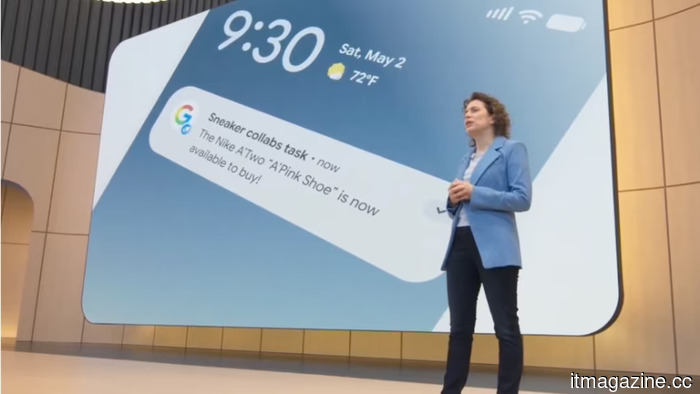
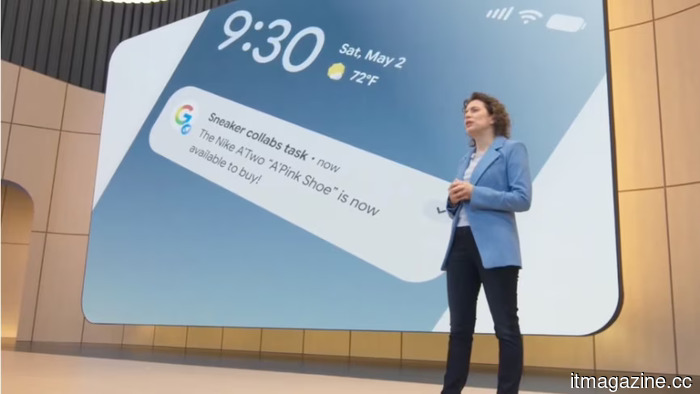
The key difference is between actively checking and passively being informed. Apple showcased its tool by monitoring a summer-camp registration page, alleviating the need for parents to constantly refresh it. Google demonstrated a similar feature at I/O, where an agent caught the moment a new basketball sneaker became available. The everyday takeaway is simple: stop refreshing and be notified instead.
Before Google and Apple Named It
The concept of software observing the web and signaling changes has roots tracing back over two decades. Google Alerts, introduced in 2003, was one of the earliest iterations: enter a keyword, and receive an email when new relevant content appears. This service has been utilized by journalists, PR professionals, researchers, and the general public for years.
Since then, the approach has evolved significantly. Page-monitoring agents like Visualping, in operation since 2017, provide cloud-based supervision of specific selected pages, notifying users of precise changes with detailed before-and-after screenshots, AI-generated summaries, and integrations with various tools.
OpenAI’s ChatGPT Pulse, launched in late 2025, conducts research overnight and delivers a personalized briefing each morning. In April, Anthropic offered a similar always-on concept to developers with Claude Code Routines, which save tasks that operate on a schedule or in response to an event.
Interest in these features is on the rise. According to Google Trends, search terms like “search agents,” “information agents,” and “page monitoring” all saw increased activity in 2026. Usage patterns also reflect this growth: in the first five months of 2026, more than 1.06 million individual pages were set up with new monitoring on Visualping alone.
Two Types of Agents, Distinct Tasks
These tools differentiate along one practical line: the scope of the monitoring agent. Open-web agents survey numerous sources to respond to a standing question. Google’s information agents, ChatGPT Pulse, and Perplexity function this way: you provide a topic, and they search across blogs, news articles, social media posts, and data feeds.
This method is effective when you don't know where the answer may come from. However, the trade-off is that this broader scanning often runs on a daily or hourly basis, potentially resulting in alerts that are too late or irrelevant due to frequent updates or automated access restrictions.
In contrast, page-monitoring agents focus specifically on a designated page and identify exact changes as they occur. This approach is ideal when you already know the specific page of interest, such as a product listing, a daycare schedule, or availability at a local swimming pool. The trade-off here is that it requires the page to be specified in advance, which makes it less suitable for open-ended exploration.
This
Other articles
 A humanoid robot ascended a volcano, aided by some very human assistance.
A humanoid robot called Pemba made it to the summit of Ecuador's Chimborazo, but the ascent also highlighted the limitations of robot autonomy, particularly when humans needed to transport it over more challenging terrain.
A humanoid robot ascended a volcano, aided by some very human assistance.
A humanoid robot called Pemba made it to the summit of Ecuador's Chimborazo, but the ascent also highlighted the limitations of robot autonomy, particularly when humans needed to transport it over more challenging terrain.
 Rivian starts R2 deliveries, viewing the contracting US EV market as a chance for growth.
On Tuesday, Rivian began delivering R2 SUVs to customers, aiming for 20,000 to 25,000 deliveries by the end of the year amidst a challenging US market with fewer new EV competitors.
Rivian starts R2 deliveries, viewing the contracting US EV market as a chance for growth.
On Tuesday, Rivian began delivering R2 SUVs to customers, aiming for 20,000 to 25,000 deliveries by the end of the year amidst a challenging US market with fewer new EV competitors.
 L’Atitude 52°N Smart Glasses That Subtly Integrate Technology
What occurs when technology doesn’t appear mechanical but instead integrates with your preferred eyewear style? The L’Atitude 52°N smart glasses address that with subtle AI that effortlessly records moments without interrupting the rhythm of your experiences.
L’Atitude 52°N Smart Glasses That Subtly Integrate Technology
What occurs when technology doesn’t appear mechanical but instead integrates with your preferred eyewear style? The L’Atitude 52°N smart glasses address that with subtle AI that effortlessly records moments without interrupting the rhythm of your experiences.
 TSMC does not exclude the possibility of increasing prices due to rising chip production costs caused by inflation.
The CFO of TSMC informed the BBC that inflation is driving up costs and while the company does not dismiss the possibility of price increases, it has excluded sudden hikes of "fourfold, fivefold."
TSMC does not exclude the possibility of increasing prices due to rising chip production costs caused by inflation.
The CFO of TSMC informed the BBC that inflation is driving up costs and while the company does not dismiss the possibility of price increases, it has excluded sudden hikes of "fourfold, fivefold."
 Both Apple and Google are interested in tracking your online activities.
In close succession, Google and Apple unveiled features that monitor web pages and notify users when there are changes. Search is evolving into an ongoing process rather than a single query.
Both Apple and Google are interested in tracking your online activities.
In close succession, Google and Apple unveiled features that monitor web pages and notify users when there are changes. Search is evolving into an ongoing process rather than a single query.
 Anthropic has launched Claude Fable 5, marking its first Mythos-class model available to the public.
On Tuesday, Anthropic introduced Claude Fable 5, a model of the Mythos class that includes safeguards preventing inquiries related to cybersecurity and biology, with a cost of $10 for every million input tokens.
Anthropic has launched Claude Fable 5, marking its first Mythos-class model available to the public.
On Tuesday, Anthropic introduced Claude Fable 5, a model of the Mythos class that includes safeguards preventing inquiries related to cybersecurity and biology, with a cost of $10 for every million input tokens.
Both Apple and Google aim to track the web on your behalf.
In close succession, Google and Apple revealed features that monitor web pages and notify users when changes occur. Searching is evolving into a continuous process rather than a one-off inquiry.