

Safari is finally addressing its extensions issue. Unlike Chrome, Apple will allow you to develop your own extensions.
Safari has not traditionally been the go-to browser for a vast add-on library. Chrome has consistently been the clear favorite for that purpose, while Apple’s browser has focused more on speed, battery efficiency, privacy, and seamless integration with its own devices.
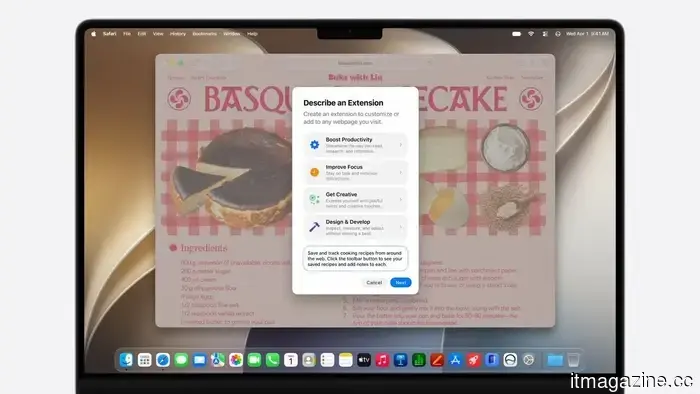
Now, Apple is exploring a new approach. Announced at WWDC, Safari will enable users to describe the type of extension they desire, and Apple Intelligence will generate it. This innovation transforms Safari AI extensions into personalized web modifications rather than additional items to search for, install, and hope are maintained.
The custom extension builder is introduced alongside smarter tab organization, page tracking through Notify Me, and automated password updates via the Passwords app. The extension feature is the standout because it addresses one of Safari's longstanding shortcomings.
Why Safari Isn't Following Chrome's Lead
With Describe an Extension, users can articulate their needs in straightforward terms, such as a button that alters webpage functions or saves information for future reference. This feature could assist with minor annoyances that are too specific for a polished extension store listing.
Safari also reduces reliance on others to create the exact add-on a user requires. A recipe shortcut, a decluttered shopping page, or a simple rating button may not warrant a public extension, but could still serve as a useful private browser enhancement.
What Else Safari Can Improve
Other AI enhancements in Safari aim to address the clutter users create while browsing. Intelligent Tab Management can evaluate open pages, identify similarities, and categorize related tabs into topics. As browsing progresses, Safari can append new relevant pages to the topic, allowing users to either close the group or save it as a Tab Group.
Notify Me targets the tab users keep open while waiting for updates. Instead of continuously monitoring a restock page or signup form, users can instruct Safari on what to watch for, close the page, and await a notification.
What Safari Must Demonstrate
Generated extensions will only be perceived as safe if Safari ensures they are easy to understand and manage. A personal add-on that alters webpages may seem beneficial, but users must know what it can access, what it can modify, and how swiftly they can disable it if needed.
Apple claims that Safari’s new intelligence is engineered to protect sensitive browsing data from being shared with anyone, including Apple itself. This assertion must manifest in a way users can visualize and control directly on their devices.
For those who have ever searched for a browser extension and regretted it immediately, this could represent a more intriguing solution. Safari may not require a plethora of add-ons if the smaller ones can be safely created.

Other articles
 iOS 27 provides the strongest indication that a foldable iPhone is imminent.
The modifications in Apple’s SwiftUI and the new framework references in iOS 27 indicate that the company might be preparing apps for an iPhone that operates on two separate displays.
iOS 27 provides the strongest indication that a foldable iPhone is imminent.
The modifications in Apple’s SwiftUI and the new framework references in iOS 27 indicate that the company might be preparing apps for an iPhone that operates on two separate displays.
 Beacon secures $225 million for its 'anti-PE' AI consolidation.
Beacon secured $225 million in a Series C funding round led by General Catalyst to purchase 'Main Street' software companies and enhance them with AI, now acquiring approximately one each week.
Beacon secures $225 million for its 'anti-PE' AI consolidation.
Beacon secured $225 million in a Series C funding round led by General Catalyst to purchase 'Main Street' software companies and enhance them with AI, now acquiring approximately one each week.
 iOS 27 is full of features. Here's a rundown of the minor updates you might have overlooked.
iOS 27 includes numerous prominent features, but the smaller updates to Mail, iCloud Shared Albums, accessibility, Home, Maps, and network switching might be the ones that stand out to users the most.
iOS 27 is full of features. Here's a rundown of the minor updates you might have overlooked.
iOS 27 includes numerous prominent features, but the smaller updates to Mail, iCloud Shared Albums, accessibility, Home, Maps, and network switching might be the ones that stand out to users the most.
 Klarna introduces US savings accounts with a 3.28% interest rate through WebBank.
Klarna introduces its high-yield savings account in the US with a 3.28% APY, offered through the FDIC-insured WebBank. This rate is lower than those of Marcus (3.4%) and SoFi (3.8%). Specifics regarding deposits have not been revealed.
Klarna introduces US savings accounts with a 3.28% interest rate through WebBank.
Klarna introduces its high-yield savings account in the US with a 3.28% APY, offered through the FDIC-insured WebBank. This rate is lower than those of Marcus (3.4%) and SoFi (3.8%). Specifics regarding deposits have not been revealed.
 The UK is reassessing its £330 million agreement with Palantir regarding the NHS.
The UK government is reevaluating the NHS's £330 million contract with Palantir and might activate a break clause for 2027, following concerns from MPs who deemed dependence on the US company a vulnerability.
The UK is reassessing its £330 million agreement with Palantir regarding the NHS.
The UK government is reevaluating the NHS's £330 million contract with Palantir and might activate a break clause for 2027, following concerns from MPs who deemed dependence on the US company a vulnerability.
 Thoma Bravo claims that the 'SaaSpocalypse' has come to an end.
Orlando Bravo of Thoma Bravo states that the 'SaaSpocalypse' has ended and that AI is providing a boost for software. However, the recovery is inconsistent, and the expenses associated with AI agents are increasing.
Thoma Bravo claims that the 'SaaSpocalypse' has come to an end.
Orlando Bravo of Thoma Bravo states that the 'SaaSpocalypse' has ended and that AI is providing a boost for software. However, the recovery is inconsistent, and the expenses associated with AI agents are increasing.
Safari is finally addressing its extensions issue. Unlike Chrome, Apple will allow you to develop your own extensions.
Safari is introducing an AI-driven extension builder that enables users to articulate the browser tool they desire. This could assist Apple in addressing one of Safari's long-standing shortcomings without competing against Chrome's extensive add-on collection.