
Mathematicians release the Leiden Declaration to oppose the misuse of their work by AI.
**TL;DR** The Leiden Declaration on Artificial Intelligence and Mathematics, supported by the International Mathematical Union and signed by Fields Medal winner Peter Scholze, urges mathematicians to address the ways AI companies are utilizing published research without permission, circumventing peer review, and jeopardizing the integrity of proof and attribution.
A group of mathematicians from institutions like Oxford, Cambridge, ETH Zurich, Columbia, and Northwestern has issued a formal declaration urging the mathematical community to tackle the threats posed by artificial intelligence to their field. The Leiden Declaration on Artificial Intelligence and Mathematics, released on Monday and backed by the International Mathematical Union, represents the most significant collective response from a major academic discipline regarding the exploitation of published research by AI companies.
The 11-page document does not oppose AI in mathematics; rather, it critiques the practices of AI companies concerning mathematical research: using published papers to train models without consent, publicizing findings through press releases instead of peer review, compromising attribution, and redirecting research priorities toward commercial gain over intellectual value. “Mathematics is, and should remain, a profoundly human endeavor,” remarked Ulrike Tillmann, vice president of the IMU.
**Five Threats to Mathematical Research**
The Declaration outlines five specific threats AI poses to the trustworthiness of mathematics. First, current AI systems generate plausible yet unreliable arguments that are hard to differentiate from correct proofs. This issue pertains to informal reasoning as well as formal computer-encoded proofs, complicating the translation between machine and human representations. The danger of AI-generated content appearing authoritative while harboring subtle errors is not unique to mathematics, but in a field that relies on certainty, it poses an existential risk.
Second, AI models trained on published mathematical works fail to adequately acknowledge the human contributions they encapsulate. The Declaration highlights that much of the training data was acquired by "systematically exploiting licenses and access arrangements that were not intended for artificial intelligence purposes, or by simply breaching copyright protections."
Third, the use of AI is starting to be incentivized independently, skewing hiring, funding, and acknowledgment. Fourth, results are increasingly shared through press releases and blog posts rather than peer-reviewed journals, chasing publicity “on market timelines before the accepted processes of community evaluation in mathematics have a chance to occur.” The Declaration references Google DeepMind’s AlphaProof, which resolved three problems from the International Mathematical Olympiad in 2024 but took over a year to publish its methods in a peer-reviewed venue. Google’s broader AI strategy depends on mathematical reasoning capabilities as evidence of general intelligence, creating commercial pressures to announce findings prior to adequate evaluation by the mathematical community.
Fifth, the autonomy of mathematics faces jeopardy. Research questions might be prioritized based on their suitability for automation rather than their intrinsic significance as determined by experts. “Indeed, broader understanding of the field may be permanently lost during the process of automation,” the Declaration cautions.
**Recommendations**
The Declaration offers recommendations across four levels. Individual mathematicians should disclose all use of AI tools in their papers, maintain personal accountability for the accuracy of results, refrain from granting authorship to AI systems, and “carefully consider which tools to use” based on the alignment of their developers with the Declaration’s principles.
Mathematical organizations should ensure that results derived from automated methods adhere to standards addressing the specific risks these methods entail, safeguard authors’ rights by creating licensing agreements that prevent the use of published work as training data without consent, and advocate for the continued publication of results in peer-reviewed venues. The Declaration notes that European regulatory frameworks serve as a model, but argues that the mathematical community must also establish its standards independently of government.
For policymakers, the recommendations are straightforward: “Don’t believe the hype,” the Declaration asserts. “There is currently a strong commercial incentive for the technology industry to exaggerate the capabilities of their products.” It calls for significantly enhanced public oversight of the AI industry and investment in public computational infrastructure as an alternative to proprietary systems.
**Notable Signatories**
The Declaration carries considerable weight due to its signatories. Peter Scholze, a Fields Medal laureate and director of the Max Planck Institute for Mathematics, endorsed it with a personal note: “I engage with my mathematical ideas without the use of AI and generally try to avoid reading AI-generated text as much as possible.” Additional endorsements came from Robbert Dijkgraaf, former Dutch education minister and president-elect of the International Science Council, and Steven Strogatz, Cornell's distinguished professor for public understanding of science and mathematics.
Kevin Buzzard, a professor at Imperial College and a prominent advocate for formalized mathematics, described it as “a well-considered response to the current situation, as AI continues to disrupt this area.” The conflict between AI capabilities and research integrity highlighted in the Declaration is not restricted to mathematics, though mathematicians are among the first academic communities to respond with a coordinated, institution-backed statement.
**The Broader Argument**
The Declaration’s most provocative section addresses AI companies directly. It
Other articles
 Mathematicians have released the Leiden Declaration to oppose the misuse of their work by AI.
The Leiden Declaration, supported by the IMU, cautions that AI poses a risk to the integrity of proof, attribution, and research independence, urging mathematicians to safeguard their field from corporate exploitation.
Palo Alto Networks' CEO compensation has been turned down on seven occasions, even with an 800% increase in stock value.
Palo Alto Networks' $100 million CEO compensation package has faced rejection from shareholders seven times, the highest number among S&P 500 companies, even though the stock has increased by 800% under Nikesh Arora's leadership.
Palo Alto Networks' CEO compensation was turned down seven times, even with an 800% increase in stock value.
Palo Alto Networks' CEO compensation package of $100 million has faced rejection from shareholders on seven occasions, the highest number in the S&P 500, even as the stock has appreciated by 800% under Nikesh Arora's leadership.
Mathematicians have released the Leiden Declaration to oppose the misuse of their work by AI.
The Leiden Declaration, supported by the IMU, cautions that AI poses a risk to the integrity of proof, attribution, and research independence, urging mathematicians to safeguard their field from corporate exploitation.
Palo Alto Networks' CEO compensation has been turned down on seven occasions, even with an 800% increase in stock value.
Palo Alto Networks' $100 million CEO compensation package has faced rejection from shareholders seven times, the highest number among S&P 500 companies, even though the stock has increased by 800% under Nikesh Arora's leadership.
Palo Alto Networks' CEO compensation was turned down seven times, even with an 800% increase in stock value.
Palo Alto Networks' CEO compensation package of $100 million has faced rejection from shareholders on seven occasions, the highest number in the S&P 500, even as the stock has appreciated by 800% under Nikesh Arora's leadership.
 Google Photos is finally simplifying the process of backups and exports a bit.
Google Photos is introducing incremental Takeout exports, which will reduce the size of recurring local backups following the initial full archive. However, it’s important to note that Photos must be the only product chosen during the setup process.
Google Photos is finally simplifying the process of backups and exports a bit.
Google Photos is introducing incremental Takeout exports, which will reduce the size of recurring local backups following the initial full archive. However, it’s important to note that Photos must be the only product chosen during the setup process.
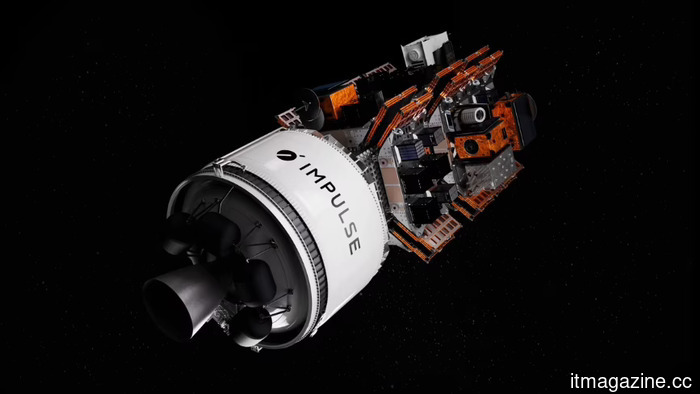 Impulse Space secures $500 million, achieving a valuation of $4.26 billion for its orbital transfer vehicles.
Tom Mueller, SpaceX's inaugural employee, secured $500 million for Impulse Space, attaining a valuation of $4.26 billion. The company is developing space tugs for both commercial clients and Golden Dome defense customers.
Impulse Space secures $500 million, achieving a valuation of $4.26 billion for its orbital transfer vehicles.
Tom Mueller, SpaceX's inaugural employee, secured $500 million for Impulse Space, attaining a valuation of $4.26 billion. The company is developing space tugs for both commercial clients and Golden Dome defense customers.
 Google Photos is finally making backups and exports somewhat less frustrating.
Google Photos is introducing incremental Takeout exports, which will reduce the size of recurring local backups after the initial full archive. However, the condition is that Photos needs to be the sole product selected during the setup process.
Google Photos is finally making backups and exports somewhat less frustrating.
Google Photos is introducing incremental Takeout exports, which will reduce the size of recurring local backups after the initial full archive. However, the condition is that Photos needs to be the sole product selected during the setup process.
Mathematicians release the Leiden Declaration to oppose the misuse of their work by AI.
The Leiden Declaration, supported by the IMU, cautions that AI poses risks to the integrity of proofs, attribution, and the independence of research, urging mathematicians to safeguard their field from corporate exploitation.