
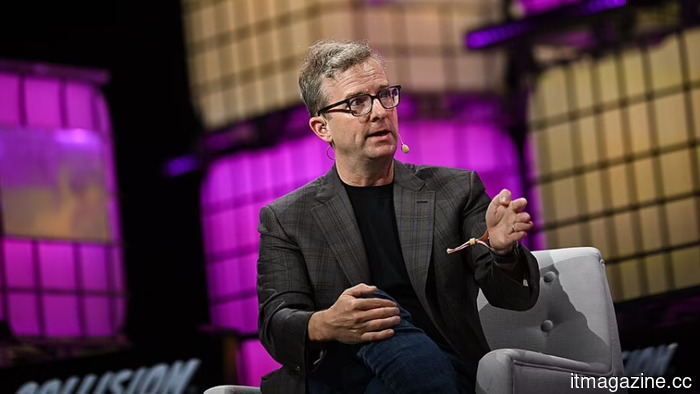
Former Meta CTO establishes a $250 million climate fund amid growing energy demands from AI.
**TL;DR** Former Meta CTO Mike Schroepfer’s Gigascale Capital has secured a $250 million fund aimed at investing in startups focused on energy, grid infrastructure, and critical minerals. The fund anticipates that the energy requirements of AI will lead to significant opportunities for clean energy startups during the AI surge.
Gigascale Capital, under the leadership of ex-Meta chief technology officer Mike Schroepfer, has announced a $250 million fund to invest in startups specializing in energy, grid infrastructure, and critical minerals. This fund, revealed on Monday, marks Gigascale’s second venture and its first to attract institutional investors. At a time when much of the venture capital sector is shifting away from climate technology towards AI, Schroepfer’s focus on the physical economy stands out as a purposeful counter-trend.
“The companies we invest in succeed because they are cheaper, faster, and more reliable,” Schroepfer commented. “The positive climate impact stems from improved system performance.” This perspective is noteworthy: Gigascale portrays clean technology not merely as a values-based investment but as an economic necessity driven by performance benefits.
**AI as a Catalyst, Not a Competitor**
The situation of a former tech executive establishing a climate-focused fund in the midst of an AI boom is less puzzling than it seems. U.S. utilities are projected to spend $1.4 trillion by 2030 to meet the electricity demands of AI data centers, which could account for 9% of the nation’s total electricity consumption by the decade’s end, up from 4% in 2023. Natural gas turbines, often used as backup power sources, are already facing waitlists that extend into the early 2030s.
This power shortage presents an opportunity that Gigascale aims to address. Companies requiring substantial electricity, whether for AI training, manufacturing, or industrial use, cannot afford to wait for utility-scale infrastructure to develop. Startups addressing the energy challenges of data centers are gaining considerable investment, and Schroepfer has suggested on podcasts that “bring-your-own power will become a competitive edge over time” for energy-intensive enterprises.
**Gigascale’s Portfolio**
Gigascale’s current investments support this concept. Commonwealth Fusion Systems, which received $863 million from backers like Nvidia, Google, and Bill Gates, is working on commercial fusion reactors. Form Energy is developing 100-hour iron-air batteries for grid-level storage. Heron Power has successfully raised $140 million for innovative grid infrastructure technologies. These ventures focus on constructing the physical infrastructure necessary for the digital economy.
**Countering the Climate Tech Retreat**
The $250 million fundraise is crucial as it emerges at a time when many in the venture industry are moving away from the “climate tech” label. Following a surge of prominent climate-focused funds from 2020 to 2023, returns have varied, and several notable climate startups have faced challenges. European venture firms are raising substantial funds with more generalized objectives, while U.S. investors have shifted capital toward AI-centric companies.
Schroepfer initiated Gigascale after investigating climate technology during the pandemic. He posits that the sector’s challenges are not technological but commercial—clean technologies must be cheaper and faster than current solutions, not merely more environmentally friendly. He cites solar energy as a prime example, which gained market share not solely due to environmental regulations but because it became the most cost-effective electricity source in many parts of the world.
The fund will also consider critical minerals and what Schroepfer refers to as “physical AI,” likely encompassing robotics and automation in manufacturing, mining, and construction. With battery storage and mineral supply chains increasingly seen as hurdles in the energy transition, startups that can resolve these issues may have a clearer path to profitability compared to those introducing additional solar products.
**The Meta Connection**
Schroepfer served as Meta’s CTO for over a decade before resigning in 2022. His time there included overseeing the company’s infrastructure development, encompassing data centers that now require considerable electricity for AI operations. This experience has given him firsthand insight into the energy limitations faced by large-scale computing and informs Gigascale’s investment strategy.
Meta has also emerged as one of the largest corporate purchasers of clean energy, with capital expenditure projections for 2026 ranging between $125 billion and $145 billion, much of which is aimed at AI infrastructure. The quest for solutions to AI’s energy challenges has generated concepts from space-based data centers to small modular nuclear reactors, but the most commercially viable solutions are likely to come from startups making practical enhancements in energy generation, storage, and distribution.
While Gigascale’s $250 million investment may seem modest compared to the magnitude of the energy infrastructure challenge, the fund's contrarian approach may be timely. If the power consumption from the AI sector continues to surge and traditional energy infrastructure struggles to adapt, the startups developing the physical infrastructure will be poised to secure value that software optimization alone cannot provide.
Other articles
 GoPro cautioned that it might not endure. The AI memory crisis is threatening the survival of companies that produce tangible products.
Memory prices increased by 80-115%. Revenue decreased by 26%. GoPro expressed "substantial doubt" regarding its ability to persist. The company is considering a sale or a shift towards the defense sector.
GoPro cautioned that it might not endure. The AI memory crisis is threatening the survival of companies that produce tangible products.
Memory prices increased by 80-115%. Revenue decreased by 26%. GoPro expressed "substantial doubt" regarding its ability to persist. The company is considering a sale or a shift towards the defense sector.
 Hackers gained control of Instagram accounts by requesting a password reset from Meta's AI chatbot.
The AI support bot included a hacker’s email, dispatched a verification code, and provided a password reset option, without requiring access to the victim’s email.
Vulnerability in WP Maps Pro for WordPress exploited to generate admin accounts.
CVE-2026-8732 in WP Maps Pro allows unauthenticated attackers to generate admin accounts on over 15,000 WordPress websites. In just 24 hours, Wordfence prevented 2,858 attacks.
Hackers gained control of Instagram accounts by requesting a password reset from Meta's AI chatbot.
The AI support bot included a hacker’s email, dispatched a verification code, and provided a password reset option, without requiring access to the victim’s email.
Vulnerability in WP Maps Pro for WordPress exploited to generate admin accounts.
CVE-2026-8732 in WP Maps Pro allows unauthenticated attackers to generate admin accounts on over 15,000 WordPress websites. In just 24 hours, Wordfence prevented 2,858 attacks.
 Salesforce's investment in Anthropic reaches $5 billion in preparation for the IPO filing.
Salesforce transformed an initial $50 million investment in Anthropic into a $5 billion stake, which now constitutes two-thirds of its entire strategic portfolio, as the creator of Claude prepares for an IPO with a $965 billion valuation.
Salesforce's investment in Anthropic reaches $5 billion in preparation for the IPO filing.
Salesforce transformed an initial $50 million investment in Anthropic into a $5 billion stake, which now constitutes two-thirds of its entire strategic portfolio, as the creator of Claude prepares for an IPO with a $965 billion valuation.
 The Asus ROG Ally X receives a unique redesign featuring an OLED display and elegant gold accents that are not overly flashy.
The anniversary edition introduces OLED to the Ally series for the first time, featuring a 7.4-inch 120Hz 1,400-nit display, AMD Ryzen AI Z2 Extreme, and TMR joysticks.
The Asus ROG Ally X receives a unique redesign featuring an OLED display and elegant gold accents that are not overly flashy.
The anniversary edition introduces OLED to the Ally series for the first time, featuring a 7.4-inch 120Hz 1,400-nit display, AMD Ryzen AI Z2 Extreme, and TMR joysticks.
 The surge in space stocks falters as the SpaceX IPO approaches and Blue Origin faces setbacks.
Rocket Lab, Intuitive Machines, and AST SpaceMobile have seen a decline of 17-23% over the course of two days as investors look to replace space proxies with SpaceX following its upcoming record IPO.
The surge in space stocks falters as the SpaceX IPO approaches and Blue Origin faces setbacks.
Rocket Lab, Intuitive Machines, and AST SpaceMobile have seen a decline of 17-23% over the course of two days as investors look to replace space proxies with SpaceX following its upcoming record IPO.
Former Meta CTO establishes a $250 million climate fund amid growing energy demands from AI.
Gigascale Capital, led by Mike Schroepfer, has raised $250 million to invest in energy and climate startups, believing that the growing energy needs of AI will position clean technology as the true beneficiaries of the AI surge.